Construction Litigation News 2026: Major Lawsuits, Legal Trends & State Updates

Contents
- 1 Introduction: Why Construction Litigation Is Surging in 2025–2026
- 2 The Current State of Construction Litigation: A National Trend Analysis
- 3 Regional Spotlight: State-Specific Legal Updates
- 4 Top 3 Emerging Legal Risks in Construction for 2026
- 5 High-Profile Case Studies and Judicial Trends
- 6 Comparative Overview: Key Construction Litigation Factors
- 7 [Visual Concept: A Flowchart Showing the Construction Litigation Process]
- 8 How to Mitigate Construction Litigation Risks in 2026
- 9 Verified Refrences
- 10 Commonly Asked Questions
- 11 Conclusion: Staying Ahead in a Litigious Construction Environment
Introduction: Why Construction Litigation Is Surging in 2025–2026
The U.S. construction industry is entering 2026 under intense legal pressure. What was once considered a cyclical risk environment has now evolved into a litigation-heavy landscape where disputes are no longer the exception but an operational reality. Across the country, courts are seeing a sharp rise in construction-related lawsuits, ranging from payment conflicts and delay claims to complex defect litigation involving multiple parties and insurers.
Several macroeconomic forces are driving this surge. Persistent inflation has increased material costs well beyond original contract assumptions. Global supply chain disruptions—though less severe than in the immediate post-pandemic period—continue to cause delays and substitutions that ripple through project schedules. At the same time, labor shortages have forced contractors to rely on less experienced workers or unfamiliar subcontractors, increasing the likelihood of workmanship disputes.
Industry observers frequently reference a trend graph showing a steep upward curve in construction litigation filings between 2022 and 2025, with early 2026 data suggesting that this trajectory has not yet plateaued. State courts in high-growth regions, particularly Florida and California, are reporting record caseloads tied to construction disputes.
In this construction litigation news deep dive, you will learn why disputes are accelerating, how state-specific legal developments are shaping outcomes, and what contractors, developers, and legal professionals should expect in 2026. We will examine the current litigation environment, highlight Florida and California as key battlegrounds, analyze emerging legal risks, and provide practical guidance to mitigate exposure—always emphasizing the importance of consulting a licensed construction attorney for project-specific advice.
Before diving into the trends, ensure your claim is still valid. Time runs out fast in construction disputes—Check your remaining legal deadline instantly with our Free Statute Checker.
The Current State of Construction Litigation: A National Trend Analysis
Construction litigation has become one of the most active areas of civil law in the United States. While disputes have always been part of the industry, the nature and scale of modern claims reflect deeper structural challenges rather than isolated project failures.
Defect claims and payment disputes remain the two dominant drivers of litigation. Defect claims often arise years after project completion and typically involve allegations of design errors, improper materials, or substandard workmanship. These cases are particularly complex because they may implicate architects, engineers, general contractors, subcontractors, suppliers, and insurers under overlapping theories of liability.
Payment disputes, by contrast, are more immediate but no less contentious. Owners facing cost overruns increasingly withhold payment, while contractors argue that delays and price escalations fall outside their contractual risk. Mechanics’ liens, bond claims under state “Little Miller Acts,” and breach-of-contract lawsuits have become routine tools in these conflicts.
According to recent industry reports from construction risk management and insurance analysts, post-pandemic projects account for a disproportionate share of new litigation filings. Projects initiated between 2020 and 2022 were often priced under volatile conditions, with contingency planning that proved inadequate once inflation and labor shortages persisted longer than expected. As these projects reach completion—or fail to do so—disputes are moving from negotiation tables into courtrooms.
Federal and state courts alike are grappling with increasingly technical cases that require expert testimony on scheduling methodologies, building codes, and cost accounting. Judges have also shown less patience for poorly drafted contracts, emphasizing that sophisticated parties are expected to allocate risk clearly and explicitly.
Regional Spotlight: State-Specific Legal Updates
One major gap in much of today’s construction litigation coverage is fragmentation. Many sources isolate state developments into separate analyses, forcing professionals to piece together a national picture. Here, we address Florida and California side by side, reflecting their outsized influence on construction law trends.
Florida Construction Litigation News & Updates
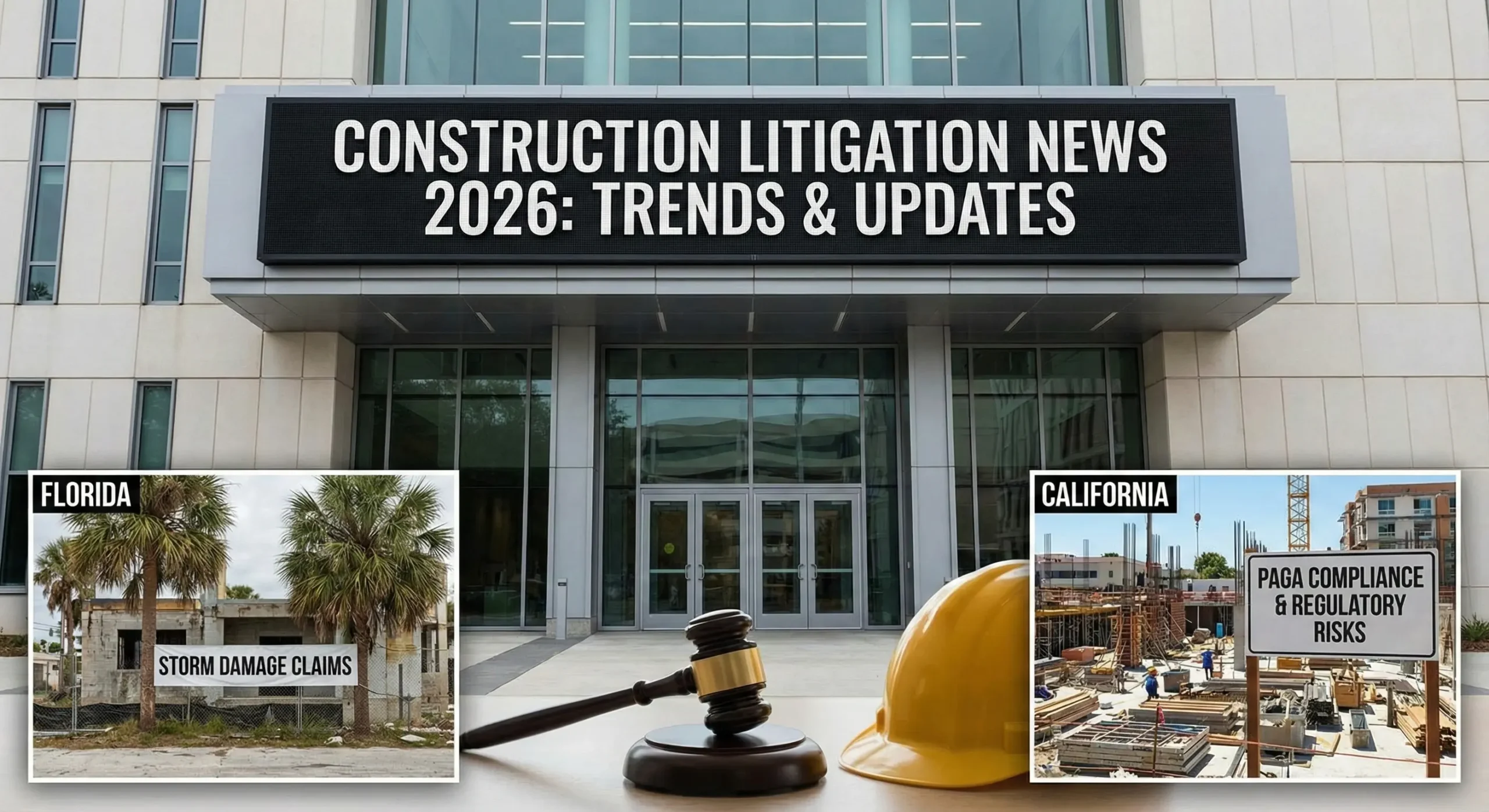
Florida remains one of the most active construction litigation jurisdictions in the country. Rapid population growth, aggressive coastal development, and a unique climate risk profile combine to create a perfect storm for legal disputes.
A central driver of recent litigation has been hurricane and storm damage claims, particularly disputes over whether observed damage stems from covered weather events or pre-existing construction defects. Insurers have become increasingly aggressive in denying or limiting coverage, arguing that poor workmanship or design flaws—not storms—are the true cause of damage. This has led to a wave of lawsuits involving contractors, developers, condominium associations, and insurance carriers.
Another significant factor is Florida’s evolving condominium regulatory framework. In the aftermath of the Surfside condominium collapse, the state enacted stricter inspection and reserve funding requirements for multi-family residential buildings. While these reforms aim to enhance public safety, they have also exposed latent construction defects in older buildings. Condominium associations, now legally obligated to address structural issues, are pursuing claims against original developers and contractors at unprecedented rates.
From a legal perspective, Florida courts continue to refine their interpretation of statutes of limitation and repose for construction defect claims. While the statute of limitations generally begins running upon discovery of a defect, the statute of repose imposes an absolute deadline, regardless of discovery. These timelines are frequently litigated, making early legal consultation essential for any party facing potential claims.
California Construction Litigation News & Trends
California’s construction litigation environment is shaped less by weather and more by regulation. The state’s expansive labor laws and stringent safety requirements create both protections for workers and significant compliance risks for employers.
One of the most consequential developments is the continued rise of claims under the Private Attorneys General Act (PAGA). While not limited to construction, PAGA claims have had a disproportionate impact on the industry due to its reliance on large, mobile workforces and complex subcontracting arrangements. Allegations of wage-and-hour violations, meal and rest break noncompliance, and misclassification of workers frequently spill over into broader construction disputes.
Seismic safety requirements also play a major role in California construction litigation. Projects that fail to meet earthquake resilience standards can face not only regulatory penalties but also civil lawsuits alleging negligence or breach of statutory duty. As building codes evolve, older projects are increasingly scrutinized under modern expectations, leading to disputes over retrofitting obligations and disclosure requirements.
California courts have also shown a willingness to scrutinize arbitration clauses in construction contracts, particularly where there is a perceived imbalance of bargaining power. This judicial posture underscores the importance of carefully drafted dispute resolution provisions that comply with both state and federal law.
Top 3 Emerging Legal Risks in Construction for 2026
As litigation volumes rise, certain risk categories are emerging as consistent sources of high-value disputes. Understanding these risks is critical for proactive legal planning.
Supply Chain Volatility and Contractual Risk Allocation
Material price volatility remains a top legal risk in 2026. Contracts executed before or during periods of extreme inflation often lack clear escalation clauses, leaving parties to argue over who bears the cost of unexpected price increases. Courts are increasingly called upon to interpret force majeure provisions, change order requirements, and implied duties of good faith in this context.
Disputes frequently arise when contractors substitute materials due to shortages, only to face claims that the substitutions constitute defects or unauthorized deviations from specifications. These cases highlight the importance of precise contractual language and documented approvals.
Labor Shortages and Work Quality Claims
The ongoing shortage of skilled labor has had a direct impact on construction quality. Projects staffed with inexperienced workers are more prone to errors, leading to defect claims that may not surface until years later. Plaintiffs’ attorneys often argue that the use of inadequately trained labor constitutes negligence per se, particularly where safety or code compliance is implicated.
From a defense perspective, these cases often turn on expert testimony and detailed project records. Contractors without robust documentation practices face significant evidentiary challenges.
Green Building Regulations and Environmental Compliance
Environmental compliance has become a major litigation frontier. Federal and state laws promoting energy efficiency, emissions reduction, and sustainable materials impose new obligations on construction projects. Failure to comply can result in regulatory enforcement actions as well as private lawsuits alleging misrepresentation or breach of statutory duty.
As green building standards become more complex, disputes increasingly involve technical questions about certification requirements and performance metrics. These cases often require multidisciplinary legal teams with expertise in environmental law, construction law, and regulatory compliance.
High-Profile Case Studies and Judicial Trends
While specific headline cases vary by jurisdiction, several judicial trends are shaping construction litigation outcomes nationwide. One notable area involves recent rulings on “pay-if-paid” clauses in subcontracts. Courts have taken differing approaches, with some enforcing these clauses strictly and others construing them narrowly to avoid unjust outcomes for subcontractors.
Another trend involves heightened judicial scrutiny of indemnity provisions. Courts are increasingly unwilling to enforce overly broad indemnification clauses that shift liability for a party’s own negligence, particularly where state anti-indemnity statutes apply.
These developments underscore the dynamic nature of construction law and the importance of staying informed about evolving case law. Parties should not assume that contract provisions drafted years ago will be enforced in the same manner today.
Comparative Overview: Key Construction Litigation Factors
| Legal Aspect | Florida | California |
|---|---|---|
| Primary Litigation Driver | Storm damage and defect claims | Labor law and regulatory compliance |
| Regulatory Focus | Condominium safety and inspections | Wage-and-hour laws, seismic codes |
| Common Defendant | Developers and insurers | Contractors and employers |
| Dispute Resolution Trend | Increased litigation over ADR clauses | Judicial scrutiny of arbitration agreements |
| Risk Mitigation Priority | Early defect identification | Compliance audits and workforce management |
[Visual Concept: A Flowchart Showing the Construction Litigation Process]
Imagine a flowchart that begins with a project delay or defect discovery and branches into negotiation, mediation, arbitration, or litigation. Each branch highlights decision points such as notice requirements, statute of limitations considerations, and insurance coverage analysis. This visual concept underscores how early strategic choices can dramatically influence legal outcomes.
How to Mitigate Construction Litigation Risks in 2026
Risk mitigation begins long before a dispute arises. Clear, well-drafted contracts remain the first line of defense. Escalation clauses addressing material price increases, detailed change order procedures, and unambiguous dispute resolution provisions can prevent many conflicts from escalating into litigation.
Equally important is comprehensive documentation. Courts place significant weight on contemporaneous records, including project schedules, inspection reports, and correspondence. Contractors and owners who fail to maintain organized records often find themselves at a disadvantage, regardless of the underlying merits of their case.
Alternative Dispute Resolution (ADR) continues to play a critical role in managing construction disputes. Mediation and arbitration can offer faster, more cost-effective resolutions than traditional litigation, but only if the governing clauses are carefully crafted and consistently applied. Before pursuing ADR or litigation, parties should consult a licensed construction attorney to evaluate jurisdiction-specific considerations and strategic implications.
Verified Refrences
U.S. Government & Regulatory Sources
- U.S. Department of Labor – Wage and Hour Division
https://www.dol.gov/agencies/whd
(Authoritative guidance on labor standards, misclassification, and wage disputes impacting construction litigation) - Occupational Safety and Health Administration (OSHA)
https://www.osha.gov
(Federal safety regulations frequently cited in construction defect and negligence claims)
State-Level Legal & Regulatory Authorities
- Florida Department of Business and Professional Regulation (DBPR)
https://www.myfloridalicense.com
(Oversight of construction licensing, inspections, and condominium regulations) - Florida Statutes – Construction Defects & Statute of Repose
https://www.leg.state.fl.us
(Primary source for statutory deadlines affecting construction defect litigation) - California Department of Industrial Relations (DIR)
https://www.dir.ca.gov
(Official authority on California labor laws, PAGA claims, and compliance enforcement) - California Legislative Information (Building & Labor Codes)
https://leginfo.legislature.ca.gov
(Current statutory framework governing seismic safety, labor compliance, and construction standards)
Judicial & Legal Research Resources
- Cornell Law School – Legal Information Institute (LII)
https://www.law.cornell.edu
(Widely trusted legal reference for U.S. statutes, case law summaries, and legal principles) - American Bar Association – Construction Law Section
https://www.americanbar.org/groups/construction_industry
(Expert commentary and professional standards from leading construction law practitioners)
Industry & Risk Analysis Reports
- Construction Industry Institute (CII)
https://www.construction-institute.org
(Research on project risk, disputes, and post-pandemic construction trends) - International Risk Management Institute (IRMI) – Construction Risk
https://www.irmi.com
(Authoritative analysis on construction claims, insurance disputes, and contract risk allocation)
Commonly Asked Questions
What is the most common cause of construction litigation?
The most common causes are construction defect claims and payment disputes. Defects may involve design errors, workmanship issues, or material failures, while payment disputes often arise from delays, cost overruns, or ambiguous contract terms.
How does the statute of limitations affect construction defect claims in Florida?
In Florida, the statute of limitations generally begins when a defect is discovered or should have been discovered with reasonable diligence. However, the statute of repose imposes an absolute deadline, typically measured from project completion, after which claims are barred regardless of discovery. Consulting a Florida-licensed attorney is essential to assess these timelines accurately.
What are the new construction laws in California for 2026?
California continues to expand labor law enforcement and environmental compliance requirements affecting construction projects. Enhanced wage-and-hour enforcement, evolving seismic safety standards, and stricter green building regulations are among the most significant developments impacting 2026 projects.
Conclusion: Staying Ahead in a Litigious Construction Environment
Construction litigation in 2026 reflects broader economic, regulatory, and social pressures reshaping the industry. As disputes become more frequent and more complex, staying informed is no longer optional—it is a professional necessity. By understanding national trends, monitoring state-specific developments in Florida and California, and proactively managing legal risk, industry participants can better navigate this challenging environment.
Ultimately, no article can substitute for personalized legal advice. Contractors, developers, and design professionals should work closely with experienced construction attorneys to address project-specific risks and compliance obligations.
For ongoing insights and timely analysis, subscribe to LawJournalDaily for weekly legal updates and stay ahead of the developments shaping construction litigation nationwide.