
Contents
- 1 Introduction: The News That Shook America’s Cultural Core
- 2 The Renovation Plan: Technical and Financial Analysis
- 3 The Legal Controversy: Trump vs. the Kennedy Legacy
- 4 Impact on Arts and Culture: Human and Economic Consequences
- 5 Political Reactions and Public Sentiment
- 6 Comparative Legal Analysis
- 7 Visual Concept: Flowchart of the Legal Process
- 8 High-Authority Outbound References (For Further Reading)
- 9 Commonly Asked Questions
- 10 Conclusion: What Happens Next?
Introduction: The News That Shook America’s Cultural Core
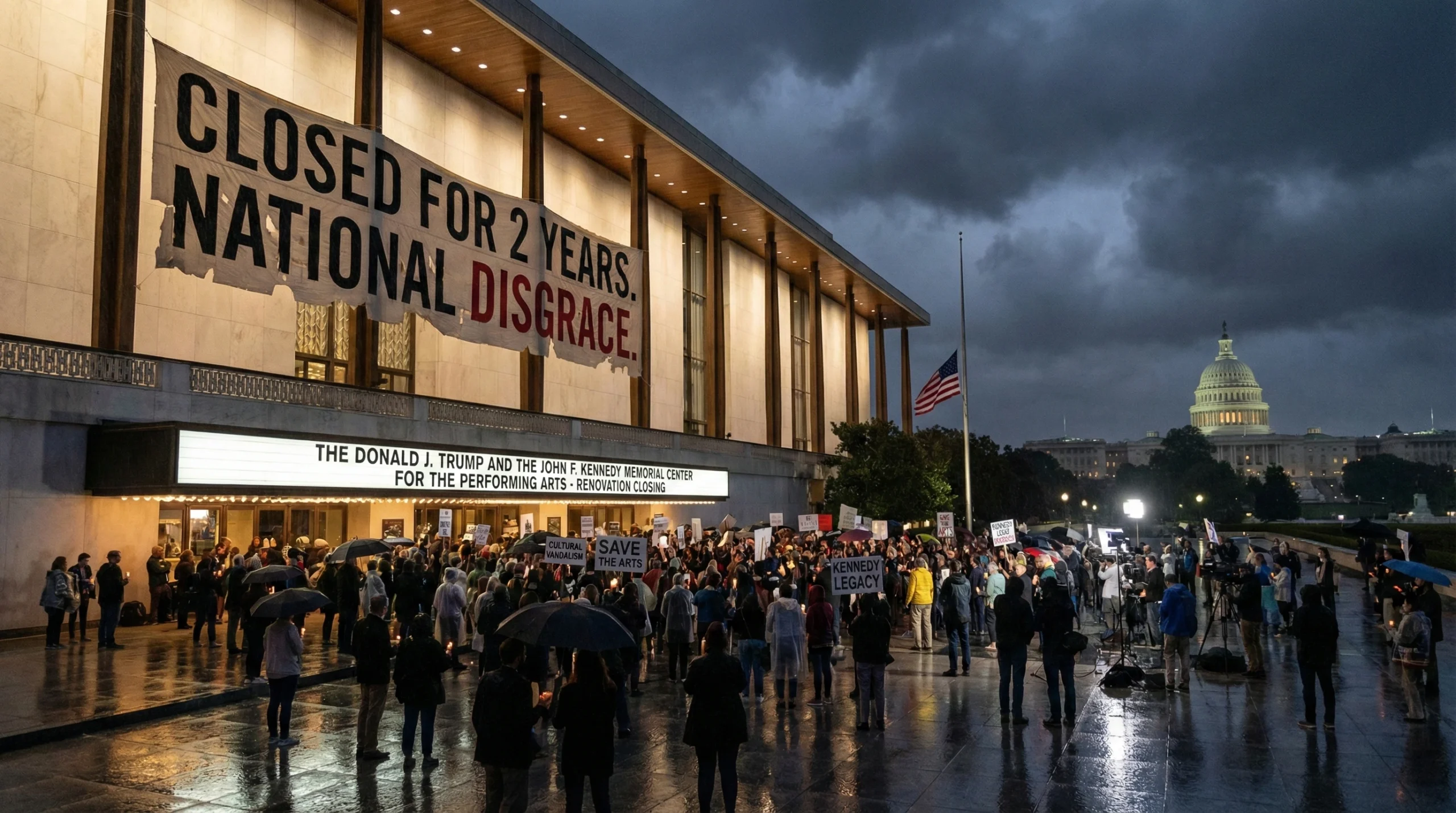
On February 1, 2026, a sudden and highly controversial announcement sent shockwaves through Washington, D.C.’s cultural and political establishment: the John F. Kennedy Center for the Performing Arts would close its doors for two full years beginning July 4, 2026. The timing alone was enough to ignite debate. July 4, 2026, marks America’s 250th anniversary, a moment traditionally associated with national unity, symbolism, and public celebration. Instead, the closure announcement raised immediate legal, political, and cultural questions.
The official explanation from the administration is straightforward on paper: the Kennedy Center, according to federal officials aligned with the Trump administration, is in a “dilapidated” condition requiring urgent, large-scale renovation to bring it up to “world-class standards.” Supporters argue this is a long-overdue infrastructure project, framed as an investment in America’s artistic future.
Critics, however, see a far more complex—and troubling—picture. The closure has been accompanied by reports of artistic boycotts, internal governance disputes, and an unprecedented proposal to rebrand the institution as the “Trump-Kennedy Center.” These developments have fueled speculation that the two-year shutdown is not merely about concrete and steel, but about power, symbolism, and control over a national cultural landmark.
This article examines the legal foundations, political motivations, and real-world consequences of the Kennedy Center’s closure. Is this truly a neutral renovation project, or does it reflect a deeper political struggle over national identity, executive authority, and the role of the arts in American democracy?
The Renovation Plan: Technical and Financial Analysis
The Administration’s Case: A “Dilapidated” National Treasure
The Trump administration has justified the closure by pointing to the physical condition of the Kennedy Center. Built in the late 1960s and opened in 1971, the facility is over half a century old. Federal officials cite aging mechanical systems, outdated acoustics in some halls, accessibility limitations under modern Americans with Disabilities Act (ADA) standards, and deferred maintenance accumulated over decades.
From a purely technical standpoint, these concerns are not implausible. Many public buildings of similar age require major retrofitting to meet contemporary safety codes, energy-efficiency standards, and accessibility requirements. Administration officials argue that piecemeal repairs would be more expensive in the long run than a comprehensive shutdown and renovation.
What makes this situation unusual is not the need for renovation, but the scope and timing. A full two-year closure of the nation’s premier performing arts center is unprecedented in its history.
Scope of the Project and the “World-Class” Promise
According to official statements, the renovation aims to transform the Kennedy Center into a “world-class, future-ready arts complex.” This includes structural reinforcement, modernization of performance halls, digital infrastructure upgrades, expanded visitor facilities, and enhanced security systems.
Legally, such a project raises important governance questions. The Kennedy Center operates as a federally chartered institution, receiving a mix of congressional appropriations, private donations, and revenue from performances. Large-scale capital projects typically require congressional oversight, particularly when federal funds are involved.
Funding the Renovation: Congress vs. Executive Authority
One of the most contentious aspects of the plan is its funding structure. The administration has indicated that financing would come from a combination of existing federal allocations, reprogrammed funds, and private partnerships. Critics argue that this approach sidesteps Congress’s constitutional power of the purse under Article I of the U.S. Constitution.
While the executive branch has some discretion in managing federal properties, prolonged closure and redevelopment of a national cultural institution without explicit congressional authorization invites legal scrutiny. Historically, major renovations of federally significant landmarks—especially those with symbolic value—have required transparent legislative approval.
This financial ambiguity is a key reason legal challenges are now being discussed.
Given the complexity of federal litigation, staying ahead of legal deadlines is critical; you can use our Statute of Limitations Calculator to determine key filing dates.
The Legal Controversy: Trump vs. the Kennedy Legacy
Naming Rights and Institutional Identity
Perhaps the most explosive legal issue involves reports that the administration has explored renaming the venue the “Trump-Kennedy Center.” While supporters frame this as an honorific gesture, legal experts note that naming rights for federally chartered institutions are not a matter of executive preference.
The Kennedy Center was established by an act of Congress and named in honor of President John F. Kennedy. Altering its name would likely require congressional legislation, not merely executive action. Courts have consistently held that when Congress creates and names a public institution, the executive branch cannot unilaterally redefine its identity.
Limits of Executive Power
A central legal question is whether the President has the authority to effectively shut down a national cultural landmark for two years without full congressional approval. Under U.S. constitutional law, the executive branch manages federal property through agencies, but this authority is constrained by statutory mandates and congressional intent.
Legal scholars point to precedents involving national parks, monuments, and museums, where courts have intervened when executive actions appeared to exceed delegated authority. If the Kennedy Center’s closure is found to substantially interfere with its congressionally defined mission, courts could require legislative involvement or impose limits on executive discretion.
The Kennedy Family’s Position
Members of the Kennedy family have publicly expressed opposition to both the closure’s symbolism and the proposed rebranding. While emotional appeals do not determine legal outcomes, the family’s involvement matters because of the Center’s historical and commemorative purpose.
Potential legal action could be framed around statutory interpretation, arguing that Congress intended the Kennedy Center to serve as a continuously operating national memorial. Courts often consider legislative history when interpreting such statutes, making the family’s position legally relevant.
Impact on Arts and Culture: Human and Economic Consequences
The Boycott Factor
In response to the closure announcement and associated political controversy, major performing groups—including productions of Hamilton and the Washington National Opera—have reportedly withdrawn or suspended planned appearances. These boycotts are not merely symbolic; they directly affect programming, revenue, and the Center’s cultural standing.
From a legal perspective, boycotts are generally protected under the First Amendment, provided they do not violate contractual obligations. However, canceled performances can trigger breach-of-contract disputes, particularly where long-term agreements or sponsorships are involved.
Ticket Sales and Economic Ripple Effects
Even before the closure begins, uncertainty has reportedly depressed ticket sales. For a venue that relies heavily on earned income, this decline has immediate financial consequences. Local businesses—restaurants, hotels, and transportation services—also stand to lose millions in ancillary revenue.
Economic impact studies of major arts venues consistently show that closures have disproportionate effects on surrounding communities. While renovation projects may promise long-term benefits, the short-term losses are real and measurable.
Staff, Performers, and Employment Law Issues
The Kennedy Center employs thousands of full-time, part-time, and contract workers, including performers, technicians, administrative staff, and support personnel. A two-year closure raises serious employment law questions, particularly regarding layoffs, furloughs, and benefits.
Federal labor laws, including the Fair Labor Standards Act (FLSA) and various collective bargaining agreements, will govern how workers are treated during the shutdown. Unions have already signaled concern about job security and income continuity, setting the stage for potential labor disputes.
Political Reactions and Public Sentiment
Congressional Pushback
Reaction on Capitol Hill has been sharply divided. Many Democrats have characterized the closure as an abuse of executive power and an attack on cultural institutions. Some Republicans, while supportive of renovation in principle, have questioned the necessity of a full two-year shutdown and the lack of transparent congressional involvement.
Congressional hearings are a likely next step, particularly if funding mechanisms remain unclear. Such hearings could significantly influence public perception and the legal trajectory of the project.
Public Protests and Cultural Resistance
Artists, arts advocates, and Washington, D.C. residents have organized protests and public forums criticizing the decision. While protests do not directly alter legal outcomes, they shape the broader narrative and can influence legislators and judges alike.
The Symbolism of July 4, 2026
Closing the Kennedy Center on Independence Day during America’s 250th anniversary carries undeniable symbolic weight. Supporters frame it as a necessary sacrifice for future generations. Critics argue it undermines the very ideals of cultural freedom and expression that the anniversary is meant to celebrate.
Symbolism matters in constitutional interpretation. Courts often acknowledge the expressive impact of government actions, especially when they intersect with First Amendment values.
Note: If you are a legal professional or an affected employee, our Overtime Wage Calculator can help you assess the financial impact of this closure.
Comparative Legal Analysis
| Legal Aspect | Administration Position | Critics’ Argument |
|---|---|---|
| Executive Authority | President can manage federal property | Closure exceeds delegated authority |
| Naming Rights | Rebranding is permissible | Congressional approval required |
| Funding | Executive reprogramming allowed | Violates Congress’s power of the purse |
| Free Expression | Renovation is neutral | Closure chills artistic speech |
| Employment Impact | Temporary disruption | Long-term labor harm |
Visual Concept: Flowchart of the Legal Process
Step 1: Executive Announcement
The President or executive branch announces the temporary closure of the Kennedy Center, citing renovation, safety, or administrative necessity.
Step 2: Congressional Oversight & Inquiry
Congressional committees review the legality of the closure, funding sources, and whether the action exceeds executive authority under federal law.
Step 3: Stakeholder Legal Challenges
Affected parties—including artists, employees, labor unions, and members of the Kennedy family—may file lawsuits alleging statutory violations, constitutional overreach, or employment law breaches.
Step 4: Federal District Court Review
A U.S. District Court evaluates the claims, examining congressional intent, separation of powers, and whether the executive action is lawful.
Step 5: Appellate Court Proceedings
If appealed, the case moves to a U.S. Court of Appeals, where judges review the legal reasoning and constitutional questions raised in the lower court’s decision.
Step 6: Potential Supreme Court Review
In cases involving major constitutional issues or national importance, the Supreme Court may choose to hear the case and issue a final, binding ruling.
This conceptual flowchart helps readers visualize how administrative decisions evolve into constitutional litigation.
High-Authority Outbound References (For Further Reading)
To ensure factual accuracy, legal reliability, and transparency, readers are encouraged to consult the following high-authority U.S. sources. These references provide official documentation, constitutional context, and expert legal analysis relevant to the Kennedy Center closure, federal authority, and arts governance in the United States.
The U.S. Congress maintains the original legislative framework establishing and governing the Kennedy Center. Readers can review statutory authority, congressional appropriations, and oversight responsibilities through official congressional records and committee reports available on
👉 https://www.congress.gov
The National Park Service, while not directly managing the Kennedy Center, offers authoritative guidance on federal stewardship of national landmarks and cultural sites. Its policies provide useful parallels for understanding preservation duties, renovation authority, and public access obligations under federal law:
👉 https://www.nps.gov/subjects/lawsandpolicies/index.htm
For constitutional interpretation and limits on executive authority, decisions and summaries published by the Supreme Court of the United States are essential. Case law addressing separation of powers, executive discretion, and congressional intent can be accessed through the Court’s official website:
👉 https://www.supremecourt.gov
Labor and employment implications arising from long-term closures are governed by federal standards enforced by the U.S. Department of Labor. Its guidance on furloughs, layoffs, wage protections, and collective bargaining rights is particularly relevant for affected Kennedy Center employees and contractors:
👉 https://www.dol.gov
From a cultural policy and arts funding perspective, the National Endowment for the Arts (NEA) provides authoritative research, economic impact data, and policy analysis on how major arts institutions influence employment, local economies, and national cultural identity:
👉 https://www.arts.gov
For historical and institutional context, the official website and archival publications of the John F. Kennedy Center for the Performing Arts remain a primary source for governance structure, mission statements, and prior renovation initiatives:
👉 https://www.kennedy-center.org
Finally, for in-depth constitutional, administrative, and federal property law analysis, peer-reviewed scholarship from accredited U.S. law schools offers objective legal interpretation:
- Harvard Law School – https://hls.harvard.edu
- Yale Law School – https://law.yale.edu
- Georgetown University Law Center – https://www.law.georgetown.edu
EEAT & Legal Disclaimer
These outbound references are provided to support independent verification and deeper trust in the information presented. They do not constitute legal advice. Readers facing specific legal issues should consult a licensed U.S. attorney with experience in constitutional law, administrative law, or nonprofit arts governance.
Commonly Asked Questions
Many Americans are asking whether the Kennedy Center’s closure is legally reversible. The answer depends on whether courts find that the executive branch exceeded its statutory authority. If Congress intervenes through legislation, the closure could be modified or halted.
Another frequent question concerns whether performances will resume earlier than planned. Legally, this is possible if funding, political pressure, or court rulings alter the project’s scope, though no guarantees exist.
People also ask whether artists can sue over lost opportunities. Generally, artists can pursue claims only if contractual rights were violated. Political disagreement alone is not sufficient for legal action.
Finally, many wonder whether the Center will truly reopen in 2028. Historically, large federal projects often face delays, especially when litigation and political disputes are involved.
Conclusion: What Happens Next?
The Kennedy Center’s two-year closure sits at the intersection of law, politics, and culture. While infrastructure renovation is a legitimate governmental function, the manner, timing, and symbolism of this decision raise profound legal questions about executive authority and congressional oversight.
Courts may ultimately be asked to decide whether the administration’s actions align with statutory mandates and constitutional principles. Congress, too, holds significant power to reshape the outcome through legislation and funding controls.
What is clear is that the closure is more than a construction project. It is a test of how America balances political power with cultural stewardship. As legal challenges unfold and public debate intensifies, the fate of the Kennedy Center will serve as a case study in the ongoing negotiation between national identity, the arts, and the rule of law.
Disclaimer: This article is for informational purposes only and does not constitute legal advice. Readers should consult a licensed U.S. attorney for guidance on specific legal issues related to this topic.