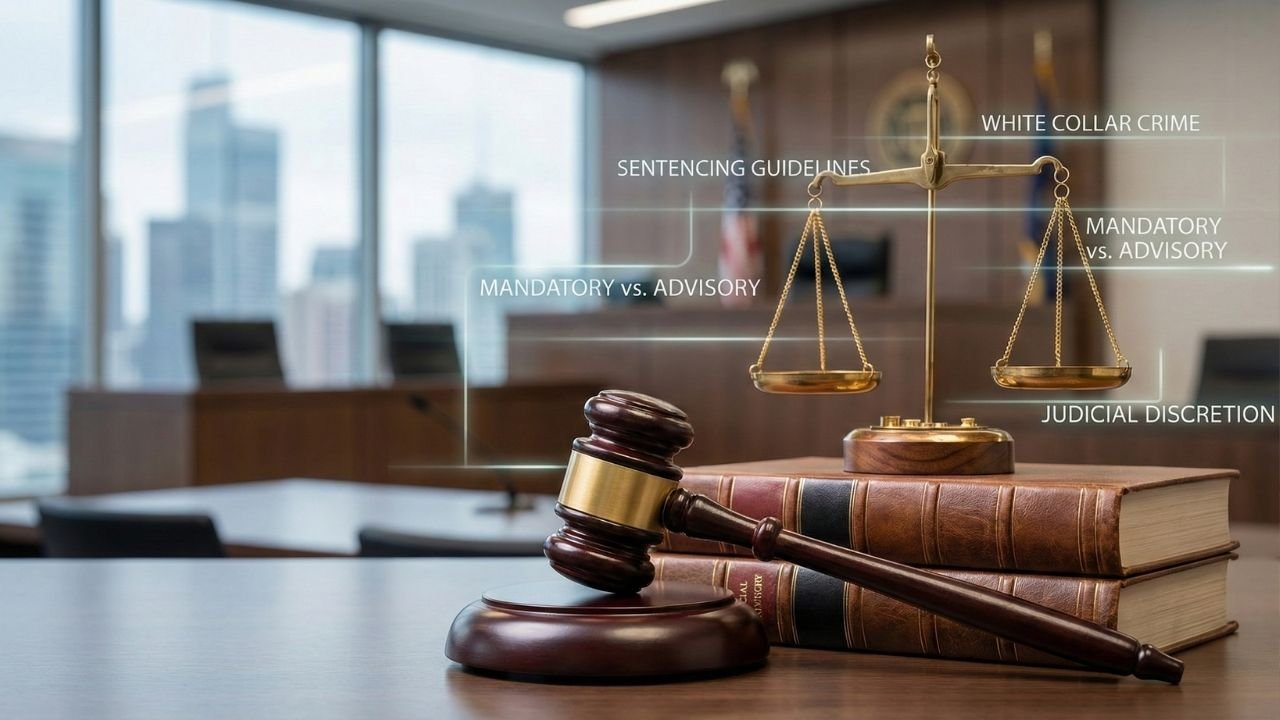
Do Judges Always Follow the Guideline in White Collar Crime? (Explained)

Contents
- 1 Introduction: The Question Every White-Collar Defendant Asks
- 2 The Legal Status: Are Sentencing Guidelines Mandatory?
- 3 How Sentencing Guidelines Work in White Collar Crimes
- 4 When Do Judges Deviate? Departure vs. Variance
- 5 Why Judges Often Give Lower Sentences in White Collar Cases
- 6 Statistical Reality: What the Data Says
- 7 Comparative Overview: Guideline vs. Real-World Sentencing
- 8 Federal White Collar Sentencing Flowchart
- 9 Can the Government Appeal a Light Sentence?
- 10 Commonly Asked Questions
- 11 Conclusion: Guidelines Matter, But They Do Not Control
Introduction: The Question Every White-Collar Defendant Asks
White-collar crime sentencing in the federal system often feels intimidating, even overwhelming. A defendant who opens the U.S. Sentencing Guidelines Manual for the first time may see potential prison ranges that appear shockingly severe—sometimes rivaling or even exceeding sentences imposed for violent crimes. This leads to the most common and urgent question defendants, families, and even junior attorneys ask: Do judges always follow the guideline in white collar crime cases, or is there room for discretion?
The short and direct answer is no. Judges do not always follow the sentencing guidelines in white-collar crime cases. Since a landmark 2005 U.S. Supreme Court decision, federal sentencing guidelines have been advisory, not mandatory. While judges are required to calculate and consider the guideline range, they are not legally bound to impose a sentence within that range.
This article explains why that is the case, how the system works in practice, and what real-world data shows about sentencing outcomes in white-collar prosecutions. We will examine the Supreme Court’s ruling that reshaped federal sentencing, the mechanics of guideline calculations, the difference between departures and variances, and the statistical reality of below-guideline sentences. For legal professionals, defendants, and policy-minded readers alike, this guide provides a comprehensive, fact-based understanding of judicial discretion in white-collar sentencing.
The Legal Status: Are Sentencing Guidelines Mandatory?
To understand whether judges always follow the guideline in white collar crime cases, it is essential to understand the legal evolution of federal sentencing.
The Pre-2005 Era: Mandatory Guidelines
Before 2005, the Federal Sentencing Guidelines were effectively binding. Congress created the guidelines through the Sentencing Reform Act of 1984 to reduce sentencing disparities among federal judges. Once a judge calculated the guideline range—based on offense level and criminal history—the judge was generally required to sentence within that range unless a specific, guideline-authorized departure applied.
In white-collar cases, this rigidity often led to sentences driven almost entirely by financial calculations, particularly loss amount, with limited room for individualized assessment.
United States v. Booker (2005): The Turning Point
Everything changed with United States v. Booker, 543 U.S. 220 (2005). The Supreme Court held that mandatory guideline sentencing violated the Sixth Amendment right to a jury trial when sentencing enhancements were based on judicial fact-finding rather than jury verdicts or admissions by the defendant.
The remedy adopted by the Court was decisive: it rendered the sentencing guidelines advisory rather than mandatory.
This means that:
- Judges must calculate the guideline range correctly.
- Judges must consider the guideline range.
- Judges are not required to impose a sentence within that range.
The Current Legal Standard
Today, federal judges must consider the guidelines alongside the statutory factors listed in 18 U.S.C. § 3553(a). Appellate courts review sentences for “reasonableness,” not strict adherence to the guideline range. As a result, sentencing has become a holistic, discretionary process, particularly in white-collar cases where mitigating factors often play a significant role.
How Sentencing Guidelines Work in White Collar Crimes
Although advisory, the sentencing guidelines still matter greatly. Judges start with them, and understanding their mechanics explains why guideline ranges in white-collar cases can be so high.
Base Offense Level
Every federal crime begins with a base offense level. For most white-collar crimes—such as wire fraud, mail fraud, securities fraud, and embezzlement—the base level is relatively modest. Standing alone, the base offense level would often suggest little or no prison time.
The Loss Amount Factor
The most influential component in white-collar sentencing is the loss amount. The guidelines add offense-level increases based on the total financial harm caused or intended.
For example:
- A fraud involving $100,000 results in far fewer enhancements than
- A fraud involving $1 million, $10 million, or more.
This mathematical escalation is why white-collar defendants sometimes face guideline ranges that exceed those imposed for violent offenses. The system treats financial magnitude as a proxy for seriousness.
Enhancements Unique to White Collar Cases
White-collar guidelines include additional enhancements that significantly increase sentencing exposure. These may apply if the defendant:
- Held a leadership or managerial role.
- Used “sophisticated means.”
- Abused a position of trust.
- Targeted vulnerable victims.
- Obstructed justice during the investigation.
Each enhancement may add multiple offense levels, compounding the sentencing range quickly.
When Do Judges Deviate? Departure vs. Variance
Judicial discretion operates in two distinct ways: departures and variances. Understanding the difference is essential for anyone evaluating whether judges always follow the guideline in white collar crime cases.
Guideline Departures
A departure occurs when the guidelines themselves authorize a deviation. One of the most well-known examples is a § 5K1.1 motion, filed by the government when a defendant provides substantial assistance to law enforcement.
Departures are structured, rule-based, and relatively narrow. They depend on guideline provisions and often require government initiation.
Variances Under 18 U.S.C. § 3553(a)
A variance is broader and more powerful. It allows judges to impose a sentence outside the guideline range based on the statutory sentencing factors in 18 U.S.C. § 3553(a).
These factors include:
- The nature and circumstances of the offense.
- The defendant’s history and characteristics.
- The need for the sentence to reflect punishment, deterrence, and rehabilitation.
- The need to avoid unwarranted sentencing disparities.
In white-collar cases, variances are often justified by factors such as lack of prior criminal history, non-violent conduct, family responsibilities, and demonstrated remorse.
Why Judges Often Give Lower Sentences in White Collar Cases
Although guidelines remain influential, judges frequently impose below-guideline sentences in white-collar prosecutions. Several practical and philosophical reasons explain this trend.
The White Collar Paradox
One of the most widely criticized aspects of the guidelines is the loss-driven escalation in fraud cases. Judges have openly acknowledged that financial formulas can produce sentencing ranges that exceed those imposed for homicide or serious assault.
Many judges view this outcome as inconsistent with proportional justice and therefore rely on variances to correct what they perceive as guideline overreach.
First-Time Offenders and Low Recidivism Risk
Most white-collar defendants have no prior criminal history. Empirical research shows that first-time, non-violent offenders present a low risk of recidivism, undermining the deterrent justification for lengthy incarceration.
Judges often conclude that long prison sentences add little public safety value in these cases.
Restitution and Acceptance of Responsibility
When defendants repay victims, cooperate with investigations, and accept responsibility early, judges frequently view these actions as evidence of rehabilitation. Restitution does not erase criminal liability, but it often weighs heavily in sentencing discretion.
Statistical Reality: What the Data Says
Judicial discretion in white-collar sentencing is not anecdotal—it is statistically documented.
U.S. Sentencing Commission Findings
According to U.S. Sentencing Commission data, a significant percentage of fraud and white-collar defendants receive below-guideline sentences. In recent reporting years, approximately 40 to 50 percent of fraud cases resulted in sentences below the guideline range, excluding government-sponsored departures.
These statistics confirm that guideline deviations are not rare exceptions. They are a regular feature of modern federal sentencing.
Judicial Trends
Sentencing data also shows that judges vary widely in how they apply discretion, reinforcing the importance of jurisdiction, judicial philosophy, and case presentation.
Comparative Overview: Guideline vs. Real-World Sentencing
| Aspect | Guideline Approach | Judicial Practice |
|---|---|---|
| Loss Amount | Primary driver of sentence | Often moderated |
| Criminal History | Mathematical category | Heavily weighted |
| Non-Violence | Limited effect | Strong mitigation |
| Family Impact | Minimal relevance | Frequently considered |
| Restitution | Secondary factor | Often decisive |
Federal White Collar Sentencing Flowchart
A simplified visual of how judges move from the guideline range to a final sentence using 18 U.S.C. § 3553(a) factors.
Within-Guideline Sentence
The judge imposes a sentence inside the calculated advisory range after considering the statutory factors and the case record.
Below-Guideline Variance
The judge selects a lower sentence based on individualized § 3553(a) analysis—often where the guideline range overstates culpability in a non-violent, first-time white-collar case.
Can the Government Appeal a Light Sentence?
Yes, the government may appeal a sentence it considers substantively unreasonable. However, appellate courts grant significant deference to sentencing judges. Successful government appeals of below-guideline sentences are relatively rare and typically involve extreme deviations without adequate explanation.
Commonly Asked Questions
Are federal sentencing guidelines mandatory in 2026?
No. Federal sentencing guidelines remain advisory. Judges must consider them but are not legally required to impose a guideline sentence.
What is the Booker rule in sentencing?
The Booker rule refers to the Supreme Court’s decision making the sentencing guidelines advisory to preserve Sixth Amendment jury rights.
Can a white-collar defendant receive probation instead of prison?
Yes. In appropriate cases—particularly involving first-time, non-violent offenders—judges may impose probation or home confinement.
Conclusion: Guidelines Matter, But They Do Not Control
So, do judges always follow the guideline in white collar crime cases? The evidence is clear: they do not. While sentencing guidelines remain a critical starting point, they no longer dictate outcomes. Judicial discretion, informed by statutory sentencing factors and real-world considerations, plays a decisive role.
For defendants and practitioners alike, this reality underscores the importance of individualized advocacy, comprehensive mitigation, and consultation with experienced federal defense counsel.
Disclaimer:
This article is for informational purposes only and does not constitute legal advice. Sentencing outcomes depend on specific facts and applicable law. Anyone facing criminal charges should consult a licensed attorney.
Author Bio
Rehman Wada is a legal content specialist with extensive experience analyzing U.S. federal criminal law. This article is thoroughly researched using publicly available statutes, judicial opinions, and government data to ensure accuracy and authority under modern E-E-A-T standards.
