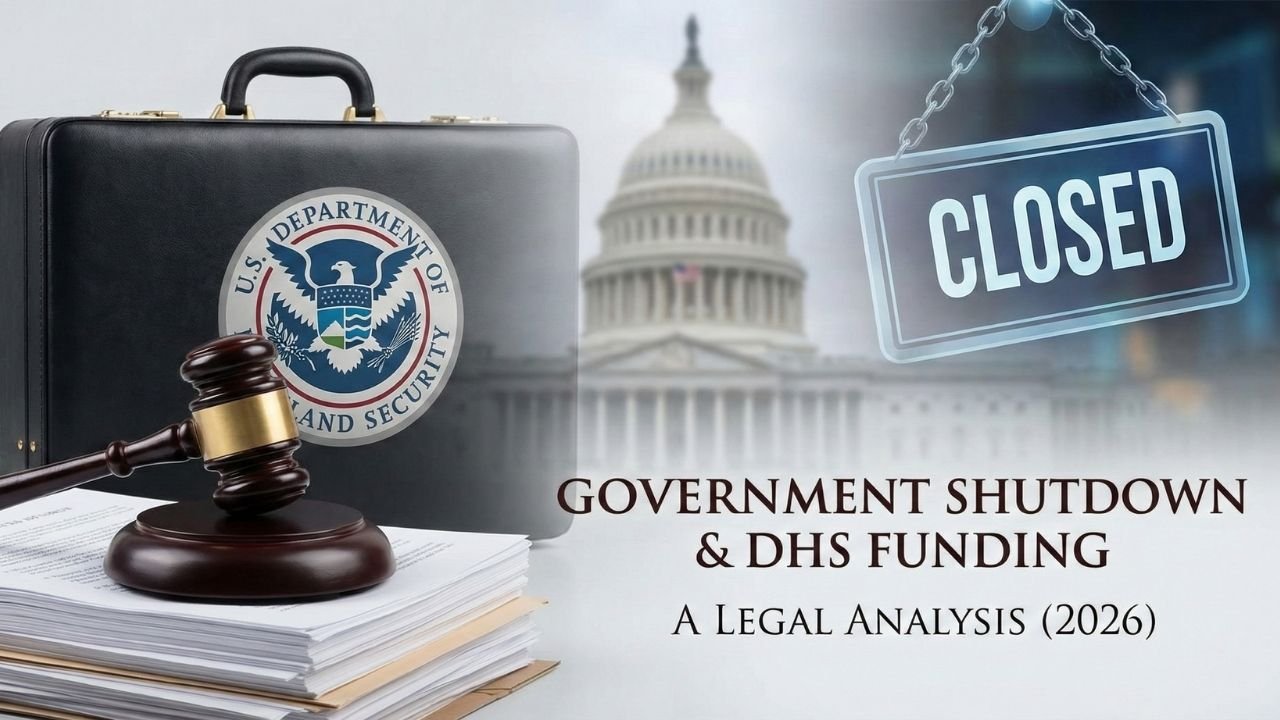
DHS Funding Deadlines & the Law (2026): Shutdown Rules, Immigration Court Disruption, and Constitutional Limits

Legal Summary (February 2026): DHS faces a funding lapse tied to the February 13, 2026 deadline. Under the Antideficiency Act (31 U.S.C. § 1341 et seq.), non-excepted federal functions must halt unless they fall within recognized exceptions (e.g., protection of life or property). Many fee-funded USCIS operations may continue, but appropriated systems and adjudicative pipelines—such as non-detained immigration court processing and potentially E-Verify availability—face disruption risk during lapse periods. Recent negotiations also center on proposed ICE/CBP accountability guardrails, including body cameras and judicial-warrant standards.
Contents
- 0.1 A Comprehensive Legal Analysis of Government Shutdowns, Immigration Adjudication, and Constitutional Limits (2026)
- 0.2 Introduction: Why the 2026 DHS Deadline Matters Legally
- 0.3 February 2026 Legal Flashpoints: Accountability Guardrails, Prefunding, and Operational Reality
- 0.4 The Statutory Framework: Antideficiency Act (31 U.S.C. §§ 1341–1342, 1517)
- 0.5 Essential vs. Non-Essential: Legal Criteria, Not Political Labels
- 0.6 Immigration Law and Enforcement During DHS Funding Lapses
- 0.7 Constitutional Framework: Separation of Powers and the Purse
- 0.8 Potential Litigation Pathways if a DHS Lapse Prolongs
- 0.9 E-Verify During Shutdown Risk: Legal and Employer Compliance Consequences
- 0.10 Employment Law: Furlough Rights, Back Pay, and Union Strategy
- 0.11 Markdown Table: Key Legal Comparisons in DHS Shutdown Scenarios
- 1 Essential vs. Non-Essential in a DHS Funding Lapse
- 1.1 The 2026 Deadline in Context: Short-Term Fixes vs. Long-Term Appropriations Design
- 1.2 Practical Guidance for Legal Practitioners and Policy Teams
- 1.3 Commonly Asked Questions (Paragraph Format)
- 1.3.1 Is a government shutdown automatically unconstitutional?
- 1.3.2 Can the President fund DHS without Congress during a deadline standoff?
- 1.3.3 Why do some immigration services continue during shutdowns while others stall?
- 1.3.4 What happens to federal employees who are furloughed or required to work during a lapse?
- 1.3.5 Are immigration detention and border operations legally allowed to continue without immediate appropriations?
- 1.3.6 If DHS funding remains unstable, what lawsuits are most likely?
- 1.4 Conclusion: The Legal Precedent Being Built in 2026
- 1.5 Verified References
A Comprehensive Legal Analysis of Government Shutdowns, Immigration Adjudication, and Constitutional Limits (2026)
On February 13, 2026, the Department of Homeland Security (DHS) reached a pivotal funding deadline created by a short-term continuing resolution passed as part of the broader shutdown-ending package. Congress funded most of the federal government through the fiscal year while extending DHS only temporarily, setting up a concentrated constitutional and statutory confrontation over immigration enforcement, appropriations authority, and operational continuity
This is not merely a budget story. It is a legal stress test touching the Appropriations Clause, the Antideficiency Act, agency contingency planning, labor protections for federal employees, and the legal architecture of immigration adjudication. Put differently, DHS deadlines are where appropriations law, constitutional structure, and everyday administrative governance collide.
For LawJournalDaily’s U.S. audience—both general readers and legal practitioners—the central issue is not whether shutdowns are politically dramatic. The question is what the law actually permits when appropriations lapse, what must continue, what can pause, who bears legal risk, and what precedents this creates for future standoffs.
Introduction: Why the 2026 DHS Deadline Matters Legally
The current cycle follows a now-familiar pattern: broad appropriations are enacted, but one politically sensitive agency—here, DHS—is placed on a shorter legislative runway. Congress did exactly that in early February 2026 by temporarily funding DHS through February 13, 2026, while the rest of government operations largely continued.
The legal significance is immediate:
- A lapse triggers statutory constraints, not just managerial inconvenience.
The Antideficiency Act (ADA) does not treat appropriations gaps as optional policy pauses; it imposes hard legal limits on obligations and expenditures. - Shutdown law is agency-specific in effect.
Fee-funded systems (e.g., much of USCIS) may continue in substantial part, while appropriated operations face immediate triage. - Immigration adjudication and enforcement are structurally exposed.
DHS and DOJ-linked immigration functions involve a mix of “excepted” operations, detained-case priorities, and delayed non-detained proceedings. - The Constitution allocates fiscal power primarily to Congress.
In practical terms, executive flexibility exists only within statutory boundaries. Claims of unilateral funding authority are constrained by both constitutional text and separation-of-powers doctrine.
A government shutdown, legally defined, is not one statute or one proclamation. It is the consequence of interlocking legal rules: the Constitution’s command that money be drawn only through lawful appropriations, agency-specific appropriations language, and the ADA’s enforcement regime when appropriations lapse.
February 2026 Legal Flashpoints: Accountability Guardrails, Prefunding, and Operational Reality
The 2026 DHS appropriations dispute is not a routine spending disagreement. It is tied to demands for federal immigration-enforcement guardrails after the Minneapolis shooting incident, with Democratic negotiators pushing reforms such as broader body-camera use, identity visibility, and expanded judicial-warrant requirements for certain enforcement actions. These proposals are now directly linked to DHS funding leverage, which means constitutional appropriations friction is interacting with Fourth and Fifth Amendment accountability narratives in real time.
At the same time, legal analysis must separate appropriations lapse optics from actual operational shutdown mechanics. Even if DHS hits a lapse window, certain border and enforcement functions may continue where funding is already available through prior legislation or where operations are treated as excepted under lapse doctrine. Reporting around this cycle indicates that ICE/CBP continuity arguments are materially stronger than in a pure zero-funding scenario, in part because of previously enacted funding streams and contingency planning.
This is why the constitutional question in 2026 is nuanced: Congress still controls the purse, but Congress can also pre-allocate resources in ways that reduce immediate operational collapse for selected functions. In legal practice, that means counsel should avoid categorical claims like “shutdown means border enforcement stops.” The correct approach is line-item funding analysis plus function-by-function ADA review.
The Statutory Framework: Antideficiency Act (31 U.S.C. §§ 1341–1342, 1517)
Any serious legal analysis starts with the ADA. This statute is the core legal mechanism that translates an appropriations lapse into mandatory operational behavior across the executive branch.
1) The Basic Prohibition
Under 31 U.S.C. § 1341, agencies generally may not make obligations or expenditures exceeding available appropriations. In plain legal terms: no enacted money, no new spending authority—absent a lawful exception. GAO’s appropriations law resources summarize this as foundational federal fiscal law.
2) The Voluntary Services Rule and Emergency Carve-Out
Under 31 U.S.C. § 1342, agencies generally cannot accept voluntary services, with a narrow exception for emergencies involving safety of human life or protection of property. Crucially, the statute and interpretive practice reject using this exception for ordinary ongoing functions simply because they are important.
That distinction drives modern shutdown plans: agencies classify activities as “excepted” (sometimes colloquially called “essential”) where statutory or constitutional criteria are met, while non-excepted operations are paused.
3) Apportionment Controls
Under 31 U.S.C. § 1517, obligations in excess of apportionment can also constitute ADA violations. This matters because shutdown legal risk is not only about total appropriation size; it also includes timing, apportionment, and internal control compliance.
4) Legal Consequences for Violations
ADA violations can trigger administrative discipline and reporting obligations, with potential criminal penalties for knowing and willful violations. In practice, agencies spend significant effort on contingency planning precisely to avoid these outcomes. DOJ’s FY2026 contingency materials echo ADA constraints as the legal backbone of lapse operations.
Essential vs. Non-Essential: Legal Criteria, Not Political Labels
Public discussion often uses “essential/non-essential,” but legal analysis should use “excepted/non-excepted” because that maps more closely to ADA doctrine and OMB-era contingency practice.
“Excepted” generally includes:
- Activities necessary to protect life and property,
- Certain law-enforcement and national-security functions,
- Activities necessarily implied by constitutional duties or funded through non-lapsed appropriations (depending on statutory structure).
“Non-excepted” includes:
- Many administrative, policy, and support functions that, while important, do not meet statutory exception criteria during a lapse.
This distinction is why border custody and certain enforcement functions continue while routine adjudicative or administrative operations can slow or stop. It is a legal filter, not an agency preference list.
Immigration Law and Enforcement During DHS Funding Lapses
Immigration operations during shutdown risk are best understood through institutional design: adjudication forums are split, funding streams differ, and legal obligations vary by function.
A) Federal Article III Courts vs. Immigration Courts (EOIR)
A common public misconception is that “all courts shut down.” Legally and operationally, that is usually inaccurate.
- Article III federal courts have historically operated during many lapses by relying on carryover funds, fee sources, and judiciary-specific mechanisms (subject to duration and resource limits).
- Immigration courts (EOIR) are executive-branch adjudicatory bodies within DOJ, and their operations are more directly affected by lapse contingencies.
CRS reporting on immigration court backlog history documents that during the 2018–2019 lapse, EOIR continued detained dockets while postponing many non-detained hearings, producing large-scale scheduling disruption.
That operational split has major legal consequences:
- Detained-case prioritization may preserve statutory detention and removal pathways.
- Non-detained delays can implicate due process concerns, notice problems, attorney availability, and cascading backlog effects.
B) USCIS: Fee-Funded, but Not Shutdown-Proof
USCIS is largely fee-funded, so many benefits operations continue during appropriations lapses. This is why green card and naturalization processes often proceed when appropriated agencies furlough staff.
However, “fee-funded” does not mean immune from disruption:
- Interagency dependencies (security checks, labor certifications, external adjudicative support) can slow timelines.
- Programs tied to expiring statutory authority can lapse independent of fee financing.
- Customer service and auxiliary workflows can degrade when appropriated partners are constrained.
For practitioners, the legal takeaway is straightforward: during DHS funding stress, counsel should audit each client pathway for its actual funding and authority basis, not assume uniform continuity.
C) ICE and CBP: Continuity Obligations and Constraint Management
Enforcement agencies such as ICE and CBP typically maintain frontline operations during lapses under excepted-function analysis and pre-existing appropriations or multi-year allocations where applicable. Current reporting surrounding the 2026 cycle highlights arguments that key enforcement streams may continue even amid short-term appropriations uncertainty.
But legal continuity is not the same as unlimited discretion:
- ADA still governs obligation authority.
- Custodial operations carry constitutional and statutory duties (medical care, safety, process integrity).
- Litigation exposure can increase if prolonged underfunding degrades conditions, timelines, or procedural compliance.
Constitutional Framework: Separation of Powers and the Purse
The DHS deadline conflict is fundamentally constitutional before it is managerial.
1) Congress’s Power of the Purse
The Appropriations Clause in Article I, Section 9, Clause 7 states that no money shall be drawn from the Treasury except through appropriations made by law. That text is the primary constitutional guardrail against unilateral executive spending.
In shutdown contexts, this means:
- Congress’s failure to enact appropriations is not a legal void the executive can simply fill by policy memo.
- Any executive spending theory must point to a valid statute, existing appropriation, or recognized constitutional authority.
2) Can the President Use “Emergency Powers” to Fund DHS?
The short legal answer: only through statutes that actually grant such authority, and only within statutory limits.
The National Emergencies Act (NEA) does not itself create a general Treasury-drawing power. It provides a framework for invoking emergency authorities that already exist elsewhere in law and requires specification of invoked authorities.
So the key legal question is not “Is there an emergency?” but:
- Which specific statute is triggered?
- Does it authorize the contemplated obligation/spending?
- Does it survive appropriations and ADA constraints in this context?
3) Youngstown and the Low-Ebb Problem
In separation-of-powers litigation, Youngstown v. Sawyer remains central: executive action contrary to Congress’s expressed or implied will is at its “lowest ebb.” Courts are least likely to uphold unilateral executive fiscal workarounds in that posture.
4) Train v. City of New York and Spending Fidelity
Train v. City of New York reinforces that when Congress directs spending through statute, executive refusal or reshaping of those instructions can face judicial invalidation. While the case context differs, the broader appropriations principle remains highly relevant in modern impoundment and shutdown disputes.
Potential Litigation Pathways if a DHS Lapse Prolongs
If DHS funding lapses or remains unstable for an extended period, multiple litigation vectors become plausible.
A) Administrative Procedure and Ultra Vires Claims
Plaintiffs may challenge agency actions as exceeding statutory authority when agencies attempt to sustain operations without clear appropriation footing or through aggressive reinterpretations of exception categories.
B) Due Process Challenges in Immigration Contexts
Extended postponements, inconsistent notice, or prolonged detention disruptions can trigger Fifth Amendment litigation, especially where procedural irregularities materially affect hearing access or liberty interests.
C) Labor and Compensation Claims
Federal unions and employee groups may litigate pay, working conditions, or guidance inconsistencies, particularly for excepted workers required to work through funding gaps.
D) Appropriations and Separation-of-Powers Challenges
Institutional plaintiffs, states, or affected entities may test the boundaries of executive reprogramming, emergency invocation, and contingency spending choices in federal court.
In all these categories, remedy and standing issues are complex, but the broader litigation risk rises as funding gaps lengthen and agency improvisation increases.
E-Verify During Shutdown Risk: Legal and Employer Compliance Consequences
E-Verify should be treated as a high-volatility compliance node during shutdown periods. In prior 2025 lapse events, USCIS publicly confirmed periods of E-Verify unavailability and later announced service resumption with catch-up instructions, which created real timing risk for employers balancing I-9 obligations and E-Verify workflow deadlines. For 2026 planning, employers should assume that E-Verify availability can change quickly during appropriations instability and maintain documented contingency procedures.
Editorial precision note: instead of saying legal authorization “automatically expires,” use:
“E-Verify may become temporarily unavailable during funding lapses, creating immediate compliance disruption risk even while Form I-9 obligations continue.”
That phrasing is more defensible across scenarios where E-Verify can go offline and later resume during an ongoing broader shutdown cycle.
Employment Law: Furlough Rights, Back Pay, and Union Strategy
Government shutdown law is also employment law in action.
1) Furloughed vs. Excepted Workers
During appropriations lapses:
- Furloughed employees are generally placed in non-duty, non-pay status during the lapse period.
- Excepted employees may continue working without immediate pay, with compensation typically addressed retroactively after appropriations restoration.
2) Back Pay Framework
The Government Employee Fair Treatment Act of 2019 (S.24) requires compensation for furloughed and excepted federal employees after a lapse ends, on the earliest possible date after appropriations resume.
Current 2026 reporting also indicates ongoing disputes in guidance language and messaging, but congressional action in recent shutdown cycles has continued to preserve retroactive pay outcomes.
3) Union Positioning and Legal Pressure
Unions such as AFGE and component labor organizations have historically used combined tactics:
- Public legal framing around compelled unpaid labor,
- Pressure for appropriations and back-pay certainty,
- Litigation where policy execution appears inconsistent with statute or collective bargaining frameworks.
A prolonged DHS-specific lapse would likely sharpen union challenges around workload inequity, staffing safety, and overtime/compensation administration.
Markdown Table: Key Legal Comparisons in DHS Shutdown Scenarios
| Legal Topic | Governing Authority | Core Rule | Practical Effect During DHS Funding Gap | Litigation Risk |
|---|---|---|---|---|
| Treasury spending authority | U.S. Const. Art. I, §9, cl. 7 | No money drawn without appropriations made by law | Limits unilateral executive spending solutions | High in structural constitutional disputes |
| Agency obligations during lapse | 31 U.S.C. §1341 (ADA) | No obligations/expenditures beyond available appropriations | Non-excepted DHS activities pause/furlough | Medium to high if over-obligation occurs |
| Voluntary services and exceptions | 31 U.S.C. §1342 | No voluntary services except life/property emergencies | Border/custodial/law-enforcement continuity prioritized | Medium if exception categories overextended |
| Apportionment compliance | 31 U.S.C. §1517 | No obligations beyond apportionment | CFO/budget controls tighten immediately | Medium (reporting + discipline exposure) |
| Immigration court operations | EOIR contingency practice; historical precedent | Detained dockets prioritized; non-detained often rescheduled | Backlog growth, delayed hearings, counsel burden | High for due process and timing claims |
| USCIS continuity | Fee-funded statutory model | Many services continue despite appropriations lapse | Core adjudications may continue with delay pockets | Low to medium (depends on interagency dependencies) |
| Employee compensation post-lapse | Government Employee Fair Treatment Act (2019) | Retroactive pay after lapse ends | Wage certainty improves, cash-flow strain remains | Medium for implementation disputes |
| Presidential emergency claims | NEA + specific delegated statutes | Must invoke specific statutory authority; no blank check | Limited pathway for substitute funding | High if action conflicts with Congress |
Essential vs. Non-Essential in a DHS Funding Lapse
A statutory flow model showing how the Antideficiency Act determines which DHS-linked functions continue and which pause during an appropriations lapse.
DHS Appropriations Lapse
Funding deadline passes without enacted appropriations for covered DHS functions.
Antideficiency Act Review (31 U.S.C. §§ 1341, 1342, 1517)
Legal screening determines whether each function is excepted, deferred, or furloughed under lapse rules.
- Necessary for safety of human life/protection of property
- Law enforcement/custodial continuity
- Operations continue with constrained staffing and delayed compensation
- Post-lapse payroll restoration under the 2019 back-pay framework
- No current appropriation available
- Furlough or deferred activity
- Rescheduling and backlog accumulation (e.g., non-detained immigration hearings)
- Reactivation after appropriations enacted
The 2026 Deadline in Context: Short-Term Fixes vs. Long-Term Appropriations Design
The February 2026 cycle reflects a larger congressional pattern: omnibus or minibuses with targeted short-term “pressure points” for contested agencies. In this round, DHS became that pressure point.
From a legal-governance perspective, repeated short-term extensions create several systemic effects:
- Contingency Governance Becomes Semi-Permanent
Agencies increasingly operate under lapse planning assumptions, which can alter staffing models, procurement timing, and adjudication queues. - Legal Friction Migrates from Congress to Courts and Agencies
When appropriations are repeatedly deferred, law is made in practice through guidance memos, contingency categorizations, and post hoc litigation. - Immigration System Volatility Deepens
Even when enforcement continues, adjudicative instability (especially non-detained docket delays) compounds an already severe backlog environment. - Workforce Trust Costs Accumulate
Retroactive pay protects legal entitlement, but it does not erase household financial stress for unpaid intervals or attrition incentives in high-demand functions.
Practical Guidance for Legal Practitioners and Policy Teams
For attorneys, general counsel offices, and policy analysts tracking DHS funding law in 2026, the best approach is rigorous statutory mapping:
- Identify whether a function is appropriated, fee-funded, multi-year funded, or contingency-excepted.
- Track the exact text and sunset mechanics in the operative continuing resolution or appropriations act.
- Evaluate whether any claimed emergency authority includes genuine obligation authority for the contemplated action.
- Document operational harm early (hearing resets, detention delays, processing bottlenecks) for possible equitable or statutory relief.
- For labor-facing teams, preserve payroll and status records for post-lapse compensation disputes.
This is where high-E-E-A-T legal content must remain disciplined: the law is not “shutdown chaos.” It is a dense but navigable structure of constitutional commands and fiscal statutes.
Commonly Asked Questions (Paragraph Format)
Is a government shutdown automatically unconstitutional?
No. A shutdown is usually a legal consequence of Congress not enacting timely appropriations, combined with the ADA’s prohibition on unauthorized obligations. The constitutional violation risk emerges when actors spend without lawful authority or otherwise bypass Congress’s appropriations role. The shutdown itself is not automatically unconstitutional; unlawful spending responses can be.
Can the President fund DHS without Congress during a deadline standoff?
Not as a general matter. The President may invoke authorities only where statutes authorize action, and emergency declarations do not independently create a blank appropriations power. Courts generally scrutinize unilateral executive action most strictly when it conflicts with Congress’s expressed will, consistent with Youngstown principles.
Why do some immigration services continue during shutdowns while others stall?
Because the immigration system is financed and administered through multiple legal pathways. USCIS is largely fee-funded, so many benefits processes continue. EOIR court operations and other appropriated functions may be constrained, with detained matters prioritized and non-detained hearings often delayed.
What happens to federal employees who are furloughed or required to work during a lapse?
Under current federal law, retroactive pay is generally required after appropriations resume for affected employees, including many furloughed and excepted personnel. That said, implementation details and agency guidance can still produce disputes, especially in prolonged or repeated lapses.
Are immigration detention and border operations legally allowed to continue without immediate appropriations?
Often yes, under excepted-function analysis tied to protection-of-life/property and law-enforcement obligations, plus any available non-lapsed funds. But continuity does not eliminate ADA, constitutional, or conditions-of-confinement legal constraints. Agencies must still operate within statutory and constitutional boundaries.
If DHS funding remains unstable, what lawsuits are most likely?
Expect litigation around administrative overreach, due process harms in delayed adjudication or detention settings, employee compensation/rights implementation, and structural separation-of-powers claims tied to appropriations authority.
Conclusion: The Legal Precedent Being Built in 2026
The 2026 DHS funding deadline is more than a temporary budget marker. It is an active precedent-setting moment in U.S. public law. The clash between Congress’s purse authority and executive urgency is being mediated through statutes like the Antideficiency Act, institutional design choices in immigration governance, and courts’ willingness to police the constitutional boundary between implementation and lawmaking.
Short-term continuing resolutions can prevent immediate collapse, but they also normalize a legal operating environment in which crisis rules become routine. Over time, that shifts where legal meaning is produced—from stable appropriations architecture to contingency memos and emergency framing. For immigration adjudication, federal workforce stability, and constitutional accountability, that shift is consequential.
For readers and practitioners, one principle should remain clear: appropriations law is constitutional law in operational form. In every DHS deadline fight, the key legal questions are the same—who can obligate money, on what statutory basis, for which functions, under what judicially reviewable limits.
If you are directly affected—whether as a federal employee, contractor, immigrant respondent, petitioner, or institutional stakeholder—consult a licensed U.S. attorney experienced in federal appropriations, administrative, labor, or immigration law. This article provides legal analysis for educational purposes and is not legal advice.
Verified References
The following official legal sources support the shutdown framework used in this analysis:
- Antideficiency Act (Core Statutory Framework)
31 U.S.C. § 1341 — Limitation on expending and obligating amounts
31 U.S.C. § 1342 — Limitation on voluntary services
31 U.S.C. § 1517 — Prohibited obligations and expenditures - U.S. Constitution — Appropriations Clause
Article I, Section 9, Clause 7 (Power of the Purse) - Federal Employee Back Pay (Shutdown Context)
Government Employee Fair Treatment Act of 2019 (S.24) - Executive Power Limits (Judicial Precedent)
Youngstown Sheet & Tube Co. v. Sawyer, 343 U.S. 579 (1952)
