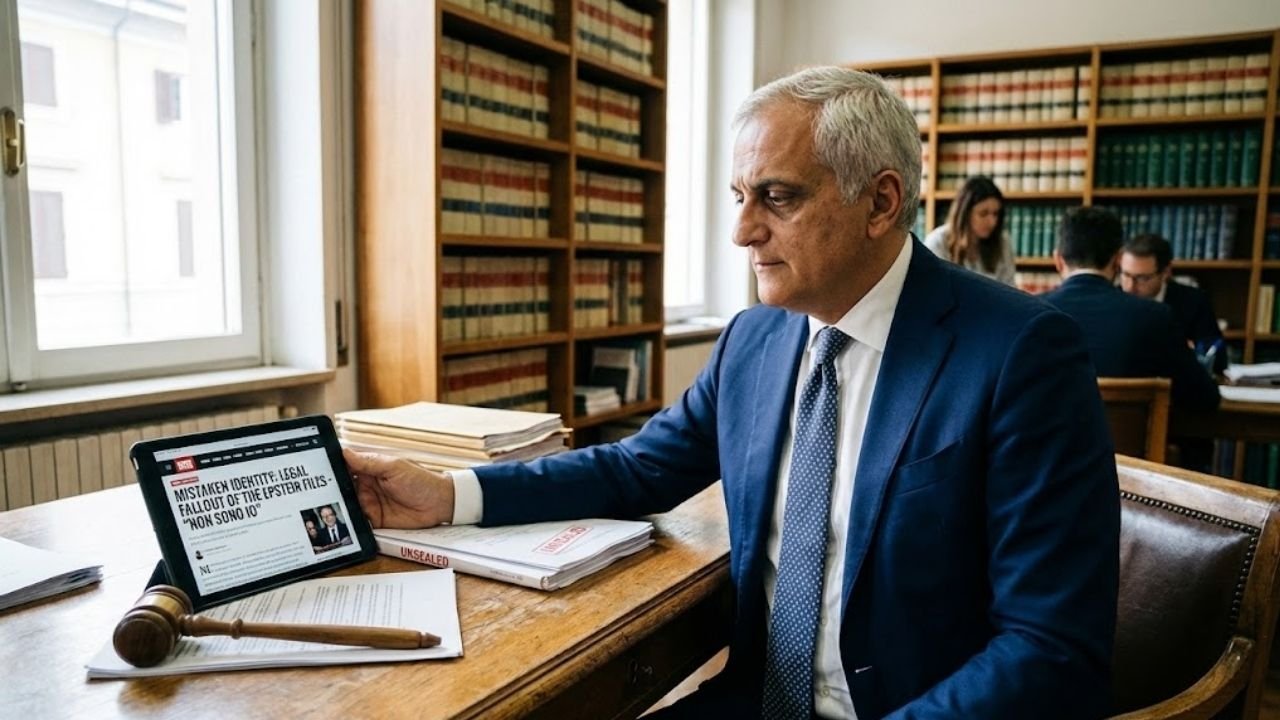
The Nicola Caputo Case: Navigating Mistaken Identity in High-Profile Legal Leaks

Contents
- 1 Introduction: When a Name Becomes a Headline
- 2 Info Box: Key Legal Context at a Glance
- 3 The “Same Name” Dilemma: Homonyms in Court Records
- 4 Why the Trend Accelerated: Networked Defamation in a “Leak Economy”
- 5 Analyzing the Defamation Case: Libel, False Association, and Viral Misinformation
- 6 If Media Used the Wrong Photo: How a Case Might Be Built
- 7 Jurisdiction Wars: EU Privacy Rights vs. U.S. Transparency
- 8 Data Table: Comparing Key Legal Pathways in Mistaken-Identity Crises
- 9 Crisis Management for Public Figures: A Legal Roadmap
- 10 Legal Ethics and Media Responsibility in News-Jacking Cycles
- 11 Reading U.S. Court Documents Without Getting Misled
- 12 The Broader Reform Question: Transparency Without Collateral Damage
- 13 Commonly Asked Questions
- 14 Conclusion: The Cost of Transparency, and the Price of Imprecision
Introduction: When a Name Becomes a Headline
A sudden spike in search interest can turn a private legal detail into a global public controversy in hours. That is exactly what happened as “Nicola Caputo” began trending in connection with Epstein-related document discussions in February 2026, after members of Congress publicly referenced names they said had appeared in redactions from released files. (New York Post)
At the center of the confusion is a core claim that matters legally: former MEP Nicola Caputo has reportedly denied involvement and framed the episode as mistaken identity involving a namesake. The legal significance is bigger than one person and one news cycle. It raises a recurring hard question in modern information law: what happens when public transparency systems identify a name, but internet distribution mechanisms attach that name to the wrong human being?
This is no longer a niche defamation issue. It is a collision between open-court principles, social-media speed, algorithmic amplification, and cross-border privacy law. The Nicola Caputo episode is a practical case study for law students, litigators, media counsel, journalists, and anyone publishing legal content in real time.
Info Box: Key Legal Context at a Glance
Underlying litigation often referenced in the Epstein document-unsealing context: Giuffre v. Maxwell, No. 15-cv-7433 (S.D.N.Y.). (CourtListener)
Judge associated with key unsealing orders: Senior U.S. District Judge Loretta A. Preska. (U.S. District Court)
Document categories frequently discussed publicly: unsealed deposition-related materials and related court filings; many public discussions also mention flight-log allegations, though legal weight varies by source and document type. (U.S. District Court)
Current trend trigger (Feb. 2026): congressional floor remarks identifying previously redacted names in newly discussed releases. (New York Post)
The “Same Name” Dilemma: Homonyms in Court Records
Legal systems are designed to identify parties and witnesses with precision. Public discourse is not. The gap between those two realities is where harm occurs.
In many court records, especially when excerpts circulate outside full dockets, the public sees plain text names without complete identifiers such as date of birth, nationality, middle names, institutional affiliations, or other disambiguating metadata. This is especially true once documents are excerpted into social posts, screenshots, and reposted summaries. A name can leave the evidentiary context that gave it meaning and become a floating label.
In high-profile matters, that label can be interpreted as accusation, guilt, or participation, even where none of those conclusions are supported by the record. In U.S. law, naming in a filing does not automatically establish culpability; pleadings and unsealed materials may contain allegations, references, or evidentiary assertions that remain contested and unproven. This is why legal professionals insist on reading complete docket entries, procedural posture, and judicial findings before making identity-based claims.
The Nicola Caputo scenario illustrates three recurring homonym risks:
First, identity collapse: two or more real people share the same name, and public conversation assumes they are one person.
Second, context collapse: a procedural document reference is reframed as a substantive finding.
Third, platform collapse: nuance present in original records disappears in social summaries and clip culture.
For legal publishers, due diligence should never stop at name matching. A responsible verification process includes confirming jurisdiction, role in litigation, source document type, procedural status, and independent biographical matches before publishing a photo, headline, or allegation. Without this, even well-meaning outlets can create a false association that is legally actionable.
Historically, mistaken-identity harms are not hypothetical. U.S. courts have seen repeated disputes involving wrong-person arrests, inaccurate records, and publication errors tied to common names. While fact patterns differ, the legal lesson is stable: when identity verification fails, downstream actors can face negligence, false light, defamation, or privacy-related exposure depending on state law and publication conduct.
Why the Trend Accelerated: Networked Defamation in a “Leak Economy”
The reason this issue feels urgent is structural. Public legal releases now move through a three-layer pipeline:
- Formal legal source (court filing, order, transcript, deposition excerpt).
- Interpretive media layer (news articles, commentary threads, influencer takes).
- Viral replication layer (memes, clipped screenshots, re-captioned images, translated summaries).
Every layer introduces new opportunities for distortion. The first may be accurate. The second may be incomplete. The third may be detached from source truth.
When a politically visible or professionally known person shares a name with someone mentioned in controversial files, reputational injury can begin before correction mechanisms even activate. This is especially acute for search engines: an early, high-engagement false association can become “sticky,” influencing autocomplete behavior and result clustering.
That is why reputational counsel increasingly treat these events as incident response rather than ordinary PR. By the time a correction appears, cached screenshots and mirrored posts may continue to circulate.
Analyzing the Defamation Case: Libel, False Association, and Viral Misinformation
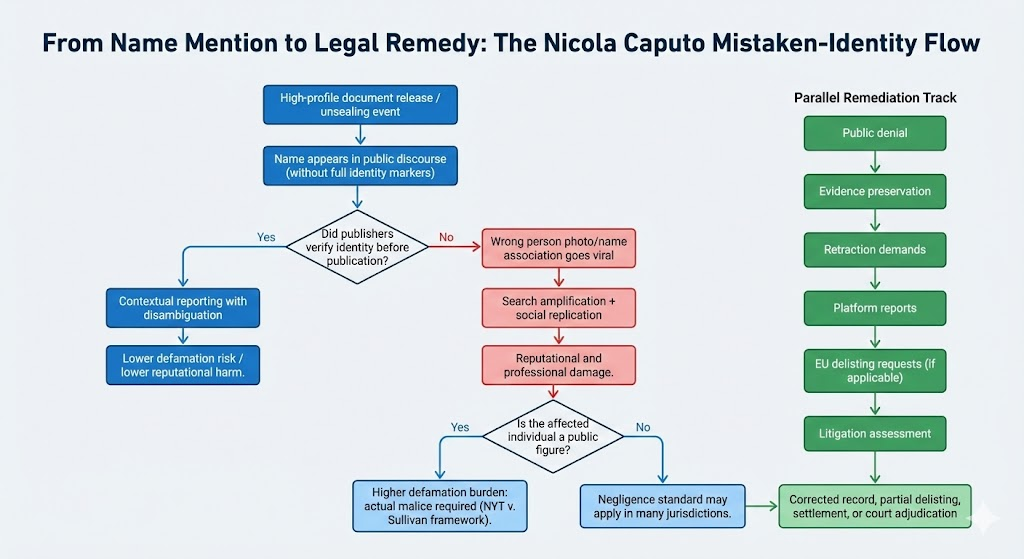
Could a person in Nicola Caputo’s position sue? Potentially yes, but outcome depends on several legal gates.
1) Core U.S. defamation elements still control
In most U.S. jurisdictions, a plaintiff must generally show: a false statement of fact, publication to a third party, fault at least amounting to negligence (or higher), and reputational harm. If the publication effectively says or implies “this specific person is connected to criminal or immoral conduct,” falsity and reputational injury may be straightforward. The difficult part is usually fault and constitutional limits.
2) Public-figure doctrine raises the burden
If the plaintiff is a public figure (or limited-purpose public figure), New York Times v. Sullivan and later cases require proof of “actual malice,” meaning knowledge of falsity or reckless disregard for truth. ({{meta.siteName}})
That is much harder than ordinary negligence. The plaintiff must show more than sloppy reporting; they must show a serious departure from truth-seeking despite obvious reasons to doubt.
For a former politician or high-profile public actor, this doctrine is central. In practical terms, evidence like internal editorial messages, ignored correction requests, failure to review available court documents, or deliberate use of the wrong photo after warnings can become critical in proving reckless disregard.
3) Defamation by implication is a major risk vector
Many viral posts do not assert “X committed Y” directly. They juxtapose a face, name, and scandal label, inviting the audience to infer guilt. U.S. courts in some jurisdictions recognize defamation-by-implication theories where a technically true statement is arranged to convey a false and defamatory meaning. Whether such claims survive depends heavily on local precedent and exact wording/imagery.
4) “Republication liability” can catch secondary amplifiers
Outlets and creators often assume only the original poster bears legal risk. That is not always true. Repeating a defamatory claim can create fresh liability, particularly if the republisher adds endorsement language or ignores obvious disproof.
5) Defamation per se may apply in certain accusations
Allegations implying serious criminal conduct or moral turpitude can fall under defamation-per-se frameworks in some states, potentially easing proof burdens around damages. But constitutional standards still apply where public figures and public issues are involved.
If Media Used the Wrong Photo: How a Case Might Be Built
Imagine a publication displays Nicola Caputo’s professional photo beside text implying his involvement in Epstein-related wrongdoing, without confirming identity. A legal complaint could be structured around:
- False statement or false implication of fact.
- Clear identification of plaintiff (photo + name).
- Publication to large audience.
- Reputational harm (professional, social, economic).
- Fault standard depending on public/private status.
- Potential request for injunctive relief where available under local law (limited in many U.S. contexts because of prior-restraint concerns).
The defense might respond with fair-report privilege, neutral-reportage arguments (where recognized), opinion defenses, lack of actual malice, rapid correction behavior, or “substantial truth.” But if identity was readily verifiable and ignored, defense posture weakens.
Jurisdiction Wars: EU Privacy Rights vs. U.S. Transparency
The Nicola Caputo conversation is inherently transnational. U.S. court-access norms and First Amendment traditions do not map neatly onto EU privacy rights.
U.S. side: transparency and speech protections
U.S. constitutional culture strongly favors open judicial proceedings and robust press freedom, especially on matters of public concern. This does not immunize false factual reporting, but it does create a high threshold for plaintiffs who are public figures.
EU side: data protection and dignity interests
Under GDPR frameworks, personal data processing must meet legal standards, and data subjects can request erasure in specific circumstances. The widely discussed “Right to be Forgotten” is not absolute, but it can be powerful when data is inaccurate, no longer relevant, or disproportionately harmful in search indexing contexts.
In Google v. CNIL, the Court of Justice of the EU held that delisting obligations under EU law do not automatically require global de-referencing; they are generally EU-scoped, with room for member-state balancing. (European Parliament)
That matters practically: a person may get delisting in EU domains or EU-accessed results while contested links remain accessible elsewhere.
Can links be removed?
Possibly, depending on platform policies, jurisdiction, and proof. A claimant like Nicola Caputo might pursue:
- Search-engine delisting requests under EU legal standards.
- Platform reporting and misinformation escalation.
- Publisher correction and retraction demands.
- Civil claims where legal thresholds are met.
The key is to distinguish between “erase the internet” (usually unrealistic) and targeted legal-technical remediation (often achievable).
Data Table: Comparing Key Legal Pathways in Mistaken-Identity Crises
| Legal Pathway | Typical Jurisdictional Anchor | Standard to Meet | Speed | Primary Remedy | Core Limitation |
|---|---|---|---|---|---|
| U.S. Defamation (Public Figure) | U.S. state tort law + First Amendment overlay | Falsity + publication + harm + actual malice | Slow to medium | Damages, corrections, sometimes settlement terms | High burden under NYT v. Sullivan |
| U.S. Defamation (Private Figure) | U.S. state tort law | Usually negligence + falsity + harm | Medium | Damages, correction leverage | Still fact-intensive; truth remains absolute defense |
| False Light / Privacy Torts | State-dependent | Highly jurisdiction-specific | Medium | Damages, reputational vindication | Not recognized uniformly across states |
| EU GDPR Delisting Request | EU data-protection regime | Inaccuracy/disproportionality/public-interest balancing | Often faster initially | Search-result delisting (regional scope) | Not absolute; public-interest exceptions apply |
| Publisher Retraction Demand | Contract/tort pre-litigation strategy | Demonstrate factual error and harm | Fast | Correction, retraction, update note | Voluntary compliance varies |
| Platform Takedown / Policy Route | Private platform policy | Policy violation (misidentification, harassment, etc.) | Fast to medium | Removal, downranking, labels | Inconsistent enforcement; opaque appeals |
Crisis Management for Public Figures: A Legal Roadmap
When mistaken identity erupts, legal strategy should run on two synchronized tracks: evidentiary rigor and communication discipline.
Stage 1: Immediate factual denial with verifiable anchors
A short public statement should do three things: deny the false association, provide identity clarifiers, and avoid speculative accusations. Overly emotional or broad language can backfire in future litigation.
Stage 2: Preservation and digital forensics
Before sending legal threats, counsel should preserve evidence: URLs, timestamps, screenshots, post-edit histories, engagement metrics, and where possible, archiving of metadata. Digital forensics can later prove publication timeline, reach, and repeated notice.
Stage 3: Precision takedown and correction requests
Generic complaints are less effective than targeted legal notices that identify the exact false assertion, exact asset (headline/image/snippet), and exact corrective text requested. For established outlets, formal retraction demands may create significant leverage.
Stage 4: Escalation ladder
If voluntary correction fails, escalation can include cease-and-desist letters, pre-action notices, search-engine delisting petitions (particularly in EU contexts), and strategic filing decisions on forum and applicable law.
Stage 5: Litigation readiness
Counsel should evaluate plaintiff classification (public/private), expected defenses, and proof of fault. In public-figure cases, evidence of repeated notice followed by continued publication can become central to actual-malice arguments.
Stage 6: Long-tail reputation remediation
Even after correction, stale links and reposts can persist. Ongoing remediation combines legal follow-up, search-signal cleanup, structured fact pages, and consistent publication of corrected narrative assets.
Legal Ethics and Media Responsibility in News-Jacking Cycles
News-jacking is not unlawful by itself. But journalism and legal commentary carry duty gradients that rise with reputational stakes.
A practical editorial standard for high-risk identity stories should include:
- Source hierarchy (primary documents over social posts).
- Identity verification protocol (at least two independent checks).
- Context framing (allegation vs finding vs conviction).
- Correction architecture (visible updates, not silent edits).
- Headline discipline (no guilt-implying ambiguity).
For legal publishers, this is also an E-E-A-T issue. Expertise is demonstrated not by speed alone, but by calibration—knowing what can be said with confidence and what must be caveated.
Reading U.S. Court Documents Without Getting Misled
The public often reads unsealed documents as if they are verdicts. They are not. In complex federal cases, you should parse:
- Case caption and docket number (to confirm correct proceeding).
- Document type (order, motion, deposition excerpt, declaration, exhibit).
- Procedural posture (pretrial, discovery dispute, appeal, final judgment).
- Judicial language (finding vs allegation vs summary of party arguments).
- Scope of unsealing (what was released and why).
In the Epstein-related unsealing context tied to Giuffre v. Maxwell, the district court’s process and order language are critical for understanding what documents signify and what they do not. (U.S. District Court)
Conflating mention with wrongdoing is precisely how mistaken-identity damage spreads.
The Broader Reform Question: Transparency Without Collateral Damage
Open courts are a democratic strength. So is press freedom. But modern distribution systems have changed the cost structure of error. A mistaken identity that once affected a local audience can now achieve global persistence in a day.
Policy reform discussion increasingly focuses on three areas:
- Structured disambiguation in public legal data
Where lawful, document systems could improve identity clarity without exposing sensitive personal data. - Correction portability
If a major source corrects a false identity association, downstream platforms could be nudged to propagate correction labels more effectively. - Cross-border legal interoperability
U.S. speech protections and EU privacy rights will continue to conflict. Better procedural bridges are needed for fast, lawful redress without chilling accurate reporting.
None of this requires weakening transparency. It requires better precision.
Commonly Asked Questions
Q: Why is Nicola Caputo trending in relation to the Epstein list?
Because a name matching his has been discussed in connection with recently referenced Epstein-related document disclosures, including congressional remarks that identified names said to have been redacted. In this environment, the former MEP’s position has been framed publicly as mistaken identity, which is why legal and media attention intensified so quickly. (New York Post)
Q: Can you sue for mistaken identity in a news report?
Yes. If a report falsely identifies you, or implies you are the person tied to harmful allegations, and that publication causes reputational damage, you may have a defamation claim (or related claim, depending on jurisdiction). In the U.S., outcomes depend heavily on whether you are a public figure. Public figures generally must prove actual malice under constitutional doctrine, while private figures often proceed under negligence standards. The exact threshold varies by state and facts.
Q: What is the “Right to be Forgotten”?
It is an EU legal concept, developed through EU data-protection law (now associated with GDPR-era practice), that allows individuals in certain circumstances to request delisting or removal of links to personal information that is inaccurate, outdated, or disproportionately harmful. It is not absolute. Courts and regulators balance privacy against public interest and freedom of information, and EU jurisprudence has clarified that delisting is generally not automatically global in scope. (European Parliament)
Conclusion: The Cost of Transparency, and the Price of Imprecision
The Nicola Caputo episode captures a defining legal challenge of the 2020s: the law of names in an age of velocity. Transparency remains essential. Public access to court materials remains essential. But when identity verification fails, innocent people can absorb immediate and durable harm that is difficult to fully reverse.
For legal professionals, the lesson is procedural discipline: verify identity before publication, preserve context, and separate allegations from adjudications. For media teams, the lesson is editorial design: headlines, images, and snippets can defame by implication even when article body text is hedged. For affected individuals, the lesson is strategic response: fast denial, evidence capture, targeted legal notices, and cross-border remediation planning.
And for policymakers, the lesson is structural: transparency frameworks must evolve to reduce collateral damage without undermining accountability.
If you are directly affected by mistaken identity in legal reporting, consult a licensed attorney in the relevant jurisdiction immediately. Timing, evidence preservation, and forum choice can materially affect whether you obtain correction, delisting, damages, or meaningful reputational repair.
Editorial Note on Sources and Legal Scope
This article provides legal analysis for educational purposes, not legal advice. U.S. defamation and privacy rules vary by jurisdiction, and cross-border outcomes depend on specific facts, platforms, and applicable law. For live matters, obtain advice from counsel licensed in your jurisdiction.
