The Legal Weight of Association: Howard Lutnick’s 2012 Epstein Island Visit Under Federal Vetting Rules

Contents
- 1 Introduction: Why this story matters beyond headlines
- 2 Key Legal Points
- 3 1) The Incident in Detail: Facts vs. speculation
- 4 2) 2012 context: why timing matters in legal assessment
- 5 3) The federal vetting process and SF-86: what it is and why it matters
- 6 4) False statements and perjury confusion: the actual criminal exposure
- 7 5) National-security adjudication: Guideline B and Guideline E in practice
- 8 6) Ethics law and the “appearance” standard: legal but still problematic
- 9 7) Guilt by association vs. criminal liability: where the line is
- 10 8) Senate confirmation and oversight: what Congress can do now
- 11 9) Corporate norms vs. public-office compliance: why transition risk is real
- 12 10) FOIA and transparency: what the public can realistically obtain
- 13 11) Comparative legal matrix: where different standards diverge
- 14 13) Discover-focused editorial execution: how to publish this responsibly
- 15 14) Practical legal reading of this controversy: what can be said now
- 16 Commonly Asked Questions
- 16.1 Is visiting Epstein’s island, by itself, a federal crime?
- 16.2 If an official omitted a relevant relationship on SF-86, is that automatically prosecution-worthy?
- 16.3 What does “appearance of impropriety” mean in practice?
- 16.4 Can the Senate investigate again after confirmation?
- 16.5 Can journalists obtain all related records through FOIA?
- 16.6 Does this type of controversy usually end in criminal court or in administrative/political channels?
- 17 Conclusion: the real verdict is about governance discipline
Introduction: Why this story matters beyond headlines
When a sitting U.S. Cabinet official acknowledges a past visit to Jeffrey Epstein’s private island, the legal question is not automatically “Was a crime committed?”
The first question is usually narrower and more technical: What did the official disclose, when, and under which federal vetting and ethics rules?
Recent reporting indicates Commerce Secretary Howard Lutnick said he visited Epstein’s island in 2012 with family members, amid growing scrutiny over earlier public descriptions of his relationship with Epstein. (TIME)
That disclosure moved the issue from pure reputational controversy into the realm of administrative process, congressional oversight, and public-trust law.
This article analyzes the issue through the legal frameworks that actually govern senior executive officials: SF-86 disclosure rules, false-statement law, national-security adjudicative standards, federal ethics principles, Senate oversight powers, and FOIA transparency limits.
The goal is not to relitigate tabloid narratives, but to explain what U.S. law does—and does not—do with facts like these.
Key Legal Points
No automatic criminal liability from mere association: Visiting a person later known for criminal conduct is not, by itself, a federal crime.
Disclosure is the legal hinge: If relevant contacts or associations were required to be disclosed in security forms or official vetting and were omitted materially and knowingly, exposure can shift to false-statement risk under federal law.
Ethics and security are separate tracks: A person may avoid criminal liability yet still face ethics scrutiny, clearance concerns, or congressional consequences.
Public trust is a legal value in federal ethics law: Executive-branch standards emphasize avoiding not only actual conflicts, but appearances that erode confidence in government integrity.
1) The Incident in Detail: Facts vs. speculation
Based on current reporting, the key fact pattern is this: Lutnick acknowledged a 2012 visit to Epstein’s island and framed it as a family-related stop during a broader trip; lawmakers and commentators then questioned consistency with earlier characterizations of minimal ties. (TIME)
At this stage, public reporting centers on statements, chronology, and transparency rather than a filed criminal case against Lutnick.
A legal analysis must separate three layers that media often blur:
Layer one: factual timeline.
What events occurred, what communications existed, and what was known publicly at the time.
Layer two: disclosure obligations.
Which forms, clearance interviews, or confirmation processes required disclosure of the contact—and with what level of detail.
Layer three: legal consequence.
Did any omission or statement become materially false in a federal matter, or does the issue remain in ethics/political accountability territory.
The distinction matters because U.S. law generally avoids “status guilt.”
Criminal liability is conduct-based, not reputation-by-proximity.
But federal service imposes a higher expectation of candor than ordinary private life, especially where national security or public trust is implicated.
2) 2012 context: why timing matters in legal assessment
The year of contact matters legally because vetting asks not only “who did you know,” but “what should a reasonable applicant have understood, and what was material to adjudicators?”
By 2012, Epstein’s prior criminal history was already public and documented from the earlier Florida case era, so any continued social or personal interaction after that period can become relevant in a risk-based review, even if not independently unlawful.
This does not predetermine wrongdoing.
It does, however, shape how an investigator or adjudicator might view judgment, candor, and potential susceptibility factors.
That is why timeline reconstruction is central in security matters.
Adjudicators do not evaluate one isolated event in a vacuum; they evaluate patterns, context, mitigation, and whether the subject disclosed the same facts consistently across documents and interviews.
3) The federal vetting process and SF-86: what it is and why it matters
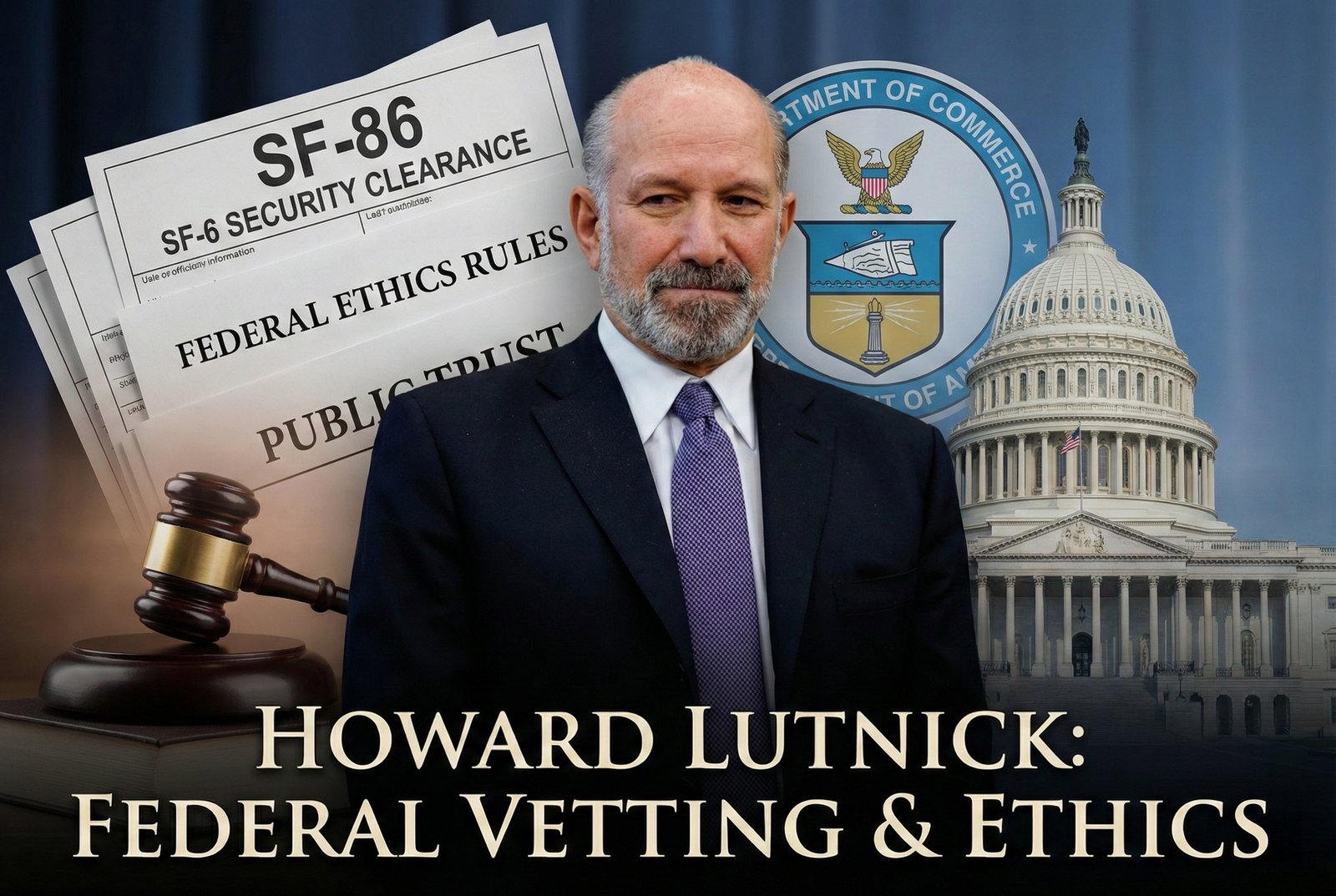
For many national-security positions, the government uses Standard Form 86 (SF-86) as the principal questionnaire for background investigations and continuing evaluation. (U.S. Office of Personnel Management)
It is not just administrative paperwork.
It is a sworn, consequential disclosure instrument used to assess trustworthiness for access to classified information.
The SF-86 process asks broad categories about conduct, contacts, vulnerabilities, and associations.
Historically, related certification materials have included association-focused sections (often referenced as “Association Record” in SF-86 certification frameworks), showing the government’s longstanding concern with risk-bearing relationships. (reginfo.gov)
The core legal principle is straightforward:
If a fact falls within the scope of a question, the applicant’s safest path is complete, timely, and consistent disclosure.
Investigators can often mitigate concerning facts if fully disclosed.
They are far less forgiving when the problem appears to be concealment or shifting narratives.
Did a visit necessarily require disclosure?
That depends on exact wording in the applicable form version, follow-up interviews, supplemental submissions, and whether investigators deemed the contact material to adjudication.
Without access to the individual’s actual SF-86 and interview files, no outside analyst can conclusively answer this.
But as a compliance principle, federal counsel typically advises expansive disclosure where doubt exists, precisely to avoid later accusations of omission.
4) False statements and perjury confusion: the actual criminal exposure
Public debate often labels every disputed disclosure as “perjury.”
Legally, that is imprecise.
For many federal disclosure contexts, the more relevant statute is 18 U.S.C. § 1001, which criminalizes knowingly and willfully making materially false statements (or concealing material facts in certain circumstances) in matters within federal jurisdiction. (Legal Information Institute)
The statute can carry serious penalties, including potential imprisonment.
Two legal gates are critical:
- Materiality — the statement or omission must matter to the federal decision process.
- Mens rea — prosecutors must show knowing and willful falsity, not mere memory error or ambiguity.
So the legal question is not “Was there an embarrassing association?”
It is “Did the person knowingly and materially misstate required facts in a federal matter?”
That is a high bar and heavily fact-dependent.
Without an indictment or adjudicative record, public commentary should avoid declaring criminal guilt as a settled conclusion.
5) National-security adjudication: Guideline B and Guideline E in practice
Security clearance determinations are governed by common adjudicative criteria under SEAD-4, which includes Guideline B (Foreign Influence) and Guideline E (Personal Conduct) among others. (DNI)
Even if a controversy has no foreign nexus, Guideline E can become central because it addresses honesty, candor, reliability, and judgment.
In real adjudications, “poor judgment” alone does not always trigger revocation.
Adjudicators assess the “whole person”: frequency, recency, seriousness, intent, rehabilitation, and mitigation.
A one-time bad decision with prompt, truthful disclosure may be survivable.
A pattern of minimization or inconsistent reporting is harder to mitigate.
That is why many clearance lawyers say the most damaging issue is often not the underlying conduct but the appearance that the applicant was not forthright.
The government can tolerate human imperfection more easily than it tolerates deceptive reporting.
6) Ethics law and the “appearance” standard: legal but still problematic
Federal ethics rules are explicit that public service is a public trust.
Under 5 C.F.R. Part 2635, executive employees must uphold principles that sustain confidence in government integrity, including avoiding actions that create the appearance of violating ethical standards. (eCFR)
This “appearance” concept is frequently misunderstood.
It does not mean public discomfort equals legal guilt.
It means ethics analysis asks how a reasonable person with relevant facts would view the official’s impartiality and integrity in office.
Subpart E on impartiality underscores the duty to avoid appearances of loss of impartiality in official duties. (eCFR)
So even absent criminal exposure, an official may face ethics questions, recusals, heightened internal review, or oversight pressure if trust optics are materially damaged.
In short:
Criminal law asks “Did you violate a statute beyond required proof?”
Ethics law asks “Can the public still reasonably trust your official judgment?”
Both are legal inquiries, but they are not the same inquiry.
7) Guilt by association vs. criminal liability: where the line is
American law rejects pure guilt by association as a substitute for proof of individual criminal conduct.
Simply meeting, traveling with, or socializing with a later-convicted person does not automatically establish conspiracy, aiding-and-abetting, or other criminal liability.
Yet association can still matter in three lawful ways:
- Credibility analysis (Were prior statements complete and consistent?)
- Risk analysis (Does this relationship raise susceptibility concerns?)
- Ethics optics (Does it undermine public confidence?)
That is why legal professionals often counsel clients in public office to treat reputationally sensitive relationships as compliance issues early, not PR issues later.
Early disclosure, documented distancing, and consistent records can reduce long-tail legal and oversight risk.
8) Senate confirmation and oversight: what Congress can do now
Even after confirmation, Senate and House committees retain robust oversight authority, including subpoena mechanisms under chamber and committee rules. CRS explains that standing committees generally possess subpoena authority, though issuance mechanics differ by chamber and committee. (congress.gov)
Congressional oversight power is a core constitutional function tied to legislation and administration review. (Legal Information Institute)
Could a committee reopen inquiry?
Yes, as a legal matter of oversight architecture, committees may seek testimony, records, or transcribed interviews if they identify a valid legislative or oversight purpose.
What tools exist if scrutiny escalates?
- Voluntary testimony requests
- Document demands
- Subpoenas
- Hearings and staff depositions
- Referrals (political, administrative, or in some circumstances criminal) depending on findings
Whether any step is taken depends on politics, committee priorities, and evidentiary sufficiency—not just legal availability.
9) Corporate norms vs. public-office compliance: why transition risk is real
Lutnick’s long private-sector background is relevant because corporate and public-law cultures evaluate relationships differently.
In private business, high-discretion networking and “client relationship” norms may be tolerated if lawful and profitable.
In federal office, the governing metric is different: transparency, impartiality, and institutional trust.
A lawful private-world judgment can become a public-office liability if it appears inconsistent with disclosure rigor or ethical expectations for government stewardship.
This is a common transition problem for executives entering federal service.
From a compliance strategy perspective, the safest bridge between the two worlds is:
- Conservative over-disclosure in vetting
- Early ethics counseling
- Written recusal and mitigation protocols when needed
- Consistent narrative discipline across legal filings, testimony, and media remarks
10) FOIA and transparency: what the public can realistically obtain
Under FOIA (5 U.S.C. § 552), any person can request federal agency records, and denials can be challenged in court. (Department of Justice)
That supports accountability journalism and public monitoring.
But FOIA is not total transparency.
CRS and DOJ guidance emphasize nine exemptions that may protect classified material, privacy-sensitive records, law-enforcement information, and other protected categories. (congress.gov)
So can journalists or the public obtain travel logs, agency communications, or ethics records?
Sometimes yes—partially.
Sometimes heavily redacted.
Sometimes denied under exemptions.
And sometimes disclosed only after litigation.
In high-profile matters, FOIA often functions as a long-cycle accountability tool rather than an immediate truth machine.
11) Comparative legal matrix: where different standards diverge
| Legal Track | Primary Question | Triggering Facts | Burden/Standard | Typical Consequence |
|---|---|---|---|---|
| Criminal (e.g., false statements) | Was there a knowing, material lie in a federal matter? | Sworn or official disclosure inconsistencies | Proof beyond reasonable doubt | Investigation, charges, potential fines/imprisonment |
| Security Clearance Adjudication | Is the person trustworthy for classified access? | Conduct, candor, judgment, pattern, mitigation | Administrative “whole-person” risk evaluation | Clearance denial/suspension/revocation, or retention with mitigation |
| Federal Ethics | Does conduct undermine impartiality or public trust? | Appearance issues, conflicts, relationship optics | Regulatory and agency ethics analysis | Recusal, counseling, discipline, reputational damage |
| Congressional Oversight | Is additional inquiry needed for legislative/oversight purposes? | Public controversy, record gaps, agency concerns | Committee process and political judgment | Hearings, document demands, subpoenas, referrals |
| FOIA Transparency | Are requested records disclosable by law? | Public-record requests to agencies | Statutory disclosure + exemptions analysis | Full release, partial release/redactions, or denial/litigation |
This table is the central takeaway: one factual episode can produce multiple legal pathways with different rules, burdens, and consequences.
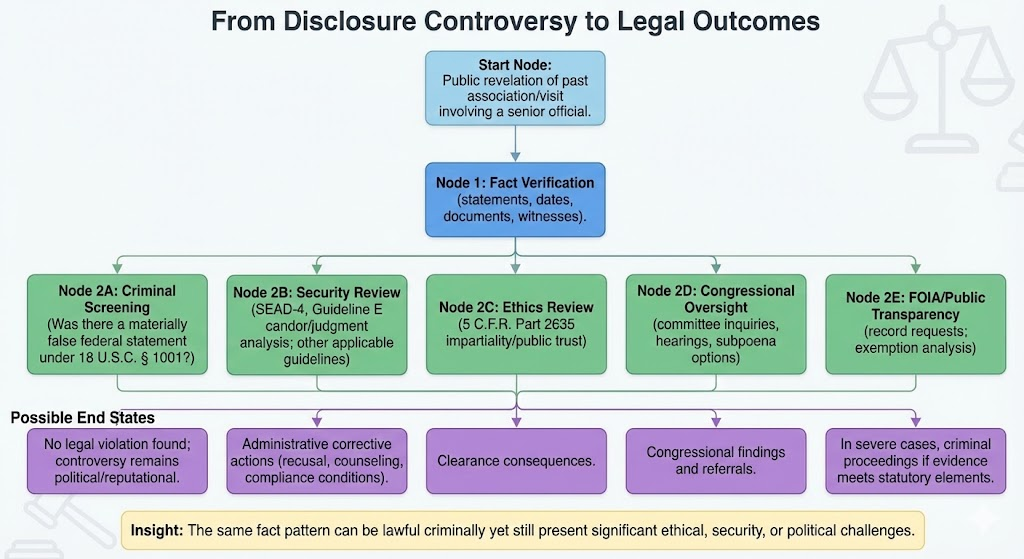
Insight:
The same fact pattern can be lawful criminally yet still produce serious ethics and governance consequences.
13) Discover-focused editorial execution: how to publish this responsibly
You asked for Google Discover-oriented strategy in English.
Here is a legally safe, high-authority implementation model:
Use short paragraphs (2–3 lines) for mobile readability.
Keep headings specific and non-sensational.
Use one clear legal claim per paragraph and support it with a source or statute reference.
For visuals, use at least 3–4 images with accurate captions and context labels:
- Howard Lutnick (licensed editorial image)
- U.S. Supreme Court building (symbolic rule-of-law context)
- U.S. Department of Commerce building (institutional context)
- Generic legal scales/documents image (conceptual legal framing)
Add descriptive alt text such as:
“U.S. Cabinet official under Senate scrutiny over prior association disclosures” rather than emotional or accusatory wording.
For your author authority section, a compliant and credible line would read:
Author Bio (example):
Rehman Wada is a legal affairs writer focused on U.S. governance, administrative law, and public-accountability systems. His work emphasizes primary-source research, statute-level analysis, and clear legal explainers for both general readers and professionals.
14) Practical legal reading of this controversy: what can be said now
At the present public-reporting stage, the strongest legally defensible statement is narrow:
- Acknowledged past association can trigger scrutiny.
- Scrutiny alone does not establish criminal liability.
- Disclosure integrity is typically the legal pivot in vetting-related controversies.
- Ethics and public-trust frameworks can generate serious consequences even without charges.
That is not hedging; it is how U.S. law is structured.
Legal systems are built to separate proof of crime from proof of poor judgment, and proof of poor judgment from political accountability.
Commonly Asked Questions
Is visiting Epstein’s island, by itself, a federal crime?
No. A visit, standing alone, is not automatically a federal offense. Criminal exposure would depend on additional conduct that satisfies specific statutory elements. That is why legal analysis focuses on what happened, what was disclosed, and whether any federal statement was knowingly and materially false.
If an official omitted a relevant relationship on SF-86, is that automatically prosecution-worthy?
Not automatically. Prosecutors would still need evidence of materiality and knowing/willful falsity under federal law. Innocent mistakes, ambiguous question scope, and corrected disclosures can matter. But deliberate concealment of material facts is treated seriously in federal vetting contexts. (Legal Information Institute)
What does “appearance of impropriety” mean in practice?
It means federal ethics analysis asks whether a reasonable person, aware of the facts, would question an official’s impartiality or integrity. It is an ethics-and-trust standard, not a criminal conviction standard. (eCFR)
Can the Senate investigate again after confirmation?
Yes. Committees generally have ongoing oversight authority and subpoena tools, subject to chamber and committee rules. Whether they act is a political and evidentiary question, not merely a legal possibility question. (congress.gov)
Not all. FOIA creates a strong disclosure mechanism, but agencies may lawfully withhold records under statutory exemptions (for example, national security, privacy, or law-enforcement protections). (Department of Justice)
Does this type of controversy usually end in criminal court or in administrative/political channels?
Most often, these matters move first through administrative, ethics, and oversight channels. Criminal cases require a separate evidentiary threshold and prosecutorial judgment.
Conclusion: the real verdict is about governance discipline
The legally precise conclusion today is this: public reporting describes an acknowledged past visit and contested narrative consistency, but that does not by itself prove criminal conduct. (TIME)
Still, in modern federal governance, the issue is larger than criminal law.
High office demands rigorous disclosure, consistent candor, and decisions that protect institutional trust.
The U.S. system is designed so that even when criminal statutes are not triggered, ethics rules, clearance standards, congressional oversight, and transparency law can still impose real accountability.
That is the enduring lesson for public officials and the public alike:
Past actions may not always create criminal liability, but they can materially affect present duty, credibility, and the integrity of governance.
And for readers, the policy question worth debating is exactly the one you raised:
Should federal vetting standards and post-confirmation disclosure expectations become stricter for senior officials in trust-sensitive roles?
Editorial legal note
This article is for general informational purposes and does not constitute legal advice. Specific cases depend on jurisdiction, facts, records, and procedural posture. For legal advice, consult a licensed U.S. attorney with relevant federal administrative, ethics, or national-security experience.