The Tumbler Ridge Shooting: A Legal Analysis of Liability, Criminal Charges, and Duty of Care

Disclaimer: This article is for informational purposes only and does not constitute legal advice. Laws vary by jurisdiction, and individuals affected by a violent incident should consult a licensed attorney in their province or territory for guidance specific to their situation.
Contents
- 1 Introduction: The Legal Gravity of the Tragedy
- 2 1. Criminal Charges & The Youth Criminal Justice Act (YCJA)
- 3 2. Civil Liability: Can the School Be Sued?
- 4 3. Parental Liability & Gun Storage Laws
- 5 4. Canada’s Gun Control Context & Bill C-21
- 6 5. Victim Compensation & Support
- 7 7. The Long Legal Road Ahead
- 8 Commonly Asked Questions
- 9 Conclusion: Accountability, Responsibility, and Prevention
Legal Quick Facts
- • Two Legal Paths: The incident triggers both criminal prosecution (State vs. Accused) and potential civil lawsuits (Victims vs. School/Parents).
- • Youth Offenders: If the suspect is a minor, the Youth Criminal Justice Act protects their identity and limits sentencing severity.
- • School Liability: Schools have a “Duty of Care,” but liability is not automatic. Negligence must be proven (e.g., ignoring specific threats).
- • Parental Responsibility: Parents can face criminal charges for “Unsafe Storage of Firearms” and civil lawsuits for negligent supervision.
Introduction: The Legal Gravity of the Tragedy
The tragic shooting in Tumbler Ridge, British Columbia, has sent shockwaves through the local community and beyond. While law enforcement agencies continue to investigate and confirm the facts, events of this magnitude inevitably trigger complex legal consequences that unfold over months—or even years.
In Canada, incidents involving serious violence—particularly those connected to schools—activate two parallel legal pathways. The first is criminal prosecution, in which the Crown seeks to hold the alleged offender accountable under the Criminal Code of Canada. The second is civil litigation, where victims and their families may pursue financial compensation against institutions, parents, or other parties whose alleged negligence contributed to the harm.
Understanding these legal mechanisms is essential for the public, policymakers, and professionals seeking clarity. This article provides a comprehensive legal analysis of potential criminal charges, the application of the Youth Criminal Justice Act (YCJA) if the accused is a minor, civil liability exposure for schools under tort law, parental responsibility under Canadian firearms legislation, and the broader policy implications of Canada’s gun control framework.
1. Criminal Charges & The Youth Criminal Justice Act (YCJA)
The Criminal Law Framework in Canada
In Canada, serious violent offences are governed by the Criminal Code of Canada. The Code establishes categories of homicide, assault-related offences, and firearm-related crimes, along with corresponding sentencing structures.
Where a fatality occurs, the Crown may consider:
- First-Degree Murder (Section 231): Requires proof of planning and deliberation. A conviction carries a mandatory life sentence.
- Second-Degree Murder: Intentional killing without proven premeditation.
- Attempted Murder (Section 239): Intent to kill without a completed homicide.
- Aggravated Assault (Section 268): Wounding, maiming, disfiguring, or endangering life.
It is important to emphasize that formal charges depend on the findings of law enforcement and prosecutorial review. Public commentary should avoid speculation about facts not yet confirmed.
Adult vs. Youth Offenders
If the alleged shooter is under the age of 18, proceedings fall under the Youth Criminal Justice Act (YCJA). This statute reflects Parliament’s intention to balance accountability with rehabilitation.
Key principles of the YCJA include:
- Protection of Identity: The identity of a youth accused is generally protected from publication (Section 110).
- Rehabilitation Focus: Sentences emphasize reintegration rather than purely punitive measures.
- Proportional Accountability: Youth are held accountable in a manner proportionate to their age and maturity.
Sentencing Differences: Adult vs. Youth
Under Canadian law, an adult convicted of first-degree murder receives:
- Life imprisonment, with 25 years before parole eligibility.
A youth convicted of the same offence faces:
- A maximum youth sentence, typically up to 10 years (including custody and community supervision), depending on age and circumstances.
- In exceptional cases, the Crown may apply for an adult sentence for a youth aged 14 or older (depending on provincial designation). Courts must determine whether a youth sentence would be insufficient to hold the offender accountable.
Additionally, Canada provides for Intensive Rehabilitative Custody and Supervision (IRCS) in cases involving serious violent offences committed by youth with mental health considerations.
The legal system’s structured approach reflects Canada’s constitutional commitment to fundamental justice under Section 7 of the Charter of Rights and Freedoms.
2. Civil Liability: Can the School Be Sued?
While criminal proceedings focus on punishment and public safety, civil law addresses compensation for harm.
The Concept of Duty of Care
Under Canadian tort law, schools owe students a legally recognized “duty of care.” Courts have often described this as analogous to the responsibility of a prudent parent—known in legal tradition as parens patriae.
This principle requires school boards and administrators to take reasonable steps to protect students from foreseeable harm.
In British Columbia, the School Act establishes governance responsibilities for public schools, while broader negligence principles arise from common law.
Elements of Negligence
To succeed in a civil claim against a school board, plaintiffs must generally prove:
- A duty of care existed.
- The school breached the standard of care.
- The breach caused the injury.
- Damages resulted.
The central issue often becomes foreseeability.
Was there evidence of threats, prior violent behavior, or bullying reports that were ignored? Did administrators follow established threat assessment protocols?
Courts evaluate whether the harm was reasonably foreseeable and whether the institution’s response was reasonable under the circumstances—not whether the outcome could have been prevented with hindsight.
Occupiers’ Liability
Under the Occupiers Liability Act, property occupiers—including school boards—must ensure that premises are reasonably safe for visitors.
This does not impose strict liability. Rather, it requires reasonable care in maintaining security measures, supervision policies, and safety protocols.
Legal Comparison Table: Criminal vs. Civil Proceedings
| Aspect | Criminal Proceedings | Civil Litigation |
|---|---|---|
| Governing Law | Criminal Code of Canada | Common Law Tort Principles & Provincial Statutes |
| Initiated By | Crown Prosecutor | Victims or Families |
| Burden of Proof | Beyond a reasonable doubt | Balance of probabilities |
| Objective | Punishment & deterrence | Financial compensation |
| Possible Outcomes | Imprisonment, probation | Monetary damages |
| Duration | Months to years | Often multiple years |
3. Parental Liability & Gun Storage Laws
Criminal Responsibility Under Firearms Legislation
Canada maintains strict firearm storage requirements under the Firearms Act and related regulations.
Owners must:
- Store firearms unloaded.
- Secure them with a locking device.
- Store ammunition separately.
Failure to comply can result in charges such as “Unsafe Storage of a Firearm” under the Criminal Code.
If a firearm used in a crime was improperly stored, parents or lawful owners may face criminal prosecution—even if they did not directly participate in the offence.
Civil Liability: Negligent Supervision
Separate from criminal charges, families of victims may pursue civil claims against parents under theories of:
- Negligent supervision.
- Failure to secure dangerous property.
Canadian courts require proof that parents knew—or ought to have known—about the risk and failed to act reasonably. Civil liability depends heavily on factual evidence.
4. Canada’s Gun Control Context & Bill C-21
Canada’s firearms regime has undergone significant reform in recent years.
The Bill C-21 introduced measures including:
- A national handgun transfer freeze.
- Expanded red flag provisions allowing courts to remove firearms from individuals deemed a threat.
- Stronger penalties for firearms trafficking.
Policy debates often intensify following high-profile violent incidents. While legislative reform is a parliamentary function, incidents such as the Tumbler Ridge tragedy may influence future enforcement priorities or statutory amendments.
5. Victim Compensation & Support
Regardless of criminal or civil outcomes, victims in British Columbia may apply to the Crime Victim Assistance Program (CVAP).
Administered provincially, CVAP provides financial assistance for:
- Counseling services.
- Medical expenses.
- Lost income support.
- Funeral costs.
Importantly, compensation eligibility does not depend on a criminal conviction or civil judgment. The program recognizes the long-term psychological and financial impacts of violent crime.
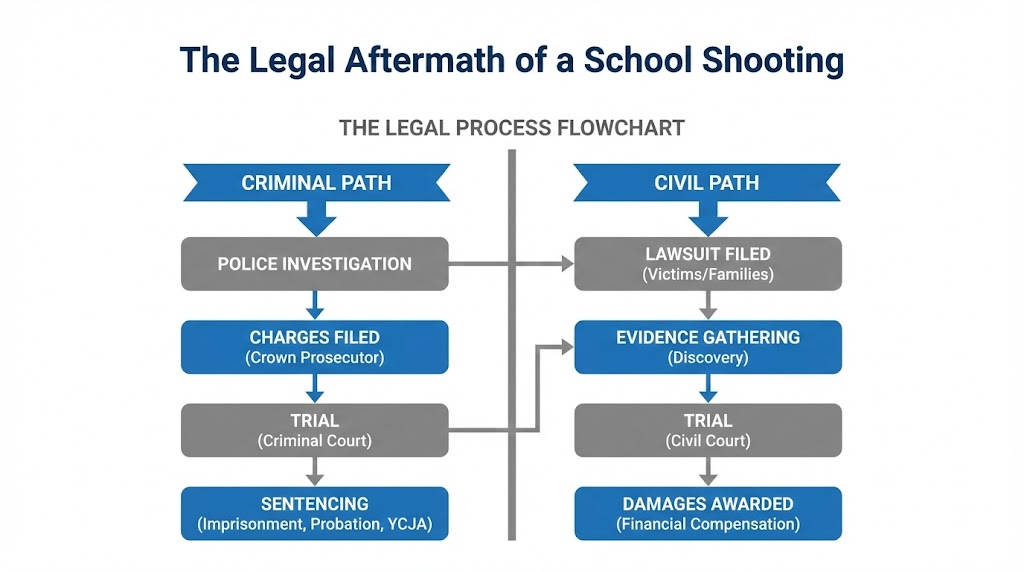
The two tracks proceed independently but may intersect where evidence overlaps.
7. The Long Legal Road Ahead
In the aftermath of a tragedy, the criminal justice system often moves deliberately. Forensic analysis, witness statements, and mental health evaluations require time. Civil litigation typically extends even longer due to complex evidentiary and procedural requirements.
While public attention may fade, legal proceedings frequently continue for years.
Families affected should consult experienced counsel in areas such as:
- Criminal defense.
- Personal injury litigation.
- Wrongful death claims.
- Firearms regulatory compliance.
(For further reading, see our related guides on Personal Injury Law and Criminal Defense Explained.)
Commonly Asked Questions
Can a school automatically be held liable for a shooting on its premises?
No. Canadian courts require proof of negligence. Plaintiffs must show that the harm was foreseeable and that the school breached its duty of care.
If the accused is under 18, can their name be published?
Generally, no. The Youth Criminal Justice Act prohibits publication of identifying information, subject to limited exceptions.
Can parents face jail time if their firearm was used?
Yes, if prosecutors prove unsafe storage or other regulatory violations under the Criminal Code or Firearms Act.
How long do civil lawsuits take?
Civil cases involving institutional defendants can take several years due to complex evidence and procedural requirements.
Are victims compensated even if no lawsuit is filed?
Yes. Programs like CVAP in British Columbia provide financial assistance independent of civil proceedings.
Conclusion: Accountability, Responsibility, and Prevention
The Tumbler Ridge shooting represents not only a profound human tragedy but also a multifaceted legal event. Canadian law addresses such incidents through criminal prosecution, youth justice principles, civil negligence standards, firearm regulation, and victim compensation frameworks.
While police investigations and court proceedings form the visible response, civil accountability and regulatory reform often shape long-term change.
Those directly impacted should seek guidance from licensed legal professionals to understand their rights and options.
Disclaimer: This article is for informational purposes only and does not constitute legal advice. Individuals should consult a qualified lawyer licensed in their jurisdiction for advice specific to their situation
