Bridge Collapse Lawyer: Seeking Justice & Compensation for Structural Failures

Contents
- 1 Introduction: When Infrastructure Fails, Legal Strategy Must Be Stronger Than Ever
- 2 Understanding Liability: Who Is Responsible for a Bridge Collapse?
- 3 Common Causes of Structural Failures
- 4 Legal Challenges in Bridge Collapse Cases
- 5 Types of Compensation You Can Recover
- 6 Key Legal Comparison Table: Bridge Collapse Claims at a Glance
- 7 Why Engineering Expertise Matters in Your Legal Team
- 8 State Deadline Snapshot: Why Location Changes Your Legal Rights
- 9 Steps to Take Immediately After a Bridge Accident
- 10 Frequently Asked Questions
- 10.1 How long do bridge-collapse lawsuits take?
- 10.2 Can I sue the state for a bridge collapse?
- 10.3 What is the average settlement for a structural failure case?
- 10.4 Is a bridge collapse automatically negligence?
- 10.5 Do I need experts in my case?
- 10.6 Should I speak to the insurance company before hiring counsel?
- 11 Conclusion: Justice in Structural-Failure Cases Requires Speed, Precision, and Technical Depth
Introduction: When Infrastructure Fails, Legal Strategy Must Be Stronger Than Ever
A bridge collapse is one of the most devastating forms of public-infrastructure harm. In a matter of seconds, ordinary life—commuting, work travel, emergency access, freight movement—can turn into mass-casualty chaos, long-term disability, wrongful death claims, and severe economic disruption for families and communities. The Baltimore Francis Scott Key Bridge disaster forced the country to confront this reality again, and federal investigators later identified preventable safety failures and risk-management gaps that raised major legal questions about who should be held accountable. (ntsb.gov)
From a legal standpoint, bridge-collapse litigation is not just “another personal injury case.” It is often a high-complexity, multi-defendant, high-evidence dispute involving engineering standards, public-agency decision-making, maritime or trucking factors, government-claim rules, insurance layering, and expert-heavy causation battles. In many cases, a general personal injury approach is not enough. Victims and families need counsel that can integrate tort law, construction law, government liability rules, and technical engineering analysis in one coordinated strategy.
This article explains how liability is analyzed in structural-failure cases, why these claims are uniquely difficult, what compensation may be available, and what victims should do immediately to protect their rights. It is written for both the U.S. general public and legal professionals seeking a practical, authority-focused framework under U.S. law.
A crucial reminder at the outset: legal outcomes vary significantly by jurisdiction and fact pattern. If you or a loved one was affected by a bridge collapse, consult a licensed attorney in your state immediately to evaluate deadlines, immunity rules, and evidence preservation obligations.
Legal Accuracy Note: This guide is written for educational purposes using publicly available legal frameworks and infrastructure safety references. It does not create an attorney-client relationship and is not a substitute for state-specific legal advice.
Readers seeking broader legal context should also review our guides on Personal Injury Law, Construction Negligence, and Public Infrastructure Safety Litigation. Together, these resources explain how duty of care, breach analysis, and damages valuation interact across private and government defendants in high-impact injury claims.
Understanding Liability: Who Is Responsible for a Bridge Collapse?
Bridge-collapse liability is rarely singular. In most catastrophic-structure cases, responsibility is distributed across multiple actors whose duties overlapped over years: government owners, engineering consultants, construction firms, maintenance contractors, and potentially third-party operators (such as vessels or heavy trucks). In legal practice, the strongest plaintiff cases are built by mapping each defendant’s duty, breach, causation role, and insurance/indemnity position.
Government entities: DOTs, state agencies, and municipal owners
Many bridges are publicly owned or managed by state transportation authorities, municipal departments, toll agencies, or quasi-public entities. These bodies are generally responsible for inspection programs, maintenance budgets, risk assessments, retrofit planning, warning systems, and hazard mitigation. The legal theory against public owners is typically negligence, negligent maintenance, failure to warn, or failure to adopt reasonable protective measures given known risks.
However, suing a government entity introduces sovereign immunity constraints and special pre-suit procedures. At the federal level, the Federal Tort Claims Act (FTCA) provides a limited waiver of immunity for certain negligence claims, but with important exceptions and administrative-exhaustion requirements. (congress.gov) States have their own tort-claims statutes, notice requirements, and damage caps. Missing a statutory notice deadline can destroy an otherwise valid case.
In major failures, public-entity exposure can also involve allegations that the agency ignored prior recommendations, deferred critical upgrades, or failed to complete vulnerability assessments despite evolving risk conditions. Recent federal investigative findings in the Baltimore context highlighted how risk modeling and protective planning can become central to post-collapse accountability analysis. (ntsb.gov)
Construction companies and design-build contractors
If the collapse has roots in construction-phase error—improper sequencing, rebar placement defects, concrete quality failures, nonconforming welds, or substitution of substandard materials—general contractors and key subcontractors can face significant civil liability. Plaintiffs often pursue negligence, negligence per se (where code/regulatory violations apply), breach of contract-based third-party theories in some contexts, and product/material defect claims where appropriate.
Construction defendants typically argue compliance with plans/specs, owner-directed changes, acceptance of work, or superseding negligence by maintenance entities years later. Plaintiffs counter through forensic reconstruction, change-order history, QA/QC records, and expert testimony tying original defects to failure mode.
Engineering firms and structural consultants
Design professionals are frequently a central target in collapse litigation because calculation errors, load-path mistakes, inadequate redundancy assumptions, flawed fatigue modeling, or failure to account for foreseeable collision/hydrologic/seismic stress can produce catastrophic consequences. Engineering malpractice standards are expert-defined and heavily technical: what would a reasonably prudent structural engineer have done under similar circumstances at the time of design and subsequent review cycles?
The defense typically emphasizes adherence to then-applicable codes and peer review. Plaintiffs often focus on known hazards, outdated assumptions, ignored warning indicators, and failure to recommend necessary retrofit once risk escalated.
Maintenance and inspection contractors
Where public owners outsource inspection cycles or maintenance execution, third-party contractors may be liable for negligent inspection, incomplete reporting, inaccurate condition scoring, or failure to flag urgent hazards. These claims often hinge on document-heavy proof: inspection logs, photo archives, corrosion measurements, crack-mapping progression, deferred-work orders, and communications about budget impacts.
A recurring litigation theme is “paper compliance vs. real safety.” Defendants may show checklists were completed; plaintiffs may show the checks were superficial, mis-scored, or disconnected from actionable repair planning.
Third-party logistics actors: vessels, trucking fleets, and cargo operations
Some bridge failures are triggered by external impact events rather than internal deterioration alone—ship allisions, barge strikes, oversize-load collisions, or overweight truck operations. In those cases, maritime law, commercial-transport regulations, operator training, vessel/equipment maintenance, route controls, and dispatch decisions can all come into play. In the Key Bridge disaster, the NTSB reported findings regarding vessel electrical failure and broader preventability factors, illustrating how transportation-operator negligence can intersect with infrastructure-protection shortcomings. (ntsb.gov)
Key Takeaway: Bridge collapse cases almost always involve multiple defendants. A successful claim depends on identifying each party’s specific duty, breach, and causal role—public agencies, private contractors, engineering firms, and third-party operators.
Common Causes of Structural Failures
Bridge collapses typically emerge from cumulative risk, not a single dramatic error. Litigation strategy improves when counsel and experts distinguish “trigger event” from “systemic contributors.”
Design defects and underestimation of foreseeable loads
A design can be code-compliant at one point in time yet still become unsafe if assumptions age poorly and hazards evolve. Common design-related allegations include inadequate impact resistance, insufficient redundancy, poor fatigue detailing, underestimation of dynamic loads, and failure to model modern freight or vessel profiles. The legal question is whether reasonable professionals should have anticipated and mitigated the risk, especially after new data or standards emerged.
Neglected maintenance and inspection blind spots
Corrosion, spalling, joint deterioration, bearing failure, and metal fatigue are often progressive and detectable before catastrophic failure—if inspection quality is robust and repair budgets are actually deployed. Negligence exposure expands when agencies or contractors identify problems but repeatedly defer action without defensible risk controls.
ASCE’s national infrastructure analysis has consistently emphasized that condition, resilience, and sustained investment remain pressing concerns even amid incremental improvement, underscoring why deferred maintenance can become a legal flashpoint after major incidents. (asce.org)
Overloading and operational misuse
Bridges are designed with load assumptions and regulatory operating envelopes. Chronic overweight traffic, unauthorized loads, or poor enforcement of posted limits can accelerate fatigue and damage. In litigation, black-box data, weigh-station records, permit files, and telematics may become critical evidence.
Flood scour, extreme weather, seismic events, temperature cycling, and salt exposure can materially change structural risk. A key legal issue is whether owners and engineers reasonably adapted maintenance and retrofit programs to foreseeable environmental realities. The standard is not perfection; it is reasonableness under known or knowable risk conditions.
Construction-era defects that emerge later
Some structural problems remain latent for years before cascading into visible failure. Plaintiffs must then navigate statutes of repose, discovery rules, and expert causation complexities: was the collapse caused by original defect, poor maintenance, external impact, or a blend?
Legal Challenges in Bridge Collapse Cases
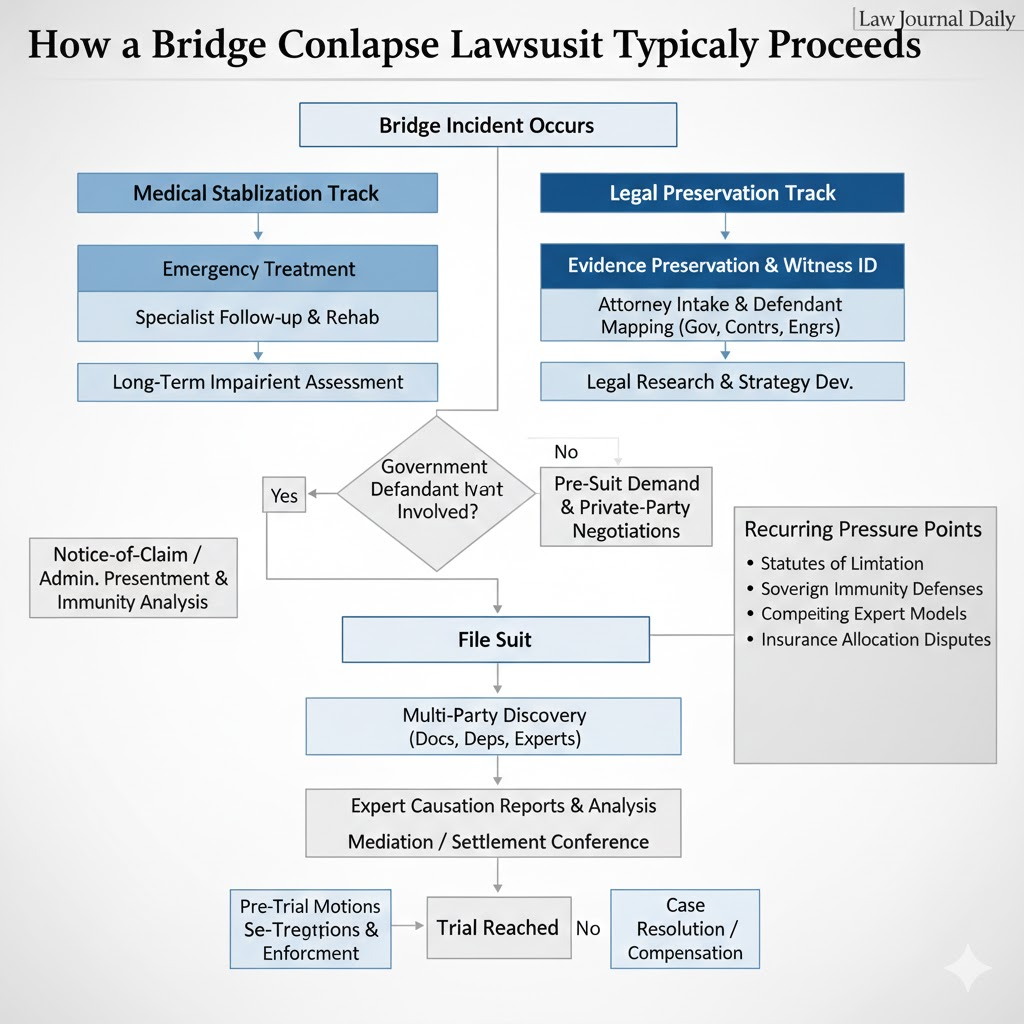
Bridge-collapse lawsuits are among the most procedurally demanding cases in civil practice. Victims often face a race against deadlines, immunity defenses, and evidence decay.
Sovereign immunity and government-claims procedure
The doctrine of sovereign immunity means you generally cannot sue government entities unless a statute authorizes it and you follow strict procedural rules. At the federal level, FTCA claims require administrative presentment before suit, and certain categories remain excluded by statutory exceptions. (congress.gov) State and local claims similarly require compliance with notice-of-claim statutes, shorter timelines, and specific filing formalities.
For victims, this is not a technicality—it is outcome determinative. If counsel is retained late, a potentially strong case can be procedurally barred.
Statute of limitations and statutes of repose
Every jurisdiction imposes filing deadlines for personal injury and wrongful death claims. Some claims accrue on injury date; others may involve discovery-rule disputes for latent defects. Construction-related claims may face statutes of repose that cut off liability after a fixed period regardless of discovery.
In multi-defendant cases, different deadlines may apply to different parties (government vs. private defendants), making early case triage essential.
Multi-defendant litigation and allocation battles
Bridge collapse claims frequently include public owners, contractors, engineers, transport operators, and insurers—each represented by sophisticated defense teams. Defendants will often cross-claim against one another for contribution and indemnity, contest apportionment percentages, and seek to shift primary fault. Plaintiffs’ counsel must stay focused on complete factual development rather than allowing defense infighting to dilute victim recovery.
Technical causation and expert-war dynamics
These cases are expert-intensive from day one: structural engineering, materials science, maritime operations, human factors, occupational safety, economic damages, vocational impact, and life-care planning. Courts often gatekeep expert testimony under evidentiary standards, and weak expert methodology can cripple a claim.
Insurance complexity and public-risk financing
Policy stacks can include commercial general liability, professional liability, maritime policies, excess layers, public risk pools, and contractor wrap programs. Coverage disputes may run in parallel with liability litigation, affecting settlement timing and structure.
Key Takeaway: Deadlines and immunity rules can defeat strong claims if you file late or in the wrong format. Early counsel is not optional in structural-failure litigation—it is case-preserving.
Types of Compensation You Can Recover
Compensation in bridge-collapse litigation depends on injury severity, liability findings, jurisdictional law, available defendants, and applicable caps. While no attorney can ethically promise a fixed result, damage categories are generally well established.
Economic damages
Economic losses are quantifiable financial harms. They usually include emergency transport, hospitalization, surgeries, medications, rehabilitation, assistive devices, home modifications, and projected future medical care. For working victims, damages may include past lost income, reduced earning capacity, and benefits loss. Catastrophic injury claims often require forensic economists and vocational experts to project lifetime impact.
Property losses may also be recoverable when vehicles, equipment, or business assets were destroyed in the collapse event.
Non-economic damages
Non-economic damages address human loss that does not appear on a receipt: physical pain, mental suffering, trauma-related conditions, loss of enjoyment of life, and relational harm (including loss of consortium in qualifying jurisdictions). Defense counsel often contests valuation aggressively, so plaintiffs need thorough medical, psychiatric, and narrative evidence to present a credible life-impact story.
Wrongful death and survival damages
When a collapse causes fatalities, eligible family members may pursue wrongful death claims for financial dependency losses and, in many states, loss of companionship and services. Separate survival actions may recover damages the decedent could have claimed had they lived (subject to state law). Funeral and burial costs are typically included where permitted.
Punitive damages in structural-failure contexts
Punitive damages are not automatic and generally require proof beyond ordinary negligence—such as willful, wanton, reckless, or conscious disregard conduct under state law. Some jurisdictions restrict or cap punitive recovery, and public entities may be immune from punitive exposure. Still, where evidence shows intentional concealment, deliberate noncompliance, or extreme indifference to known danger, punitive theories may be viable against private actors.
Key Takeaway: There is no universal payout formula. Real case value depends on injury severity, liability proof, jurisdiction rules, defendant solvency, and available insurance/public compensation channels.
Key Legal Comparison Table: Bridge Collapse Claims at a Glance
| Legal Dimension | Private Defendants (Contractor/Engineer/Operator) | Government Defendants (State/Local/Federal Entity) | Practical Impact for Victims |
|---|---|---|---|
| Ability to Sue | Generally available under negligence/product/professional liability theories | Limited by sovereign immunity waivers and tort-claims statutes | Early legal screening is critical to identify proper causes of action |
| Pre-Suit Requirements | Usually standard pre-suit investigation; no universal notice statute | Often strict notice-of-claim or administrative presentment requirements (e.g., FTCA at federal level) | Missed notice deadlines can bar claims entirely |
| Deadlines | Standard statutes of limitations; may involve repose statutes in construction cases | Often shorter or different deadlines than private claims | Counsel must calendar multiple limitation frameworks |
| Damages Exposure | Compensatory damages commonly available; punitive may be available depending on state law and conduct | Compensatory may be limited by statutory caps; punitive often barred | Case valuation can differ sharply by defendant type |
| Defenses | Comparative fault, superseding cause, code-compliance defenses | Immunity exceptions, discretionary-function arguments, statutory protections | Plaintiffs need tailored strategy, not one-size-fits-all pleadings |
| Evidence Emphasis | Design docs, QC logs, maintenance files, corporate communications | Agency policies, inspection regimes, funding decisions, risk assessments | Document preservation and public-record acquisition are central |
| Settlement Dynamics | Insurance limits and coverage disputes drive negotiation | Public-fund considerations and statutory constraints affect negotiation pace | Resolution may be slower and procedurally heavier |
Why Engineering Expertise Matters in Your Legal Team
In bridge-collapse litigation, engineering is not a side note; it is the spine of the case. Liability often turns on failure mode: what physically happened first, what should have been predicted, and what protective interventions were feasible before the incident.
A sophisticated legal team works with structural engineers, materials experts, and accident reconstruction professionals from the earliest phase. Their job is to translate technical causation into legally admissible proof. That includes preserving debris evidence, modeling load behavior, analyzing fracture patterns, interpreting inspection records, and identifying points where industry-standard action should have occurred but did not.
This interdisciplinary method is also essential for defeating common defense narratives: “unavoidable accident,” “sole third-party fault,” or “act of God.” Engineering experts can test those claims against data and standards rather than rhetoric.
Federal safety frameworks and technical sources matter here. For construction-related jobsite dimensions, OSHA standards inform baseline safety obligations in relevant contexts. (osha.gov) For infrastructure condition and resilience context, ASCE publications provide useful background for risk discussions (though they do not replace case-specific expert testimony). (asce.org)
State Deadline Snapshot: Why Location Changes Your Legal Rights
Bridge-collapse claims are highly jurisdiction-specific. Filing windows, notice rules, and immunity exceptions can differ sharply by state and by defendant type (private vs. government). The table below is a general educational snapshot, not legal advice. Always verify current law with local counsel because statutes can change and exceptions may apply.
| State | Personal Injury (General Rule) | Wrongful Death (General Rule) | Government Claim Notes (High-Level) |
|---|---|---|---|
| California | Commonly 2 years | Commonly 2 years | Claims against public entities often require an early administrative claim (commonly much shorter than civil filing deadlines). |
| New York | Commonly 3 years (injury) | Commonly 2 years (wrongful death) | Public authority/municipal claims may involve notice-of-claim requirements and shorter procedural windows. |
| Texas | Commonly 2 years | Commonly 2 years | Government-related claims may be limited by the Texas Tort Claims framework and notice rules. |
| Florida | Commonly 2 years (many negligence contexts) | Commonly 2 years | Sovereign immunity statutes and notice conditions can alter procedure and damages exposure. |
Editorial note to place under table:
“Deadlines may be tolled, shortened, or modified by specific facts, defendant identity, and statutory updates. Confirm current law before relying on any summary.”
Steps to Take Immediately After a Bridge Accident
The first 24 to 72 hours after a bridge incident can determine both medical and legal outcomes. Families often underestimate how quickly evidence is lost and narratives harden.
First, prioritize emergency medical care. Even if injuries seem minor, delayed complications are common in high-impact events. Medical records also become foundational evidence linking trauma to the incident.
Second, preserve evidence deliberately. Keep photographs, videos, clothing, vehicle data, dashcam files, medical paperwork, employer wage documentation, and all communications with adjusters or investigators. If possible, document the timeline while memory is fresh.
Third, identify witnesses early. Contact details for bystanders, co-workers, first responders, and nearby businesses can be decisive, especially when official findings take months.
Fourth, avoid recorded statements to opposing insurers before legal review. Insurers are entitled to investigate, but early statements made under stress can be taken out of context and used to reduce claim value.
Fifth, consult qualified counsel quickly—especially if any government entity may be involved. The earlier an attorney issues preservation notices and evaluates notice deadlines, the stronger your legal position.
Pro Tip: Do not give a recorded insurance statement before legal review when catastrophic infrastructure failure is involved. Early “informal” statements are often used later to contest causation or reduce damages.
Frequently Asked Questions
How long do bridge-collapse lawsuits take?
Bridge-collapse lawsuits usually take longer than typical injury claims because they involve multiple defendants, dense technical evidence, and layered insurance/public-liability issues. In straightforward private-party injury matters, resolution may occur within a year or two, but major structural-collapse litigation can take several years—especially when government defendants, expert challenges, or consolidated proceedings are involved. Timing is affected by medical recovery (damages maturity), court scheduling, motion practice, and whether liability is hotly disputed.
Can I sue the state for a bridge collapse?
Potentially yes, but not in the same way you would sue a private company. State and local governments are protected by sovereign-immunity doctrines unless waived by statute. Most jurisdictions require strict pre-suit notices and procedural compliance, often on shorter timelines than ordinary negligence cases. At the federal level, the FTCA provides a limited pathway for certain claims against the United States, with administrative prerequisites and exceptions. (congress.gov) Because deadlines can be unforgiving, immediate consultation with counsel is essential.
What is the average settlement for a structural failure case?
There is no reliable universal “average” that predicts your case. Settlement value depends on severity of injuries, permanency, wage loss, liability strength, number of viable defendants, jurisdictional rules, statutory caps, and available insurance/funding sources. Catastrophic injury and wrongful death matters can involve substantial damages, but complex liability disputes can delay resolution and reduce recovery against certain defendants. Any lawyer promising a guaranteed figure early is usually overselling. A defensible estimate requires medical stabilization, liability evidence, and expert damages analysis.
Is a bridge collapse automatically negligence?
No. A collapse is evidence of potential negligence, but liability still requires legal proof of duty, breach, causation, and damages. Defendants may claim unforeseeable third-party impact, sudden mechanical failure beyond reasonable control, compliance with standards, or superseding causes. Plaintiffs must prove not only that something failed, but that the defendant(s) unreasonably caused or contributed to that failure.
Do I need experts in my case?
In almost every serious bridge-collapse case, yes. Courts and insurers expect expert-supported causation for structural mechanics, design/maintenance standards, injury prognosis, and economic damages. Without strong expert work, even emotionally compelling claims can underperform or fail.
Should I speak to the insurance company before hiring counsel?
You can report basic facts needed for claim opening, but avoid detailed or recorded statements until you obtain legal advice. Early statements made without full information can be used to challenge causation, injury severity, or fault allocation later.
Conclusion: Justice in Structural-Failure Cases Requires Speed, Precision, and Technical Depth
A bridge collapse is never just a headline—it is a legal, human, and civic emergency. Victims are often dealing with life-changing injuries, grief, employment disruption, and uncertainty while powerful institutions mobilize defense teams immediately. The legal system can deliver compensation and accountability, but only when claims are built with precision: timely filings, disciplined evidence preservation, rigorous expert analysis, and a strategy that understands both tort law and engineering reality.
If there is one practical takeaway, it is this: act early. Early action protects your health, your evidence, and your legal rights. In cases involving public infrastructure, delay can be fatal to a claim because procedural windows close quickly. In cases involving private contractors and operators, early technical investigation can prevent critical evidence loss and strengthen causation proof.
For families affected by a structural disaster, accountability is not just about compensation. It is also about public safety—forcing systemic corrections so the same preventable failures do not happen again.
If you or someone you love was impacted by a bridge collapse, speak with a licensed attorney in your jurisdiction as soon as possible to assess deadlines, potential defendants, and the full value of your claim.
Professional Guidance Reminder: Because structural-collapse claims often involve sovereign immunity, technical causation disputes, and multiple limitation periods, consult a licensed attorney promptly in your jurisdiction.