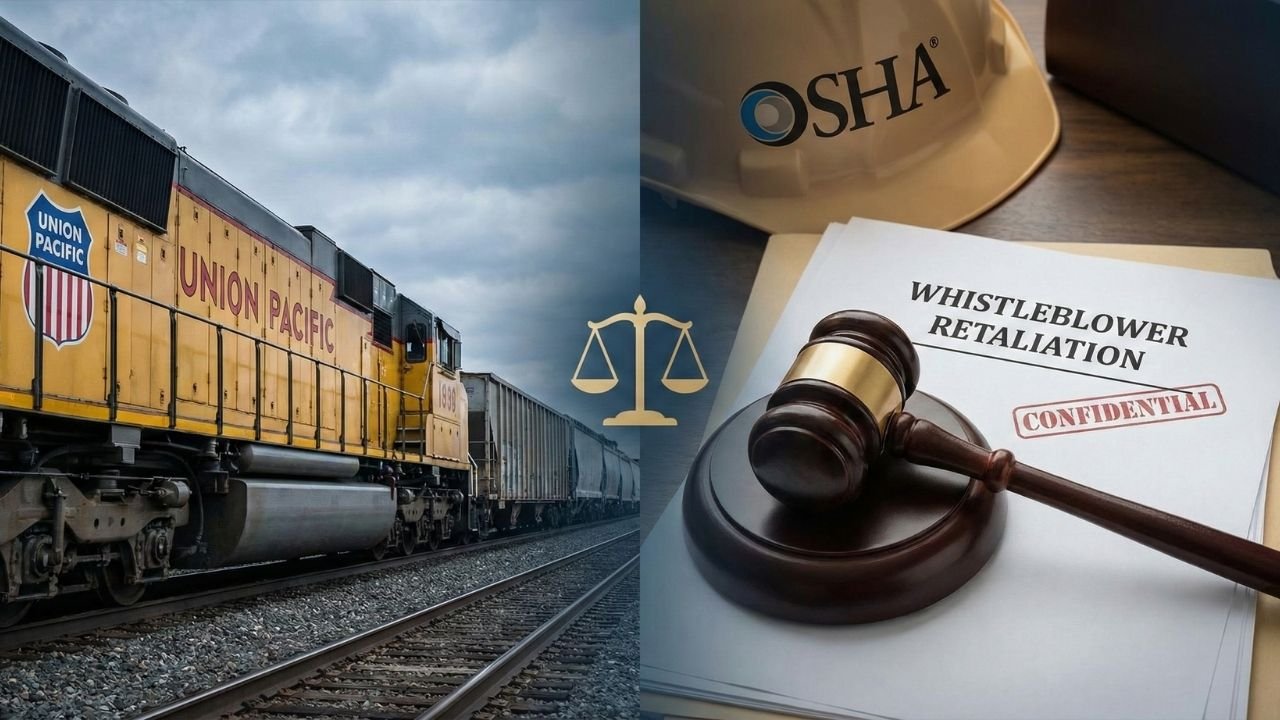
Union Pacific Railroad Whistleblower Retaliation: Legal Rights, OSHA Protections, and Recent Case Settlements

Contents
- 1 Introduction: A Growing Concern for Railroad Workers
- 2 What Constitutes Whistleblower Retaliation at Union Pacific?
- 3 The Role of the Federal Railroad Safety Act (FRSA)
- 4 Case Study and Recent Settlements (2025–2026 Updates)
- 5 How to File a Whistleblower Retaliation Claim
- 6 Potential Damages and Compensation
- 7 Visual Concept: Whistleblower Retaliation Legal Process Flow
- 8 Commonly Asked Questions
- 9 Conclusion: Protecting Your Rights as a Railroad Worker
- 10 Verified References
Introduction: A Growing Concern for Railroad Workers
For thousands of railroad workers across the United States, reporting safety violations is not just part of the job—it is a matter of life and death. Yet, an increasing number of Union Pacific Railroad employees have alleged that speaking up about safety hazards, injuries, or regulatory violations has resulted in retaliation rather than protection. From sudden terminations to aggressive disciplinary hearings, these alleged practices have raised serious legal and ethical questions within one of America’s largest freight rail networks.
Under federal law, specifically the Federal Railroad Safety Act (FRSA), 49 U.S.C. § 20109, railroad employees are legally protected when they report safety concerns, injuries, or violations of federal safety rules. These protections are enforced by the Occupational Safety and Health Administration (OSHA), a division of the U.S. Department of Labor. Workers who face retaliation may be entitled to significant legal remedies, including reinstatement, back pay, compensatory damages, and punitive damages.
A crucial legal requirement is the 180-day filing deadline. Under 29 C.F.R. § 1982.103(d), a railroad employee must file a whistleblower complaint within 180 days of the retaliatory act. Missing this deadline can result in permanent dismissal of the claim. To ensure you don’t miss any critical deadlines, you can use our Statute of Limitations Calculator to determine the exact filing window for your case. Early legal consultation is also essential to protect your rights.
What Constitutes Whistleblower Retaliation at Union Pacific?
Whistleblower retaliation occurs when an employer takes adverse action against an employee because the employee engaged in a protected activity. In the railroad industry, protected activities are clearly defined under federal law.
Protected Activities Under FRSA
Under 49 U.S.C. § 20109, the following activities are legally protected:
- Reporting a work-related injury or illness
- Reporting unsafe conditions such as defective tracks, faulty equipment, or unsafe operations
- Refusing to violate a federal safety law or regulation
- Cooperating with a federal safety investigation
- Requesting medical treatment after a workplace injury
Employees who engage in any of these actions cannot legally be disciplined, demoted, or terminated because of it.
Common Retaliation Tactics Observed in Practice
Although retaliation can be overt, it is often subtle and strategic. Based on OSHA enforcement records and litigation filings, common tactics allegedly used by employers—including Union Pacific in several cases—include sudden disciplinary charges following safety reports, excessive hearings designed to intimidate, managerial isolation or “ghosting,” and internal blacklisting that limits job opportunities.
Courts and administrative law judges often analyze the timing of these actions and whether a causal connection exists between the protected activity and the adverse employment action.
The Role of the Federal Railroad Safety Act (FRSA)
The Federal Railroad Safety Act is the primary statute governing railroad whistleblower protections in the United States. It was strengthened by the Implementing Recommendations of the 9/11 Commission Act of 2007, expanding both protections and available damages.
OSHA’s Enforcement Authority
The Occupational Safety and Health Administration (OSHA) enforces FRSA whistleblower provisions through its Whistleblower Protection Program. OSHA has the authority to investigate complaints, order preliminary reinstatement, award damages, and refer cases to administrative law judges.
If OSHA finds reasonable cause to believe retaliation occurred, it may order immediate reinstatement and compensation even before a full administrative hearing.
Statute of Limitations: The 180-Day Rule
A crucial legal requirement is the 180-day filing deadline. Under 29 C.F.R. § 1982.103(d), a railroad employee must file a whistleblower complaint within 180 days of the retaliatory act. Missing this deadline can result in permanent dismissal of the claim, making early legal consultation essential.
Case Study and Recent Settlements (2025–2026 Updates)
Recent cases between 2025 and early 2026 have significantly shaped the legal landscape for railroad whistleblower claims—especially those involving Union Pacific Railroad.
The Juan Garza Case (August 2025)
One of the most important recent whistleblower rulings involved Juan Garza, a locomotive engineer based in Texas.
Garza reported back pain following a minor rideshare accident. After reporting the injury—an action protected under FRSA—Union Pacific accused him of dishonesty and terminated his employment.
Following an investigation, OSHA ruled in August 2025 that Union Pacific’s actions constituted unlawful retaliation. In its official findings, OSHA described Union Pacific as a “serial violator” of federal whistleblower protections and ordered the company to pay $355,000 in total damages, including $150,000 in punitive damages.
The award included back pay, compensatory damages, and attorney’s fees—demonstrating the substantial liability employers may face under FRSA.
Granas v. Union Pacific Railroad Co. (Oregon Jury Verdict, 2025–2026)
Another landmark case, Granas v. Union Pacific Railroad Co., brought national attention to Union Pacific’s internal employment policies.
In late 2025, an Oregon jury awarded approximately $27 million in damages to a railroad worker who was removed from service under the company’s controversial “One Percent Policy.”
This policy allegedly mandated removal of any employee with even a 1% risk of future incapacitation due to injury. The presiding judge characterized this as a “blanket policy” that could violate federal disability and employment laws, including the Americans with Disabilities Act (ADA).
Although statutory caps may reduce the final payout, the case represents one of the largest jury verdicts involving railroad employment practices in recent years and highlights potential systemic issues.
How to File a Whistleblower Retaliation Claim
Filing a claim under FRSA requires both legal awareness and procedural accuracy.
Step 1: Document All Evidence
Employees should maintain thorough records of all communications, including emails, disciplinary notices, performance reviews, and medical documentation. These records can establish a timeline and demonstrate retaliatory intent.
Step 2: File a Complaint with OSHA
Whistleblower complaints must be filed through OSHA’s Whistleblower Protection Program. Filing can be done online, by mail, or through a regional OSHA office. The complaint must clearly state the protected activity and the adverse action taken.
Step 3: Consult a Specialized FRSA/FELA Attorney
Given the legal complexity, consulting a licensed attorney experienced in railroad law is strongly recommended. An attorney can ensure compliance with statutory deadlines, represent the employee during OSHA investigations, and litigate the case if necessary.
Potential Damages and Compensation
Successful whistleblower retaliation claims can lead to substantial financial recovery and equitable relief.
Compensation Overview
| Type of Remedy | Description | Legal Authority |
|---|---|---|
| Back Pay | Lost wages, bonuses, and benefits | 49 U.S.C. § 20109(e) |
| Reinstatement | Return to previous position with seniority | OSHA Orders |
| Compensatory Damages | Emotional distress and reputational harm | Federal Case Law |
| Punitive Damages | Up to $250,000 for willful misconduct | FRSA Statutory Provision |
| Attorney’s Fees | Paid by employer if employee prevails | Statutory Mandate |
Punitive damages are particularly significant in FRSA cases, as they serve to deter future misconduct by employers.
Visual Concept: Whistleblower Retaliation Legal Process Flow
[Visual Concept: A professional legal flowchart]
- Employee reports safety concern or injury
- Employer takes adverse action (discipline, termination, demotion)
- Employee files OSHA complaint within 180 days
- OSHA conducts investigation
- If merit found → preliminary reinstatement and damages ordered
- Case proceeds to Administrative Law Judge hearing
- Appeals may go to Administrative Review Board and federal courts
This structured process ensures multiple layers of review and legal protection for whistleblowers.
Commonly Asked Questions
Many railroad workers ask whether they can legally be terminated for reporting an injury. Under federal law, termination for reporting a work-related injury in good faith is unlawful retaliation under FRSA.
Another frequent concern is whether a worker can pursue both a personal injury claim and a retaliation claim. In many situations, the answer is yes. A worker may bring a claim under the Federal Employers’ Liability Act (FELA) for the injury itself and a separate FRSA claim for retaliation.
Workers also ask how long cases take. OSHA investigations may take several months, but full litigation—especially if appealed—can take years. However, preliminary reinstatement orders can provide relief during the process.
Finally, many employees worry about legal costs. Under FRSA, prevailing employees are entitled to recover attorney’s fees and litigation costs, making legal representation more accessible.
Conclusion: Protecting Your Rights as a Railroad Worker
Whistleblower protections are a cornerstone of federal railroad safety law. When employees speak up about unsafe conditions, they are protecting not only themselves but also the traveling public.
The latest 2025–2026 cases—including the $355,000 OSHA award to Juan Garza and the $27 million Granas verdict—demonstrate that the legal system is actively enforcing these protections.
If you are a Union Pacific employee and believe you have faced retaliation for reporting a safety issue or injury, you have rights under the Federal Railroad Safety Act. Acting promptly, preserving evidence, and consulting a qualified attorney can make the difference between losing your livelihood and securing justice.
Stay updated with LawJournalDaily for more legal insights on railroad workers’ rights.
Verified References
- Federal Railroad Safety Act (49 U.S.C. § 20109)
https://www.law.cornell.edu/uscode/text/49/20109 - OSHA Whistleblower Protection Program (FRSA Overview)
https://www.whistleblowers.gov/statutes/frsa - 29 C.F.R. Part 1982 – Procedures for FRSA Whistleblower Complaints
https://www.ecfr.gov/current/title-29/subtitle-B/chapter-XVII/part-1982 - U.S. Department of Labor Newsroom – OSHA Enforcement Releases
https://www.dol.gov/newsroom/releases/osha - Americans with Disabilities Act (42 U.S.C. § 12101)
https://www.law.cornell.edu/uscode/text/42/12101