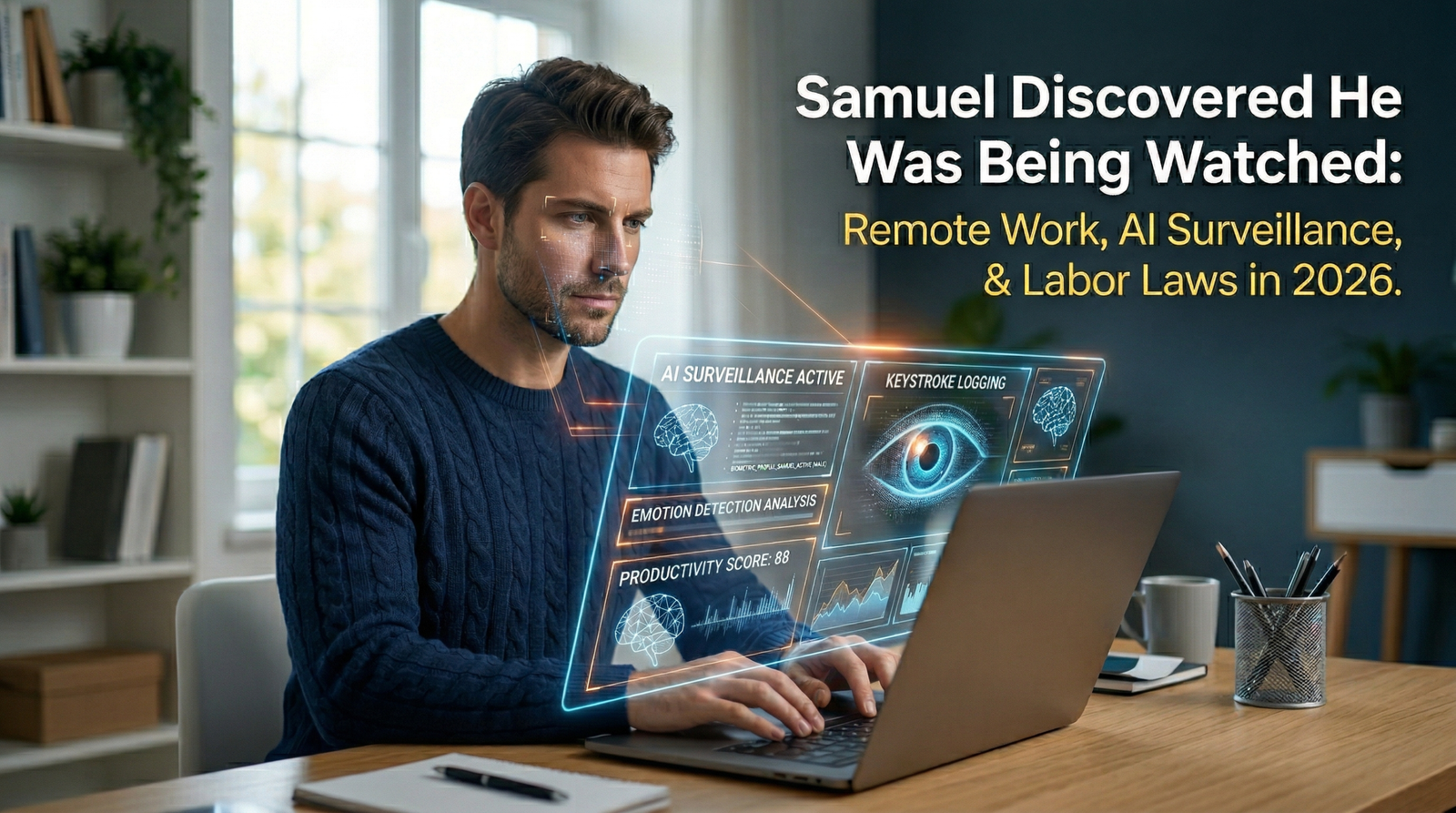
Employee Privacy and Remote Work Monitoring Laws in 2026: What Every Worker and Employer Must Know Right Now

Contents
- 1 A Real Story: The Day Sarah Discovered She Was Being Watched
- 2 1. What Is Remote Work Monitoring in 2026?
- 3 2. Federal Laws That Govern Employee Monitoring
- 4 3. The 2026 AI Monitoring Revolution — and the New Laws Around It NEW 2026
- 4.1 Illinois — HB 3773 (Effective January 1, 2026)
- 4.2 Texas — Responsible AI Governance Act (Effective January 1, 2026)
- 4.3 Colorado — AI Act, SB 24-205 (Effective June 30, 2026)
- 4.4 California — Multiple AI Laws (Effective 2025–2026)
- 4.5 New York City — Local Law 144
- 4.6 Michigan — Proposed Legislation (February 2026)
- 5 4. Federal vs. State Tension: The Trump AI Executive Order NEW 2026
- 6 5. Can Employers Monitor Personal Devices?
- 7 6. What Are Employees’ Legal Rights in 2026?
- 8 7. State-by-State Monitoring Laws: 2026 Edition
- 9 8. What Employers Are Legally Required to Disclose in 2026
- 10 9. Employee vs. Employer Rights: Side-by-Side (2026)
- 11 10. The Mental Health Cost of Constant Surveillance
- 12 11. How to Protect Yourself as a Remote Employee in 2026
- 13 12. Frequently Asked Questions (2026 Edition)
- 14 Conclusion: Your Rights Are Evolving — Stay Ahead of Them
A Real Story: The Day Sarah Discovered She Was Being Watched
Sarah had worked from her home office for two years without a single complaint. She was a committed marketing manager — answering emails before 8 a.m., joining every call, hitting every deadline. Then one afternoon, her manager sent her a message: “I noticed you were away from your computer for 47 minutes between 10 and 11 this morning. Can you explain?”
Her stomach dropped. She had stepped away to comfort her sick daughter. She had no idea that her employer had installed software on her company laptop that tracked mouse movements, keystrokes, and idle time. She felt violated. Surveilled. Like a suspect rather than a valued employee.
She is not alone. Since 2020, millions of remote workers have found themselves under digital surveillance — often without meaningful notice, and almost never with a full understanding of their legal rights. And in 2026, the situation has grown even more complex: artificial intelligence is now driving monitoring tools, new state laws are taking effect, and the federal government is pushing back against state-level AI regulation. The landscape is shifting fast.
So what is actually legal in 2026? And where does it end?
Short answer: Employers can legally monitor remote workers on company equipment in most circumstances — but the rules are tightening significantly, especially around AI-driven surveillance. Employees have more rights than ever before, and those rights now differ widely by state. This article lays it all out clearly.
1. What Is Remote Work Monitoring in 2026?
Remote work monitoring has evolved dramatically since 2020. What began as basic time-tracking software has become a sophisticated surveillance ecosystem powered increasingly by artificial intelligence. In 2026, employers can — and many do — deploy tools that:
- Log every keystroke and mouse movement, including idle time calculations
- Capture random or continuous screenshots of employee screens
- Record login and logout times across all platforms and apps
- Monitor email and chat messages on company platforms
- Track websites, downloads, and application usage
- Analyze webcam footage using facial recognition or emotion-detection AI
- Generate AI-powered productivity scores and behavioral profiles
- Use GPS to track company devices and vehicles
- Capture audio from calls and meetings for AI transcription and analysis
- Screen job applicants and evaluate performance using automated decision systems (ADS)
In my experience reviewing remote work policies, I have found that the latest generation of monitoring software does not just record data — it scores employees, flags anomalies, and in some cases triggers automated disciplinary workflows without any human review. That shift from observation to automated judgment is exactly what new 2026 laws are designed to address.
AI-powered monitoring tools — including those that score productivity, assess behavior, or influence performance reviews — are now subject to specific legal requirements in Illinois, Colorado, Texas, California, and New York City as of 2026. If your employer uses any automated or AI-driven evaluation tool, your rights have recently expanded. Read on.
2. Federal Laws That Govern Employee Monitoring
The United States still does not have a single comprehensive federal privacy law for employees. The framework remains a patchwork of overlapping statutes:
The Electronic Communications Privacy Act (ECPA)
The Electronic Communications Privacy Act remains the primary federal law on workplace electronic monitoring. It prohibits intentional interception of electronic communications — but includes a broad business exception when employees consent, typically through employment contracts or IT acceptable use policies. Once you sign that policy, ECPA protections on that device are largely waived.
The Fair Labor Standards Act (FLSA)
Under the Fair Labor Standards Act (FLSA), enforced by the U.S. Department of Labor, non-exempt employees must be paid for all hours worked — including time captured by monitoring software outside normal hours. In 2026, as AI monitoring tools track work around the clock, this has become an increasingly active area for wage claims. If your employer’s software shows you working 50 hours, they owe you for 50 hours.
The National Labor Relations Act (NLRA)
The NLRA protects your right to discuss wages, working conditions, and to organize with coworkers. Employers cannot use monitoring systems to target or retaliate against employees exercising these rights. The NLRB has continued to scrutinize AI-based monitoring that could suppress protected conversations, including those in private messaging channels.
The Americans with Disabilities Act (ADA)
Monitoring systems — especially webcams and AI emotion-recognition tools — must not capture or process protected health information. AI tools that analyze facial expressions or behavioral patterns may inadvertently flag employees with disabilities or neurodivergent conditions, creating both ADA and bias-discrimination liability for employers.
If you signed an employment contract, employee handbook acknowledgment, or IT acceptable use policy, you almost certainly consented to baseline monitoring on company devices. But that consent does NOT automatically cover AI-based surveillance tools, biometric data collection, or automated disciplinary systems — especially in states with new 2026 AI laws.
3. The 2026 AI Monitoring Revolution — and the New Laws Around It NEW 2026
This is the biggest development of 2026, and most employees have no idea it is happening. Employers are now using AI tools to score worker productivity, predict flight risk, analyze communication sentiment, and make or assist with decisions on promotions, discipline, and termination — all without direct human review. Several states have enacted laws specifically to address this.
Illinois — HB 3773 (Effective January 1, 2026)
Illinois amended its Human Rights Act to explicitly prohibit employers from using AI in recruitment, hiring, promotion, discipline, or any employment decision if that AI use has a discriminatory effect on a protected class. Critically, employers in Illinois must now provide written notice to applicants and employees whenever AI is used in an employment decision. This applies to off-the-shelf screening tools and proprietary software alike.
Texas — Responsible AI Governance Act (Effective January 1, 2026)
Texas’s new law prohibits developers and deployers of AI systems from intentionally using AI for discriminatory purposes. It covers AI tools used in employment contexts, including monitoring software that generates behavioral profiles. While it does not create a private cause of action — only the state attorney general can enforce it — it sets a clear compliance bar for Texas employers.
Colorado — AI Act, SB 24-205 (Effective June 30, 2026)
Colorado has enacted the most comprehensive state AI law in the country. It requires employers who use “high-risk AI systems” — defined to include tools that make or substantially assist employment decisions — to conduct bias impact assessments, provide advance notice to workers before AI is used in any decision affecting them, give employees the right to appeal AI-generated decisions, and publish a public statement about their AI systems and how bias risk is managed. Non-compliance is enforced by the state attorney general.
California — Multiple AI Laws (Effective 2025–2026)
California has enacted a layered suite of AI workplace protections, including Civil Rights Department regulations under FEHA that took effect October 2025, covering Automated Decision Systems (ADS) used in hiring and performance evaluations. California AB 1883 (moving through committee in early 2026) would specifically regulate workplace surveillance tools and employer use of worker data. Employers in California must treat AI vendors as their legal agents and are responsible for discriminatory outcomes their tools produce. California AB 1898 would further require written notice anytime a workplace AI tool assists in an employment decision.
New York City — Local Law 144
New York City’s Local Law 144 remains in effect and requires independent bias audits for any Automated Employment Decision Tool (AEDT) used in hiring or promotion. Employers must publish annual audit summaries, and candidates must be notified before an AEDT is used on them.
Michigan — Proposed Legislation (February 2026)
In February 2026, Michigan lawmakers introduced a bill specifically targeting AI monitoring tools in the workplace. It would require advance written employee notification, limit data collection to work-related activity, and restrict how AI-generated monitoring reports can be used in disciplinary decisions. The bill is not yet law but signals where the regulatory tide is heading nationally.
Many clients ask us at LawJournalDaily whether their employer’s “productivity score” or “engagement rating” is subject to these new AI laws. The answer in Illinois, Colorado, and California is almost certainly yes — if that score influences any employment decision, the employer must notify you and, in some states, give you a right to appeal it. Ask your HR department directly which automated tools are used to evaluate your performance.
4. Federal vs. State Tension: The Trump AI Executive Order NEW 2026
On December 11, 2025, President Trump signed an executive order titled “Ensuring a National Policy Framework for Artificial Intelligence,” which directed the federal government to review and potentially challenge state AI laws deemed inconsistent with a national framework. The order specifically established an AI litigation task force empowered to challenge state laws on grounds of federal preemption and unconstitutional regulation of interstate commerce.
Colorado’s AI Act was the only law specifically named in the executive order. Despite this, legal experts across the political spectrum have noted that these state laws remain valid and enforceable until a court or Congress says otherwise. Employers in Illinois, Colorado, Texas, and California should not assume federal pushback eliminates their state compliance obligations — it does not.
Separately, the Trump administration has dramatically restricted telework for federal government employees in 2026, with the Office of Personnel Management directing agencies to end most remote and hybrid arrangements. This federal workforce shift does not affect private-sector employees, but it signals a broader shift in how the current administration views remote work accountability.
Do not assume that because the federal government is pushing back on state AI laws, those laws no longer apply to you. Unless a court has specifically enjoined a state law, it remains in full force. As of April 2026, no court has blocked the Illinois, Texas, or Colorado AI employment laws. Employers in these states must still comply.
5. Can Employers Monitor Personal Devices?
This remains one of the most frequent questions from workers in 2026. The short answer: monitoring your personal, employee-owned device without explicit consent almost certainly violates the ECPA and state computer fraud laws.
However, several important nuances have grown sharper:
- If your employer installed MDM (Mobile Device Management) software, a VPN, or a work profile on your personal phone as a condition of employment, they likely have broad visibility into work-related activity on that device — and sometimes beyond.
- If you use a personal device to access company networks, systems, or cloud platforms, your employer can monitor that session activity and network traffic.
- BYOD (Bring Your Own Device) policies remain highly variable. Some properly carve out personal data; many do not. In 2026, several states are proposing laws that would require BYOD policies to clearly separate personal and work data zones.
- AI tools that analyze communication metadata — even on personal devices connected to company systems — may constitute monitoring under new state AI definitions.
Before installing any employer-required software on your personal device, ask for a written explanation of exactly what data the software collects, how long it is stored, and whether AI analysis is applied to it. Under Illinois law (as of January 2026), you are specifically entitled to this information when AI tools are involved. In California, you can request access to your personal data under the CCPA.
6. What Are Employees’ Legal Rights in 2026?
Employee rights in 2026 are both broader and more complex than ever before. Here is what workers are entitled to, depending on their state:
- Right to notice: Several states require advance written disclosure of monitoring, including specific disclosure when AI tools are used (Illinois, Colorado, California, New York, Connecticut, Delaware).
- Right to appeal AI decisions: In Colorado (effective June 30, 2026), employees have an explicit right to appeal employment decisions made by or substantially assisted by AI.
- Right to data access: Under the California Consumer Privacy Act (CCPA), employees can request what personal data their employer has collected, including monitoring data and AI-generated profiles.
- Right against algorithmic discrimination: Laws in Illinois, Colorado, Texas, and California prohibit AI tools that produce discriminatory outcomes based on race, gender, age, disability, and other protected characteristics.
- Right against monitoring organized activity: The NLRA continues to protect your right to discuss wages and working conditions. Employers cannot use monitoring — human or AI — to suppress these conversations.
- Right to personal privacy: Personal communications on personal devices remain strongly protected. Monitoring purely personal activity — even during work hours — is generally unlawful without consent.
- Right to FLSA wage protections: All monitored work time must be compensated for non-exempt employees. AI-enabled monitoring that captures after-hours work can actually support an overtime wage claim in your favor.
7. State-by-State Monitoring Laws: 2026 Edition
The gap between the most protective and least protective states has grown even wider in 2026, largely driven by new AI employment laws. Here is where each major state stands today:
| State | Key 2026 Requirements | AI-Specific Law? | Protection Level |
|---|---|---|---|
| California | CCPA data rights, FEHA ADS regulations (Oct 2025), AI Transparency Act (Jan 2026), AB 1883/1898 advancing through legislature (2026) | Yes — Multiple | Very Strong |
| Illinois | HB 3773 (Jan 1, 2026): AI in employment decisions must be disclosed; AI discrimination prohibited. BIPA covers all biometric data. | Yes — HB 3773 | Very Strong |
| Colorado | AI Act SB 24-205 (June 30, 2026): Impact assessments, employee notice, right of appeal for AI employment decisions. Most comprehensive AI law in the U.S. | Yes — SB 24-205 | Very Strong |
| New York | NY Civil Rights Law §52-c requires prior written notice of email/internet monitoring. NYC Local Law 144 mandates bias audits for AI hiring tools. | Yes — NYC LL144 | Strong |
| Texas | RAIGA (Jan 1, 2026): Prohibits intentional AI discrimination in employment. No private cause of action; AG enforcement only. | Yes — RAIGA | Moderate |
| Connecticut | Existing advance notice requirement for electronic monitoring. SB 435 (2026) advancing through legislature on automated employment decision systems. | Pending — SB 435 | Moderate-Strong |
| Delaware | Requires notice before monitoring telephone, email, or internet. No AI-specific law yet. | None yet | Moderate |
| Minnesota | HF 4451/SF 4686 introduced in 2026 to regulate electronic monitoring tools; SF 4689/HF 4445 to regulate automated decision systems. | Pending (2026) | Developing |
| Washington | SHB 1672 reintroduced in 2026 session: would restrict AI-based monitoring, facial/emotion recognition, and require employee notice. | Pending (2026) | Developing |
| Michigan | New bill (Feb 2026) introduced to regulate AI monitoring tools, require employee notification, and limit AI use in disciplinary decisions. | Proposed (2026) | Developing |
| Florida | Mirrors ECPA at the state level. No AI-specific employment monitoring law. Limited employee protections beyond federal baseline. | None | Weaker |
For the most current information on your state’s labor laws, the U.S. Department of Labor’s state labor office directory remains the most reliable official starting point.
8. What Employers Are Legally Required to Disclose in 2026
Disclosure requirements have become significantly more detailed in 2026. Best-practice (and legally compliant) employers should provide employees with:
- A written monitoring policy describing every type of monitoring in use — including AI-driven tools
- Identification of which specific AI or automated decision systems are used and what decisions they influence
- The name, vendor, and version of any AI tool used in employment decisions (required in Illinois as of January 2026)
- What personal data is collected, how long it is retained, and who has access to it
- Whether AI-generated scores or profiles are used in performance reviews, promotions, or disciplinary processes
- In Colorado (from June 30, 2026): results of bias impact assessments and instructions on how to appeal an AI-assisted decision
- A signed employee acknowledgment confirming receipt and understanding of the policy
An employer in Illinois who uses AI to assist in a hiring, promotion, or discipline decision without providing written notice to the employee is in direct violation of HB 3773 effective January 2026. This is not a best-practice suggestion — it is a legal requirement with enforcement teeth. If you are in Illinois and your employer uses AI-driven performance tools without telling you, document this and consult an employment attorney.
9. Employee vs. Employer Rights: Side-by-Side (2026)
| Issue | Employee Rights (2026) | Employer Rights (2026) |
|---|---|---|
| Company device monitoring | Right to clear notice; right to know what is collected and whether AI analyzes it | Broad right to monitor with proper notice and disclosure |
| Personal device monitoring | Strong protection; employer cannot monitor without explicit consent | Very limited — requires specific, informed consent |
| AI-driven productivity scoring | Right to notice (IL, CO, CA, NYC); right to appeal in Colorado (from June 2026) | Can use AI tools but must disclose and avoid discriminatory outcomes |
| Biometric data (face scan, emotion AI) | Strong protection under BIPA (IL) and new AI laws; requires express written consent | Highly restricted in IL, CO, CA; requires consent and bias assessments |
| Email & chat on work accounts | Right to notice; personal emails on work accounts retain some protection in several states | Can monitor with proper notice and consent policies in place |
| GPS tracking | Right to know tracking is occurring; off-hours tracking of personal vehicles is generally unlawful | Can track company vehicles and devices during work hours only |
| AI in hiring/firing decisions | Right to human review in several states; right to appeal in Colorado; right to notice in IL and CA | Must conduct bias audits (NYC), impact assessments (CO), and notify employees (IL, CO, CA) |
| Wage protections | All monitored work time — including AI-flagged after-hours activity — must be compensated under FLSA | Cannot selectively use monitoring data; must pay for all time the software records as worked |
10. The Mental Health Cost of Constant Surveillance
The legal analysis matters enormously — but so does this: constant monitoring causes real, documented harm to workers.
Sarah, from the opening of this article, told us she developed anxiety about taking bathroom breaks. She started timing her water intake. She felt she needed to justify every moment of her workday. That is not a productive workforce. That is a distressed one.
In 2026, the problem is intensifying. When AI generates a productivity score for your employer every hour, the psychological pressure on workers is qualitatively different from having a manager occasionally check in. It is relentless, opaque, and — critically — workers often have no idea how the score is calculated or what they can do about it. Researchers studying this have called it “algorithmic anxiety.” It is real, it is widespread, and it is not yet adequately addressed by any law.
Courts and regulators are beginning to take note. A monitoring policy that is technically legal can still create liability if it is applied in a harassing manner, targets a protected class, or produces outcomes that a reasonable person would find degrading or hostile. The new AI bias laws in Illinois and Colorado are partly a response to documented cases where AI monitoring tools flagged employees with disabilities at disproportionately high rates.
If your employer’s monitoring practices — especially AI-generated scores or alerts — are causing documented stress, anxiety, or health impacts, speak to your doctor and document it in writing. Healthcare provider records can become relevant evidence if the monitoring crosses into harassment, or if you need to request an ADA accommodation. In Colorado, you may also have grounds to request a human review of AI decisions that affect your employment.
11. How to Protect Yourself as a Remote Employee in 2026
- Read everything you sign. Your employment contract, IT policy, and handbook likely contain monitoring and AI tool disclosures. Read them fully, even if HR rushes you through onboarding.
- Keep work and personal devices completely separate. Never use your work device for personal banking, personal email, or any private communication.
- Ask specifically about AI monitoring. Ask HR in writing: “Does the company use any AI or automated tools to evaluate my performance, productivity, or behavior?” Keep their answer.
- Know your state’s 2026 law. Illinois employees can demand AI disclosure. Colorado employees have the right to appeal AI decisions (from June 30, 2026). California employees can request their data under the CCPA. New York employees are entitled to prior written notice of monitoring.
- Document everything unusual. If monitoring seems to increase after you discuss wages with a coworker or raise a workplace concern, note the dates and keep records.
- Track your own hours. Keep an independent log of when you actually work. If AI monitoring records your hours differently from your own log, that discrepancy matters legally under the FLSA.
- Consult an employment attorney. Many offer free initial consultations. A 30-minute conversation can clarify your full legal position.
- File a complaint if warranted. The NLRB, your state’s department of labor, the EEOC (for discrimination), or your state attorney general (for AI law violations in CO, IL, TX) are all available avenues.
12. Frequently Asked Questions (2026 Edition)
Conclusion: Your Rights Are Evolving — Stay Ahead of Them
Remote work monitoring in 2026 is no longer just about screen tracking and idle-time software. It is about AI systems that score your behavior, predict your performance, and influence decisions about your career — often without you knowing it is happening. The law is catching up, and catching up fast.
The most important 2026 takeaways for employees:
- Illinois employees have a legal right to know when AI is used in any employment decision, effective January 1, 2026
- Colorado employees will have the right to appeal AI employment decisions from June 30, 2026 — the strongest protection in the country
- California, Texas, and NYC also have significant AI employment rules now in force
- The Trump executive order does not eliminate state AI laws — they remain in full force
- Federal monitoring of government workers has been sharply restricted, but private-sector rules are unchanged
- AI monitoring data that captures after-hours work can support FLSA wage claims in your favor
- Constant AI surveillance has documented mental health consequences — courts are beginning to recognize this as legally relevant
For employers: The cost of non-compliance in 2026 is rising. Disclosure failures, biased AI tools, and automated disciplinary systems without human oversight expose organizations to enforcement actions from state attorneys general, EEOC investigations, and civil litigation. Conducting a comprehensive AI audit of your HR tools is no longer optional — it is essential.
1. Review every employment and IT document you signed for monitoring and AI tool disclosures.
2. Identify your state’s current law using the Department of Labor’s state labor office directory.
3. If your employer uses AI in performance reviews or discipline, ask HR in writing for the specific tools used — this is your legal right in Illinois and California.
4. For wage concerns related to time-tracking data, contact the U.S. Department of Labor’s Wage and Hour Division.
5. If you believe monitoring is unlawful or discriminatory, consult a licensed employment attorney in your state — most offer free initial consultations.
Disclaimer: This article is for general informational purposes only and does not constitute legal advice. Laws cited reflect publicly available information as of April 2026. For advice specific to your situation, please consult a licensed employment attorney in your jurisdiction.