
Contents
- 1 What to Do Legally If a Freelance Client Ghosts You
- 1.1 Why Ghosting Happens (And Why It Is Not Your Fault)
- 1.2 Essential Clauses Every Freelance Contract Must Have
- 1.3 Freelance NDA: What the Template Really Needs
- 1.4 Who Owns the Copyright: Freelancer or Client?
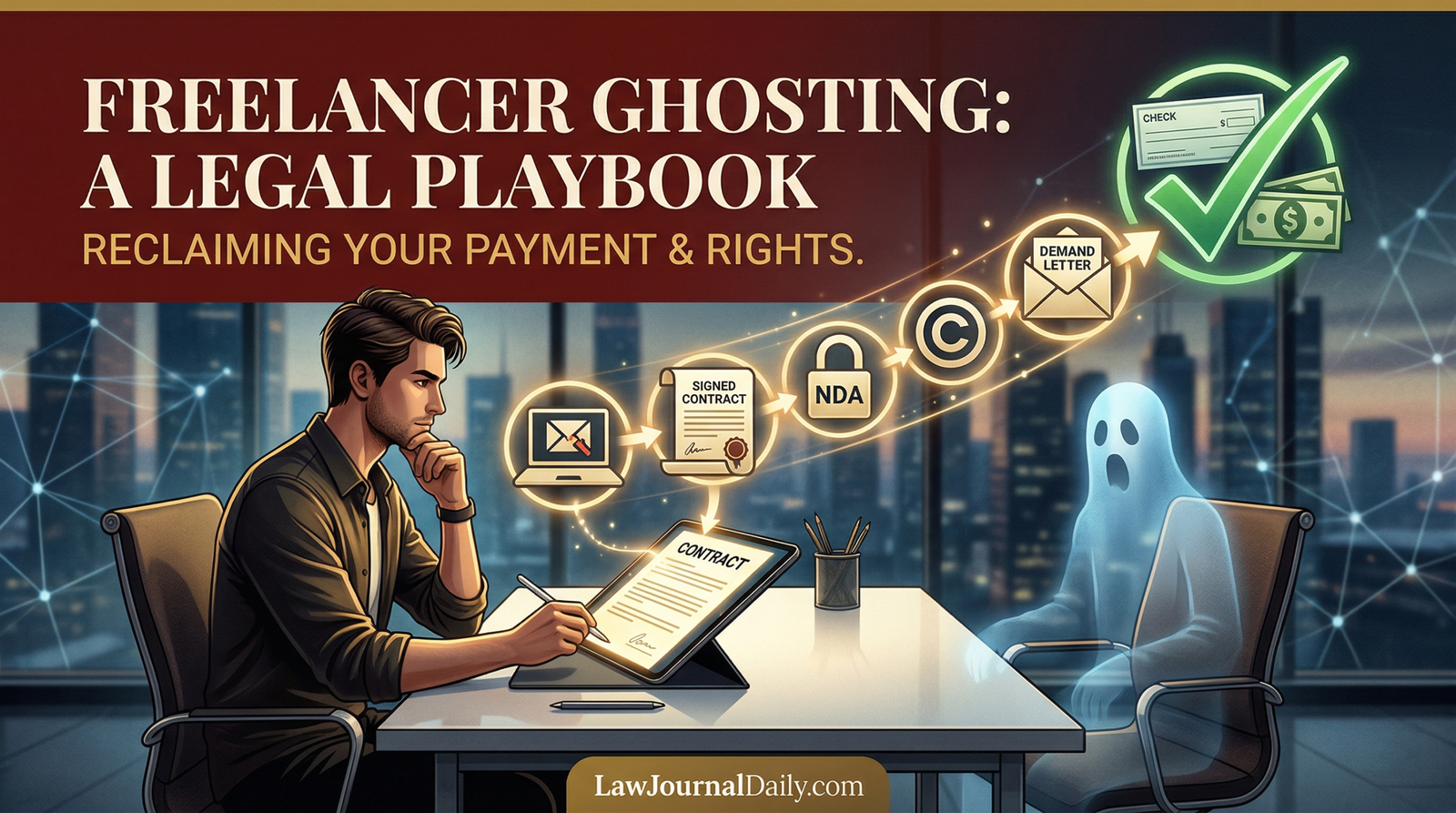
- 1.5 Step-by-Step: What to Do Legally When a Freelance Client Ghosts You
- 1.5.0.1 Document Everything Immediately
- 1.5.0.2 Send a Formal Follow-Up (Not Just a Nudge)
- 1.5.0.3 Review Your Contract for Dispute Clauses
- 1.5.0.4 Assert Your Copyright in Writing
- 1.5.0.5 Send a Legal Demand Letter
- 1.5.0.6 File in Small Claims Court (If Necessary)
- 1.5.0.7 The Copywriter Who Won Without a Lawyer
- 1.6 How to Send a Legal Demand Letter for Unpaid Invoices
- 1.7 Escalation: Small Claims Court and Beyond
- 1.8 Frequently Asked Questions
What to Do Legally If a Freelance Client Ghosts You
You delivered the work. You sent the invoice. And then—nothing. No reply, no payment, no explanation. Here is the step-by-step legal playbook every freelancer needs before the next client disappears.
Picture this: you spend three weeks designing a full brand identity. The client approves every round of revisions, you hand over the final files—and then the silence begins. Emails bounce into the void. Messages are left on read. The invoice creeps past 30 days, then 60. You are not alone. In my years of covering online business and digital publishing, I have seen this story play out hundreds of times, and it is devastating every single time.
The good news? You have more legal leverage than you think. The bad news? Most freelancers never use it, because nobody told them how. This guide changes that.
- Why Ghosting Happens (And Why It Is Not Your Fault)
- Essential Clauses Every Freelance Contract Must Have — the first line of defense
- Freelance NDA: What the Template Really Needs
- Who Owns the Copyright: Freelancer or Client?
- Step-by-Step: What to Do Legally When a Client Ghosts You
- How to Write a Legal Demand Letter for Unpaid Invoices
- Escalation: Small Claims Court and Beyond
- FAQ
Why Ghosting Happens (And Why It Is Not Your Fault)
Clients ghost for a hundred reasons: cash flow problems, business failures, deliberate exploitation, or sometimes just cowardice. Understanding the “why” matters because it shapes your response. A client who ghosted due to a genuine cash crisis is approachable differently from one who clearly received your work, used it, and stopped responding.
One of the most common mistakes I see freelancers make is going silent right back, hoping the invoice magically clears. It will not. The longer you wait, the more leverage you lose. After a certain point, recovering payment becomes legally and practically harder. Time works against you.
The solution starts long before a client ghosts you—it starts with your contract.
Essential Clauses Every Freelance Contract Must Have
A solid freelance contract is not bureaucratic busywork. It is the document that turns “he said, she said” into a clear legal record. If you are working without one (or with a vague email chain), you are giving away your most powerful tool.
The Non-Negotiable Clauses
- Payment Terms: Specify the rate, due date (e.g., “Net 14”), late payment fees (typically 1.5%–2% monthly), and accepted payment methods. Ambiguity here is the single biggest driver of non-payment disputes.
- Deposit or Kill Fee: A non-refundable upfront deposit (20%–50% is standard) means you are never doing fully spec work. A kill fee protects you if the project is cancelled mid-way.
- Scope of Work: Define exactly what is included—and what is not. Scope creep that is not billed is free labor. Courts have ruled in favor of freelancers who documented scope changes in writing.
- Revision Rounds: Specify how many revision cycles are included and what triggers additional billing. This prevents the “just one more change” spiral.
- Deliverables and Ownership Transfer: State clearly that copyright transfers only upon receipt of full payment. More on this below.
- Dispute Resolution Clause: Specify your preferred mechanism—mediation first, then arbitration or small claims. Also specify governing jurisdiction.
- Termination Clause: What happens if either party wants out? Who owns what at that point? What fees are owed?
I always recommend freelancers send contracts as digital documents with e-signature (via tools like DocuSign or HelloSign). A signed contract is far harder to dispute than a PDF attached to an email with no reply. And yes, an email chain can constitute a contract in many jurisdictions—but you do not want to test that theory in court if you can avoid it.
For a deeper reference on what makes a freelance contract legally enforceable, the Freelancers Union Contract Creator is one of the most reliable free tools available. It was built with actual attorneys and reflects real-world freelancer needs.
Freelance NDA: What the Template Really Needs
Non-Disclosure Agreements (NDAs) come up in two contexts for freelancers: you are asked to sign one by a client (protecting their confidential business information), or you need one to share your own proprietary process or information before a project begins.
Most NDA templates you find online are written for corporate contexts. What freelance NDA templates actually need to be legally sound is slightly different.
Core NDA Legal Requirements for Freelancers
- Definition of Confidential Information: This must be specific. “All information shared” is too broad to enforce in many courts. Name categories explicitly: client data, marketing strategies, unreleased products, financial figures.
- Exclusions: Information that is publicly available, already known by the freelancer, or received from a third party without restriction should be excluded. Without this, an NDA can be challenged.
- Duration: Perpetual NDAs are increasingly being struck down. A defined period—two to five years is common—is more legally defensible.
- Return or Destruction of Materials: Include a clause requiring confidential materials to be returned or destroyed upon project completion or contract termination.
- Mutual vs. One-Way: If you are also sharing proprietary information (your creative process, custom tools, strategy), insist on a mutual NDA rather than signing a one-sided agreement.
The Designer Who Forgot the NDA
Maya, a brand identity designer, was hired to rebrand a startup. No NDA was signed. She posted the in-progress mockups in her portfolio to attract clients during the project. The startup—which had a competing company—panicked and used this as a pretext to withhold payment and terminate the contract, claiming she had “breached confidentiality.” Without an NDA in place, neither party had clear obligations. Maya had no written protection for the work she had produced, and the startup had no documented confidentiality obligation. The dispute ended in a messy partial settlement. A properly drafted mutual NDA would have clarified both parties’ rights from day one.
Who Owns the Copyright: Freelancer or Client?
This is the most misunderstood area of freelance law—and it can be your single most powerful piece of leverage when a client ghosts you.
Under U.S. copyright law (Title 17, Chapter 1), the default rule is clear: the creator owns the copyright. If you are a freelancer who wrote an article, designed a logo, or built a website, you own that work unless you have signed a written agreement that says otherwise.
The “Work for Hire” Exception
Copyright only transfers to the client under two circumstances: the work is explicitly categorized as “work for hire” in a signed written agreement, or you sign a written copyright assignment. An email saying “you own everything you create for us” does not legally constitute a work-for-hire agreement in most jurisdictions.
This is your leverage. If a client has received your deliverables and is refusing to pay, they may be using copyrighted material they legally do not own. A cease-and-desist notice pointing this out often produces payment faster than any demand letter alone.
Always include a copyright retention clause in your contract that reads something like: “All intellectual property, creative assets, and deliverables remain the sole property of [Your Name] until payment is received in full. Upon receipt of final payment, copyright is assigned to the client.” This single clause has recovered more unpaid invoices for freelancers I have worked with than any other tactic.
For international freelancers, copyright rules vary. The World Intellectual Property Organization (WIPO) maintains a comprehensive resource on copyright laws across jurisdictions.
Step-by-Step: What to Do Legally When a Freelance Client Ghosts You
The moment silence stretches past your contract payment deadline, the clock starts. Here is the exact sequence to follow.
Document Everything Immediately
Screenshot every communication. Download email threads to PDF. Save approval messages, project briefs, revision sign-offs, and your final delivery confirmation. Courts and small claims processes run on paper trails. Without documentation, your claim is a memory against theirs.
Send a Formal Follow-Up (Not Just a Nudge)
This is not “hey, just checking in.” Send a written email with a specific subject line like “Invoice #[number] — Payment Due [date] — Formal Follow-Up.” State the amount owed, the due date, and that you will be taking further action if payment is not received within 7 business days. Tone matters: professional, factual, no emotional language.
Review Your Contract for Dispute Clauses
Check what your contract says about late payment, dispute resolution, and jurisdiction. Some contracts require mediation before any legal action. Skipping this step can actually weaken your legal position if you escalate prematurely.
Assert Your Copyright in Writing
If deliverables have been received, send a written notice stating that copyright has not transferred due to non-payment. Inform them that unauthorized use of the work constitutes copyright infringement. This often triggers rapid payment from larger companies with legal departments who understand the exposure.
Send a Legal Demand Letter
This is the last step before formal legal proceedings. A demand letter signals you are serious and creates a final paper record. Details on how to write one are in the next section.
File in Small Claims Court (If Necessary)
For amounts under the small claims threshold in your jurisdiction (typically $5,000–$10,000 in the U.S., varying by state), small claims court is fast, inexpensive, and does not require a lawyer. Win rates for freelancers with solid documentation are high.
The Copywriter Who Won Without a Lawyer
James, a senior copywriter, completed a $4,200 website copy project for a marketing agency. After delivery, the agency went silent for 45 days. James documented his delivery confirmation email, the revision approvals, and his contract’s payment terms. He sent a formal copyright notice and then a demand letter. The agency responded within 48 hours—paying in full plus a late fee—because they had already published his copy on their live website and their own lawyers flagged the copyright infringement exposure. James never needed a court.
How to Send a Legal Demand Letter for Unpaid Invoices
A demand letter for unpaid invoices is a formal written notice that serves two purposes: it gives the client a final opportunity to pay before legal proceedings, and it creates a documented legal record showing you acted in good faith.
What Your Demand Letter Must Include
- Your full name and contact information
- The client’s full legal name and address (use their registered business name if applicable)
- Invoice number, amount owed, and original due date
- A clear statement of the debt: “As of [date], you owe [amount] for services rendered under our agreement dated [date].”
- Reference to your contract and the relevant payment clause
- Copyright notice if deliverables have been used without payment
- A deadline to respond: 7 to 14 days is standard
- Consequences of non-payment: “Failure to remit payment by [date] will result in legal action including filing in [jurisdiction] small claims court and/or reporting the debt to relevant credit agencies.”
- Your signature
Send the demand letter via email and certified mail with return receipt. The combination creates a dual delivery record that is harder to dispute.
For a free legal reference on demand letter standards, Nolo’s guide to demand letters is one of the most authoritative publicly available resources on the subject.
Do not threaten anything in a demand letter that you are not prepared to follow through on. Empty threats erode your credibility. If you say you will file in small claims court in 14 days, mean it. Clients’ lawyers know how to identify bluffs, and an unexecuted threat weakens every subsequent communication.
Escalation: Small Claims Court and Beyond
If the demand letter is ignored or rejected, small claims court is usually the most practical next step for freelance disputes under the jurisdictional limit. In most U.S. states, you do not need a lawyer, filing fees are low ($30–$100), and judgments are often issued within weeks.
Before You File, Check Your State’s Freelancer Protection Laws
Several states now have specific freelancer protection statutes. New York’s Freelance Isn’t Free Act is the most comprehensive in the U.S., mandating written contracts for projects over $800 and providing statutory penalties for non-payment including double damages and attorney’s fees. California, Illinois, and Colorado have adopted similar protections. Know your local laws—they may give you remedies beyond the contract value itself.
The Developer Who Used State Law as a Weapon
Priya, a freelance web developer based in New York, was owed $6,800 by a media company that stopped responding after launch. She filed under the Freelance Isn’t Free Act. Because the company had no written contract (their oversight, not hers), they were automatically in violation. The statute allowed Priya to claim double her unpaid amount plus attorney’s fees. The company settled for the full $6,800 plus $1,200 in costs before the case went to hearing. Priya never needed a trial.
When to Involve an Attorney
For disputes above the small claims threshold, or where significant intellectual property is at stake, consulting an attorney is worth the investment. Many intellectual property attorneys offer flat-fee demand letters and initial consultations. University legal clinics also provide free or reduced-cost services. The Legal Services Corporation maintains a directory of free legal aid resources across the United States.