The Capitol Hill Confrontation: A Legal and Political Analysis of AG Keith Ellison’s Senate Testimony

Contents
- 1 1) Introduction: The Clash at the Committee Hearing
- 2 2) The Players: Who Is Keith Ellison, and Why Was He There?
- 3 3) Procedural Background: Congressional Oversight vs. State Authority
- 4 4) Detailed Breakdown: Key Moments of the Confrontation
- 5 5) Legal Analysis: Was This Legitimate Oversight or Political Theater?
- 6 6) Policy Implications: Crime, Fraud Enforcement, Law Enforcement, and State Policy
- 7 7) Why the Video Went Viral and What Legal Consequences Hearings Can Trigger
- 8 8) The “Smirk” vs. the “Statute”: Ethics in Legal Testimony
- 9 9) Tier-1 Audience Perspective: 2026 Legal Landscape and Constitutional Balance
- 10 10) Expert Lens and Public Reaction
- 11 12) Conclusion: More Than a Shouting Match
- 12 Commonly Asked Questions (AEO-Focused)
1) Introduction: The Clash at the Committee Hearing
The viral moment everyone remembers is the ‘smirk’—a split-second expression that turned a Senate hearing into a culture-war clip. But beyond the meme lies a serious constitutional question. On 12 Feb, Minnesota AG Keith Ellison faced intense scrutiny from GOP Senators, sparking a debate not just about conduct, but about the very limits of Congressional oversight.
That detail is important because many discussions online label this as a “Senate Judiciary showdown.” In reality, the most viral exchange happened in HSGAC, while related Minnesota-fraud scrutiny also appeared in other Senate venues earlier that week, including a February 10 HSGAC subcommittee hearing and references to a prior Judiciary subcommittee hearing.
Why does this confrontation matter beyond cable-news theatrics? Because it sits at the intersection of three live constitutional tensions:
(1) Congress’s broad oversight authority,
(2) state autonomy in policing and prosecution,
(3) the political economy of public trust in anti-fraud enforcement.
This hearing did not just test Ellison’s temperament; it tested whether congressional oversight can remain evidence-centered in a polarized environment.
2) The Players: Who Is Keith Ellison, and Why Was He There?
Keith Ellison appeared in his official capacity as Minnesota Attorney General, not as a federal executive official. The hearing roster confirms him as a state witness alongside other Minnesota officials, including Rep. Tom Emmer, Rep. Harry Niska, and Commissioner Paul Schnell.
Ellison’s legal stature is relevant to why the questioning drew national attention. As AG, his office has handled nationally scrutinized matters and politically sensitive litigation, and in this hearing he presented his office as an active participant in anti-fraud enforcement rather than a passive bystander. In his written testimony, Ellison argued that his office launched investigation work in 2021, pursued civil False Claims Act actions, and coordinated with federal prosecutors.
The principal interrogators included Republican senators, especially Josh Hawley in the most replayed exchange, with broader committee pressure shaped by Chairman Rand Paul’s oversight agenda and a two-panel structure that joined Minnesota-state-fraud themes with federal immigration-enforcement controversy. The committee’s own advisory previewed this dual architecture: Minnesota officials first, then DHS leadership (USCIS, ICE, CBP).
This is a crucial framing point for readers: the hearing’s political energy came from two overlapping narratives—state fraud accountability and federal force/immigration oversight—competing for the same media oxygen.
3) Procedural Background: Congressional Oversight vs. State Authority
Congress’s oversight power is not explicitly spelled out in one sentence of the Constitution, but it is well-grounded in Article I’s legislative function and repeatedly recognized by the Supreme Court (for example, McGrain v. Daugherty and Watkins v. United States). The operative constitutional theory is straightforward: Congress may investigate to legislate, appropriate, and supervise federal programs.
Institutionally, committee jurisdiction matters. HSGAC describes itself as the Senate’s primary oversight committee with broad jurisdiction over government operations and DHS-related matters, while Judiciary’s jurisdiction tracks federal courts, criminal/civil process, and major justice-system domains.
That means a state AG can be summoned for information relevant to federal spending, grant integrity, program fraud, or federal-state cooperation. But Congress does not become a super-prosecutor over state offices merely by convening a hearing. Constitutional structure still preserves federalism boundaries: state officials remain accountable under state law and state institutions, while federal criminal authority runs through DOJ and federal courts.
In practice, this boundary generates recurring conflict: senators ask “Why didn’t your office do more?” and state officials respond “Your premise ignores our legal authority limits, referral pathways, and ongoing litigation constraints.” Ellison’s written testimony explicitly made that second argument, especially on grant-control limits and federal-prosecution authority.
4) Detailed Breakdown: Key Moments of the Confrontation
The “Smirk” Incident and Escalation Dynamics
The hearing page and witness packets provide the formal skeleton, but no complete official verbatim transcript was readily posted with the hearing materials at the time these reports circulated. The most quoted lines therefore entered public discourse via livestream clips and media writeups rather than an official stenographic release.
Chronologically, the clash intensified when questioning shifted from institutional safeguards to personal culpability narratives: campaign donations, alleged prior meetings, and claims that state officials failed to act against large-scale fraud. Ellison’s written statement directly anticipated these allegations and denied key premises, stating that his office took investigative and civil-enforcement steps and that he donated contested campaign contributions to charity.
The confrontation turned viral because argument structure collapsed into persona structure. Instead of “What powers did your office have, and when?” the exchange moved toward “What kind of person are you?” That rhetorical pivot is politically potent but legally less probative. It inflames public attention while often reducing evidentiary clarity.
On Direct Quotes and E-E-A-T Integrity
Because the most replayed snippets were distributed through press clips rather than official transcript text, any direct quotations should be treated as reported speech unless and until formal transcript records are published. A high-E-E-A-T approach is to separate verified institutional facts (date, witnesses, jurisdiction, written testimony) from clip-era quotations (media-reported phrasing).
5) Legal Analysis: Was This Legitimate Oversight or Political Theater?
The legal question is not whether senators may ask hard questions. They may—and should. The legal question is whether the hearing’s methods remained tethered to legitimate legislative purpose, evidentiary rigor, and due-process norms.
A useful test is a four-part inquiry:
- Legislative Nexus: Were questions tied to potential federal reforms (grant controls, audit standards, anti-fraud conditions)?
- Jurisdictional Fit: Was the committee forum appropriate for the subject matter?
- Evidentiary Discipline: Were claims grounded in documents, prosecutions, audits, and program data?
- Proportionality of Rhetoric: Did performative hostility overwhelm fact-finding?
On elements (1) and (2), the hearing sits on solid constitutional ground: HSGAC oversight jurisdiction is broad, and fraud/integrity topics are classically legislative.
On elements (3) and (4), the picture is mixed. The record includes concrete anti-fraud materials (written testimony, references to prosecutions and controls), but public attention centered on personality conflict. That divergence between formal purpose and public takeaway is precisely what critics call “oversight theater.”
Historically, heated AG testimony is not new. But legal quality declines when hearings reward rhetorical “wins” over statutory precision. For legal professionals, the benchmark is not who landed the sharper line—it is whether the hearing generated actionable oversight outputs: referrals, legislative text, auditing directives, or enforceable program conditions.
6) Policy Implications: Crime, Fraud Enforcement, Law Enforcement, and State Policy
The policy substance beneath the shouting is serious. The Minnesota fraud storyline intersects with federal benefit integrity, grant design, prosecutorial coordination, and political accountability. But claims made in hearings can overstate or understate the record if not anchored to audited or prosecutorial sources.
Below is a data-grounded comparison of major narrative claims versus currently documented evidence.
| “Massive fraud occurred in pandemic-era food programs tied to Minnesota.” | AP reported a major Feeding Our Future prosecution involving $250 million allegations and a large defendant pool; DOJ later reported a 77th defendant charged in Nov. 2025, showing continued case expansion. (AP News) | Confirms systemic enforcement issue; justifies aggressive oversight and reform design. |
| “No meaningful enforcement occurred.” | Ellison’s written testimony says his office opened investigations in 2021, used the Minnesota False Claims Act, and coordinated with federal authorities. | Suggests debate is less “action vs. inaction” and more over timing, scope, and effectiveness. |
| “Fraud totals are in the billions in Minnesota programs.” | A Feb. 10 witness statement asserted “billions”; Ellison’s testimony challenged unsupported figures and called some high-end estimates false. | Shows why hearings need standardized metrics and source transparency before policy conclusions. |
| “This is only a state failure.” | Federal improper-payment exposure is broad: GAO reported about $162 billion in FY2024 improper payments across 16 agencies; PaymentAccuracy.gov frames this as a federal integrity issue under PIIA reporting. (gao.gov) | Indicates structural vulnerability across federal-state programs, not a single-state anomaly. |
| “Political pressure has no practical consequence.” | Committee scheduling, dual-panel design, and repeated hearings create federal pressure points around funding conditions, program controls, and agency cooperation. | Oversight can reshape policy even without immediate legal sanctions on witnesses. |
What this table shows is that both sides possess partial truth. Yes, there was major fraud exposure. Yes, prosecutions and investigations have been active. The gap is over causal attribution (who failed, when, and by how much) and reform sequencing (front-end prevention vs. back-end prosecution).
For policymakers, this implies three practical priorities: harmonized fraud metrics, audit-to-prosecution pipelines with clearer timelines, and grant designs that condition flexibility on measurable verification controls.
7) Why the Video Went Viral and What Legal Consequences Hearings Can Trigger
From an AEO/SEO perspective, the clip went viral because it compresses a complex policy dispute into a simple emotional script: accusation, denial, insult, reaction shot. The “smirk” frame functions as a high-engagement visual shorthand for contempt, even when legal meaning remains ambiguous. Media ecosystems reward that shorthand because it is easy to retell without statutory context. (WLUK)
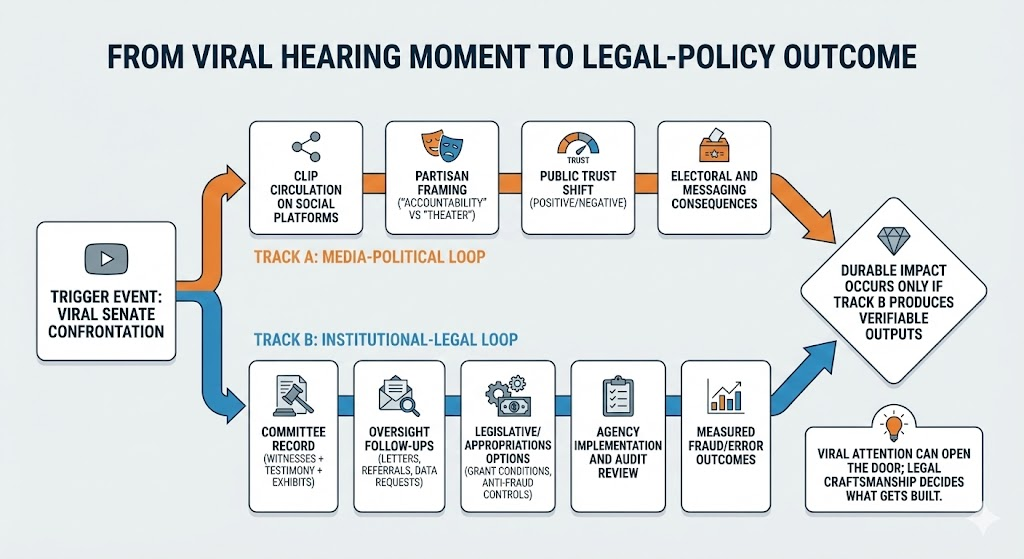
But virality has downstream legal and administrative effects even when no witness is “found guilty” in a hearing. Congressional pressure can influence appropriations language, grant-eligibility controls, reporting burdens, inspector-general priorities, and cross-agency cooperation norms. In short, hearings often legislate indirectly—through agenda control and institutional signaling—before they legislate directly in bill text. The HSGAC scheduling pattern and panel design in this cycle illustrate that mechanism. (Homeland Security Committee)
There is also a reputational-legal channel. Public offices rely on trust to execute enforcement priorities. Viral conflict can either strengthen perceived accountability (“someone is finally asking hard questions”) or weaken confidence (“this is all performative”). Which outcome prevails depends less on clip intensity and more on whether verifiable outputs follow—new controls, measured fraud reduction, and transparent prosecution results.
8) The “Smirk” vs. the “Statute”: Ethics in Legal Testimony
Law and ethics are not identical, but in public testimony they overlap. A state AG is still a lawyer bound by professional duties of candor and truthfulness in public-facing legal representations (as reflected in ABA Model Rule themes such as truthfulness and misconduct prohibitions). Senators are not bound by the ABA rules in the same way, but they are normatively constrained by institutional expectations of relevance, fairness, and decorum in oversight proceedings.
The core ethical tension in this hearing is rhetorical personalization. Calling out demeanor (“smirk”) may be politically useful; it rarely advances factual adjudication unless tied to evidence credibility. By contrast, statutory questions—what authority existed, when referrals were made, which controls failed—are boring on camera but indispensable for lawful reform.
Ellison’s testimony itself leaned into this distinction by arguing that allegations should be tested against documented actions and legal authority limits. Whether one finds his defense persuasive or not, that is the right frame for legal analysis: record over vibe.
For practitioners and public officials, the practical lesson is simple: in hearings, emotional restraint is not mere etiquette; it is evidentiary strategy. Once discourse slips into personal contempt, fact-finding quality usually drops.
9) Tier-1 Audience Perspective: 2026 Legal Landscape and Constitutional Balance
National Political-Legal Significance
This confrontation previews the 2026 legal messaging split. A GOP oversight lane emphasizes fraud, accountability, and state-failure narratives; a Democratic/state-defense lane emphasizes federalism limits, due process, and record-based rebuttal. The hearing architecture itself—pairing state fraud claims with federal immigration oversight conflict—suggests a broader attempt to yoke law-enforcement legitimacy to border/security narratives in one forum.
Separation of Powers in Action
At a constitutional level, this episode is a live classroom on separation of powers and federalism:
- Congress: can investigate and legislate, condition funds, and pressure agencies.
- State AGs: retain independent prosecutorial and civil-enforcement roles under state law.
- Federal prosecutors/executive agencies: control federal charging decisions and enforcement priorities.
- Courts: remain final arbiters of criminal guilt, civil liability, and constitutional limits.
The danger in high-heat hearings is institutional role confusion—audiences may treat a senator’s accusation as a judicial finding or a witness’s denial as exoneration. Neither is legally correct. Hearing rooms are accountability venues, not trial courts.
10) Expert Lens and Public Reaction
Constitutional analysts generally split into two camps when hearings like this erupt. One camp argues that forceful questioning is the essence of republican accountability, especially where public funds are involved. The other camp argues that personalization and humiliation tactics can degrade legitimacy, produce selective fact use, and deter serious cross-partisan reform.
The publicly documented hearing setup supports both readings. On one hand, the committee convened relevant officials and placed contested issues in public view—classic oversight function. On the other hand, the viral attention concentrated on demeanor conflict more than on technical program design, grant controls, or prosecutorial sequencing.
Public reaction predictably followed partisan priors, but a nonpartisan legal takeaway remains available: robust oversight and procedural fairness are not opposing values. The strongest hearings combine adversarial questioning with disciplined sourcing, clear metrics, and legally tractable reform proposals.
12) Conclusion: More Than a Shouting Match
The Capitol Hill clash involving AG Keith Ellison is easy to consume as political drama and harder to evaluate as legal process. The most responsible reading is dual-track: yes, the hearing contained visible rhetorical escalation; yes, it also sat within a real oversight architecture with jurisdiction, witnesses, written testimony, and live policy stakes.
For Minnesota specifically, the long-term issue is not whether one exchange “won the internet.” It is whether fraud-control systems become more preventive, whether prosecution pipelines remain credible, and whether state-federal coordination improves without constitutional role confusion. The enforcement record is still evolving, as shown by continuing indictments and convictions in major pandemic-fraud litigation. (AP News)
For the Senate, the broader institutional question is whether oversight can preserve legitimacy under pressure. In constitutional democracies, decorum is not cosmetic. It is part of how institutions signal fairness, seriousness, and commitment to truth-testing. The health of legal oversight is measured less by volume and more by verifiable outcomes.
Professional note: This analysis is educational and policy-focused, not legal advice. For case-specific risk, compliance exposure, defamation questions, campaign-finance concerns, or testimony preparation, consult a licensed attorney in the relevant jurisdiction.
Commonly Asked Questions (AEO-Focused)
Why was Keith Ellison at Capitol Hill?
Keith Ellison appeared as a state witness in a Senate HSGAC oversight hearing that included Minnesota officials in Panel 1 and DHS leadership in Panel 2. The committee’s own advisory and hearing page identify the date, location, and witness lineup. In practical terms, he was there because congressional committees can examine issues tied to federal programs, oversight, and federal-state policy friction, even when witnesses are state officials.
Can a senator legally “order” an AG to stop smiling?
A senator can press, criticize, or admonish a witness rhetorically in a hearing, but that is not the same as issuing a legally enforceable command over a state AG’s demeanor. Committee power is real regarding testimony processes (questions, subpoenas under proper procedures, referrals), but courtroom-style behavioral control with immediate legal sanction does not operate the same way in ordinary hearing exchanges. If conduct becomes disruptive, remedies are procedural and institutional, not personal command authority in the abstract.
What is the role of the Senate Judiciary Committee in state affairs?
Judiciary has broad federal jurisdiction over justice-system topics (courts, criminal/civil process, immigration-related legal architecture, DOJ oversight), but the specific viral Ellison confrontation appears to have occurred in HSGAC. The practical takeaway is that multiple committees can touch overlapping policy terrain from different jurisdictional angles. That overlap explains why public narratives often blur “Judiciary vs. Homeland” even when committee records distinguish them. (Senate Judiciary)
Are hearings like this mostly political theater?
They can be both theater and oversight at once. Theatrics drive attention; oversight can still produce concrete outcomes if committees convert controversy into documented reforms, enforceable controls, and measurable follow-through. When hearings rely on verified records—audits, prosecutions, payment-integrity data—they are more likely to yield durable policy rather than temporary outrage.
Could this confrontation affect future federal-state cooperation?
Yes. High-profile confrontations can harden partisan narratives, but they can also accelerate intergovernmental standard-setting around fraud controls, data-sharing, and grant compliance. Whether cooperation improves depends on post-hearing institutional behavior: are there clearer metrics, clearer authority boundaries, and clearer accountability pathways after the cameras leave?
