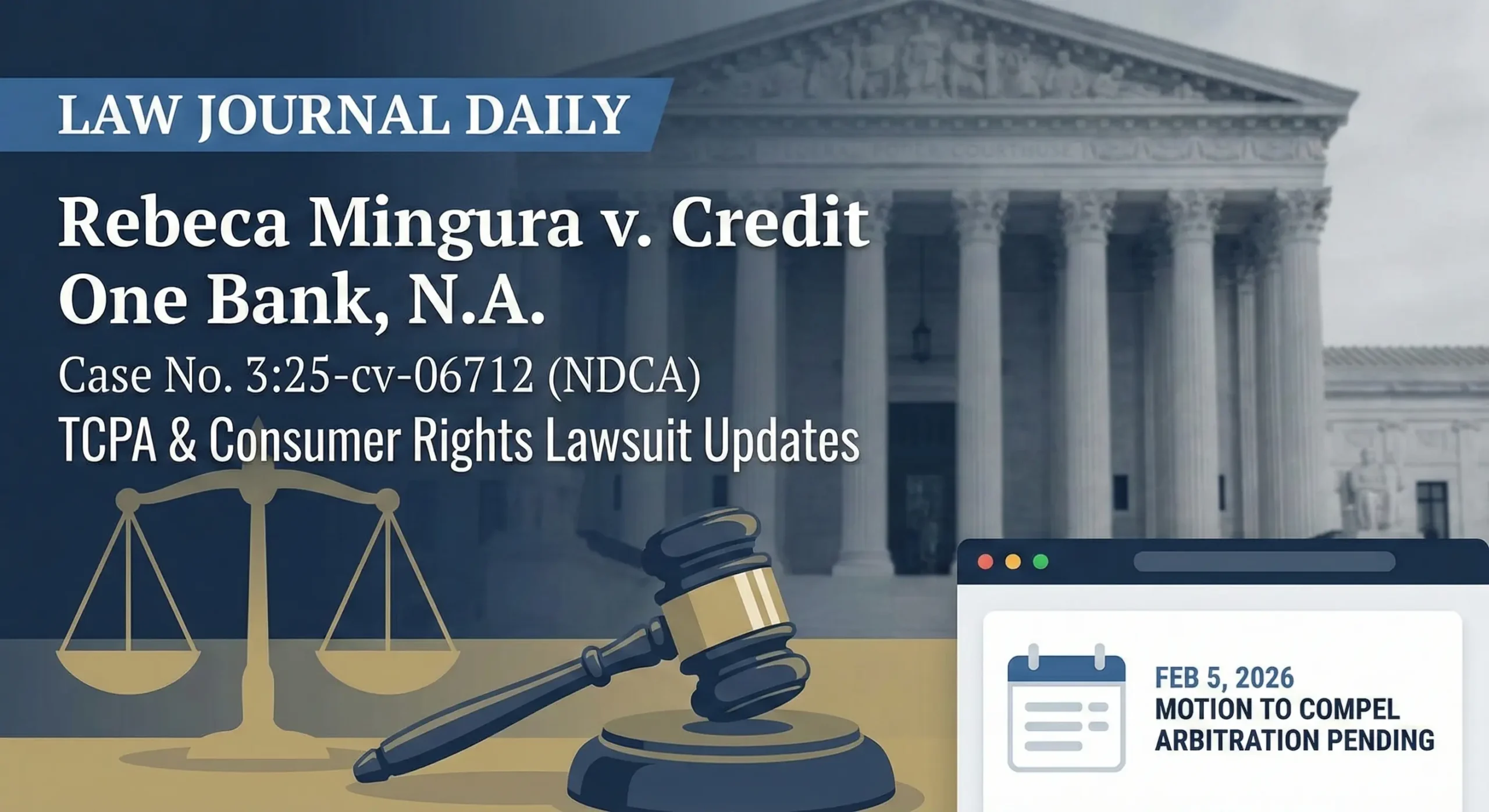
Rebeca Mingura Credit One Lawsuit: Latest Docket Updates, Key Allegations, and Legal Insights for Consumers

Updated: February 5, 2026
Primary public-source references: federal docket trackers (Justia, PacerMonitor) and statutory text sources (Cornell LII, FTC, CA Legislature).
Contents
- 1 Introduction: What the Rebeca Mingura Credit One case is about
- 2 Who Is Rebeca Mingura in the Rebeca Mingura Credit One Lawsuit?
- 3 Understanding the Allegations Against Credit One Bank
- 4 Legal Comparison Table: Key Laws Often Implicated in the Rebeca Mingura Credit One Lawsuit Pattern
- 5 Current Case Status & Court Dockets for the Rebeca Mingura Credit One Lawsuit
- 6 Potential Impact on Consumers
- 7 How to Protect Yourself from Debt Collection Harassment
- 7.1 Step one: get clarity on the debt before you react emotionally
- 7.2 Step two: document everything in a way a court or arbitrator can use
- 7.3 Step three: understand “consent” and “revocation” in TCPA-style disputes
- 7.4 Step four: if you believe conduct is unlawful, use credible reporting channels
- 7.5 Step five: check your credit reports and dispute inaccuracies the right way
- 7.6 Step six: consult a licensed attorney early—especially if arbitration is involved
- 7.7 Visual Flowchart: Rebeca Mingura Credit One Lawsuit Process and the Arbitration Fork
- 7.7.1 Consumer receives repeated calls/texts
- 7.7.2 Log calls and preserve evidence
- 7.7.3 Request validation and consider revoking consent
- 7.7.4 Consult a licensed attorney
- 7.7.5 Complaint filed (or arbitration demand served)
- 7.7.6 Defendant served; deadlines triggered
- 7.7.7 Motion to Compel Arbitration filed
- 7.7.8 Case moves to individual arbitration
- 7.7.9 Arbitration outcome
- 7.7.10 Case proceeds in federal court
- 7.7.11 Court outcome
- 8 Frequently Asked Questions (FAQ Schema Ready) about the Rebeca Mingura Credit One Lawsuit
- 9 Conclusion & Legal Disclaimer
Introduction: What the Rebeca Mingura Credit One case is about
The rebeca mingura credit one lawsuit is a consumer protection case filed in federal court in California against Credit One Bank, N.A. It is framed publicly as a putative class action centered on allegations of harassing debt-collection communications—including phone calls that the plaintiff claims were excessive and, in part, unlawful under consumer protection statutes.
At a practical level, this kind of case sits at the intersection of legal proceedings and modern communications technology: consumers who believe they are being pressured through repeated calls, texts, or prerecorded/automated outreach often look to statutes like the Telephone Consumer Protection Act (TCPA) and, depending on the facts, state debt-collection protections.
This article explains
(1) what is publicly known from docket trackers and complaint summaries,
(2) the legal theories that typically matter in these disputes,
(3) what the most recent docket activity suggests about where the case may be headed—especially with arbitration issues in play. Nothing here is a substitute for advice from a licensed attorney, and if you believe your rights are being violated, you should consult counsel in your jurisdiction.
Who Is Rebeca Mingura in the Rebeca Mingura Credit One Lawsuit?
Public docket trackers identify Rebeca Mingura as the plaintiff and Credit One Bank, N.A. as the defendant, with the action filed on August 8, 2025 in the U.S. District Court for the Northern District of California.
What the plaintiff alleges (based on public summaries and docket metadata)
A widely circulated public summary of the complaint states that the plaintiff alleges Credit One contacted her by phone, text, and email starting around April 2025 in an effort to collect on debts she allegedly owed, and that the contacts continued despite requests to stop. That summary also claims the volume of calls was extremely high over a multi-month window and that the outreach allegedly included automated calls without valid consent.
It’s important to separate what is verified from the docket from what is reported about the complaint:
- Verified via docket trackers: the case exists, the parties, the court, and that the nature of suit and cause of action are tied to the TCPA (47 U.S.C. § 227).
- Reported in complaint summaries: the alleged frequency and timing of calls, alleged vulnerability/health circumstances, alleged revocation of consent, and alleged state-law theories (e.g., Rosenthal Act / UCL) described by third-party summaries.
For readers who want primary-source certainty, the gold standard is the court’s PACER docket and filings. Public-facing docket trackers often provide partial visibility (or snapshots) and can lag behind real-time updates.
Why TCPA and debt-collection statutes come up in cases like this
Many “repeated calls” consumer cases focus on whether calls or texts were placed using an automatic telephone dialing system or an artificial/prerecorded voice without the required consent—core issues under the TCPA.
Other cases focus more on harassment/abuse rules under debt-collection statutes. The federal FDCPA prohibits a “debt collector” from harassing, oppressing, or abusing someone in connection with collecting a debt. But FDCPA coverage can hinge on who is doing the collecting (a third party vs. an original creditor), which is why state statutes—like California’s Rosenthal framework—often become central in California-based disputes.
Understanding the Allegations Against Credit One Bank
The publicly reported theories around the case fit into three buckets that legal professionals see repeatedly in consumer calling/collection litigation:
(1) harassing patterns of contact,
(2) automated/prerecorded calls or texts, and
(3) state-law consumer protection overlays.
Alleged harassing calls and debt-collection pressure
A complaint-summary source describing this lawsuit claims the plaintiff received multiple calls daily and that the frequency impaired her phone use and caused distress.
From a legal standpoint, courts usually look for pattern plus context: frequency, persistence after a “stop calling” request, time-of-day patterns, and whether the communications crossed from “annoying” into “abusive.” Even where the FDCPA does not apply (depending on the collector’s status), state laws may regulate the calling behavior directly.
In California, for example, the Rosenthal statutory scheme includes provisions addressing repeated calling and unreasonable frequency—concepts that can align closely with “harassment” allegations.
Alleged automated calls and the TCPA angle
The TCPA’s core prohibition relevant to many debt-collection robocall cases is the restriction on calls to cell phones using an ATDS or an artificial/prerecorded voice without the prior express consent of the called party (subject to exceptions and evolving case law).
In TCPA litigation, the factual fight often centers on:
- What technology was used (human dialing vs. automated systems; prerecorded vs. live voice).
- Whether consent existed, and if so, whether and how it was revoked.
- Who placed the call and on whose behalf.
- The call records: timestamps, call duration, and metadata.
Because TCPA cases can carry statutory damages that scale with the number of unlawful calls/texts, the “proof mechanics” matter: phone logs, carrier records, internal dialing platform logs, and testimony about communications history. (Legal Information Institute)
Alleged state-law violations in California: Rosenthal and UCL
A public summary of this case describes the lawsuit as alleging violations of the TCPA, the Rosenthal Fair Debt Collection Practices Act (often discussed as California’s debt-collection protections), and California’s Unfair Competition Law (UCL).
Two key legal realities often get lost in non-lawyer coverage:
First, California’s framework can be broader than what laypeople expect. Civil Code § 1788.17 requires “every debt collector” collecting or attempting to collect a consumer debt to comply with many FDCPA provisions and be subject to FDCPA-like remedies.
Second, California’s UCL (Business & Professions Code § 17200) is frequently pled as an “umbrella” claim. The UCL definition of unfair competition includes “any unlawful, unfair or fraudulent business act or practice,” which allows plaintiffs to argue that violations of other statutes constitute “unlawful” conduct actionable under § 17200.
Credit reporting issues: possible, but not the core public signal here
Your outline raises credit reporting issues as a potential theme. Based on the public docket metadata and major public summaries, the most visible “center of gravity” is calling/communications (TCPA and related state-law harassment theories), not credit reporting.
That said, credit reporting disputes often travel with debt-collection disputes, especially if a consumer asserts they don’t owe the debt or that the amounts are wrong. If credit reporting becomes part of a case, the Fair Credit Reporting Act (FCRA) can matter, including duties imposed on furnishers of information to credit reporting agencies under 15 U.S.C. § 1681s-2.
Legal Comparison Table: Key Laws Often Implicated in the Rebeca Mingura Credit One Lawsuit Pattern
| Legal Framework | Who it typically covers | Core conduct it regulates | Common remedies (general) | Common defense themes |
|---|---|---|---|---|
| TCPA (47 U.S.C. § 227) | Callers/text senders using regulated tech | Automated/prerecorded calls/texts to cell phones without required consent | Statutory damages per call/text; higher amounts if willful/knowing; injunctive relief in some contexts | Consent existed; consent not revoked; technology not covered; standing/injury disputes |
| FDCPA (15 U.S.C. § 1692 et seq.) | “Debt collectors” (often third-party collectors, with definitional nuances) | Harassment, deception, and unfair practices in debt collection | Actual damages, statutory damages, attorney’s fees (subject to limits/conditions) | Not a “debt collector”; communications were permissible; bona fide error defense |
| California Rosenthal framework (e.g., Civ. Code §§ 1788.11, 1788.17) | “Debt collectors” under CA definitions; can capture conduct beyond federal expectations | Repeated calls / unreasonable frequency; incorporation of many FDCPA sections via § 1788.17 | Actual damages; statutory penalties in certain circumstances; attorney’s fees for prevailing debtor | Not within statute’s definition; conduct not “harassment” under facts; arbitration/class waiver issues |
| California UCL (Bus. & Prof. Code § 17200) | Businesses engaged in “unlawful, unfair or fraudulent” acts | Broad consumer protection claim often piggybacking on other violations | Primarily injunctive relief and restitution (not classic tort damages) | No unlawful predicate; standing issues; remedies limitations |
| FCRA (15 U.S.C. § 1681 et seq.) | Credit reporting agencies + furnishers + users (varies by section) | Accuracy and dispute investigation obligations (especially after CRA dispute notice) | Statutory/actual damages depending on claim; attorney’s fees in certain cases | Proper investigation; no private right for certain duties; dispute not properly triggered |
This table reflects general statutory frameworks rather than case-specific findings. (Legal Information Institute)
Current Case Status & Court Dockets for the Rebeca Mingura Credit One Lawsuit
Public docket tracker data provides the most reliable “latest update” readers can access without PACER credentials.
Case number, judge, and jurisdiction
PacerMonitor lists the case as Mingura v. Credit One Bank, N.A., Case No. 3:25-cv-06712 in the Northern District of California before Judge Araceli Martinez-Olguin. (PacerMonitor)
Justia’s docket listing shows Case Number: 4:2025cv06712 and notes the nature of suit as TCPA with the cause of action 47 U.S.C. § 227—but also warns its snapshot was last retrieved on August 8, 2025 and that a more recent docket may exist on PACER.
Media-style summaries also reference Case No. 4:25-cv-06712 in NDCA. These numbering differences can reflect division formatting and how different trackers label NDCA cases. For practical purposes, the key identifiers are the court (NDCA), the parties, and the core case number string (25-cv-06712).
Rebeca Mingura Credit One Lawsuit: Latest Update from the Docket (Nov 2025–Jan 2026)
As reflected on PacerMonitor’s public docket view (which indicates the docket was last updated in mid-January 2026), the most significant procedural development is the defendant’s motion to compel arbitration and a series of stipulations and orders adjusting briefing and staying the case temporarily.
Key recent entries include:
- Oct. 17, 2025: Defendant filed a Motion to Compel Arbitration and Stay Action.
- Oct. 27, 2025: Order granting a stipulation to extend deadlines and setting a motion hearing for Feb. 12, 2026 in San Francisco, with revised opposition and reply dates.
- Nov. 26, 2025: Order granting (as modified) a joint stipulation for a brief stay and a briefing schedule relating to the motion to compel arbitration.
- Dec. 16, 2025: Order granting (as modified) a stipulation for a brief stay of the case and continuance of dates.
Two practical takeaways flow from these entries:
- Arbitration is the front-and-center battleground right now. That matters because arbitration clauses in consumer credit agreements often include class action waivers, which can drastically reshape a putative class action’s trajectory.
- The court appears to be managing the dispute through stipulated scheduling and brief stays, suggesting active negotiation over timing and perhaps early procedural positioning rather than immediate merits discovery.
Why arbitration matters so much in putative class actions
Arbitration enforcement in consumer cases often rests on the Federal Arbitration Act (FAA), which generally provides that written arbitration agreements are “valid, irrevocable, and enforceable” subject to standard contract defenses.
The Supreme Court has also issued decisions that, in many contexts, favor enforcement of arbitration agreements and can limit class procedures when class waivers exist (for example, AT&T Mobility LLC v. Concepcion, 563 U.S. 333 (2011)).
In plain English: if the court compels arbitration and the applicable agreement contains a class waiver, the case may proceed only as an individual arbitration for the named plaintiff—potentially ending the case as a class vehicle. That does not mean claims disappear, but it can change leverage, economics, and the ability of similarly situated consumers to proceed collectively.
Potential Impact on Consumers
Even when a case is styled as a class action, consumers should not assume they are “in the lawsuit” automatically. In federal court, a putative class action becomes a certified class only if the judge later grants class certification under Rule 23. If arbitration is compelled with a class waiver, class certification may never occur.
If this is a class action, what could it mean for others?
Public summaries describe the case as a class action alleging unlawful debt-collection calling practices. If a class is later certified (and if arbitration does not prevent it), potential class members might include people who received similar alleged communications during the relevant time period.
But it is equally possible—procedurally—that:
- the case becomes an individual claim in arbitration, or
- the class allegations are narrowed substantially, or
- the case resolves without class certification.
These outcomes are common in consumer calling cases.
Settlement expectations (and what can honestly be said today)
As of now, no settlement has been finalized in any way that is visible on the publicly accessible docket entries summarized above (i.e., no public entry indicating settlement approval or a final dismissal tied to settlement in the PacerMonitor view through mid-January 2026).
That said, settlements can occur confidentially in arbitration settings or be reached before formal public filings reflect the terms. If you are tracking the case for personal reasons, the most dependable route is to monitor the official court docket (PACER) and—if a class is certified or a class settlement is proposed—the court will typically require public notice procedures.
What consumers should watch for next
If you’re following the rebeca mingura credit one lawsuit because you’ve experienced similar calls, the “next signals” usually look like:
- a court order granting or denying the motion to compel arbitration,
- any amended pleading clarifying claims and class definitions, and
- if the case remains in court, early class-related activity (scheduling, discovery scope, or motions impacting certification).
How to Protect Yourself from Debt Collection Harassment
This section is general educational guidance. Specific rights and timelines can vary by state, and talking with a licensed attorney is the best way to map the facts of your situation to applicable law.
Step one: get clarity on the debt before you react emotionally
A common mistake is to treat every collection call as legitimate or, conversely, to ignore it entirely. Start by identifying whether the alleged debt is yours, whether the balance is accurate, and whether you’re dealing with an original creditor or a third-party collector—because that can affect which statutes apply (for example, FDCPA coverage questions).
Step two: document everything in a way a court or arbitrator can use
In harassment and TCPA disputes, documentation is not optional—it’s the backbone of the case. Your phone’s recent calls screen is a start, but it’s not ideal evidence. Better documentation typically includes contemporaneous notes, screenshots showing timestamps, and carrier records if needed. If voicemails are left, preserve them in a way that maintains date/time context.
Step three: understand “consent” and “revocation” in TCPA-style disputes
TCPA claims often rise or fall on consent. If you provided a number on an account application, that may be argued as consent for certain calls. Disputes then often focus on whether consent was revoked and whether calls continued afterward. The statute’s restrictions are grounded in 47 U.S.C. § 227’s prohibitions on certain automated or prerecorded calls without required consent.
Because consent disputes are fact-intensive, an attorney can help you avoid moves that unintentionally undermine your position—especially if calls relate to accounts you still maintain.
Step four: if you believe conduct is unlawful, use credible reporting channels
If you believe you are being harassed or treated unfairly, you can submit a complaint to federal regulators. The Consumer Financial Protection Bureau (CFPB) provides a complaint portal and explains that it routes complaints to companies for response and may share information with certain agencies consistent with law.
You can also file consumer complaints through the FTC’s channels for fraud and related consumer protection issues, and the FTC provides guidance materials on debt-collection practices.
Step five: check your credit reports and dispute inaccuracies the right way
Even if your immediate concern is phone harassment, credit reporting can become a parallel problem. If a tradeline is inaccurate, dispute procedures matter. Under the FCRA framework, duties for furnishers and investigation obligations can be triggered in specific ways—often after a dispute is submitted through a consumer reporting agency’s formal process.
Step six: consult a licensed attorney early—especially if arbitration is involved
Consumer credit agreements frequently contain arbitration provisions. As the docket in this case illustrates, a motion to compel arbitration can become the main event early.
A consumer rights attorney can evaluate:
- whether an arbitration agreement exists and is enforceable,
- whether any contract defenses apply (e.g., unconscionability—highly state-specific),
- whether class mechanisms are realistically available, and
- what your best path is (court, arbitration, regulatory complaint, negotiated resolution).
Visual Flowchart: Rebeca Mingura Credit One Lawsuit Process and the Arbitration Fork
This diagram illustrates the typical progression of a TCPA/debt-collection dispute and where a motion to compel arbitration can redirect the case.
Consumer receives repeated calls/texts
Calls or messages relate to an alleged debt; consumer begins to assess whether contact may be unlawful.
Log calls and preserve evidence
Save call logs, screenshots, voicemails, and identify the caller entity and phone numbers used.
Request validation and consider revoking consent
Seek clarification/validation; evaluate whether consent existed and whether revocation is applicable under TCPA theories.
Consult a licensed attorney
Assess TCPA/state-law options, evidence strength, deadlines, and forum constraints (including arbitration clauses).
Complaint filed (or arbitration demand served)
Case begins in federal court or arbitration depending on contract terms and strategy.
Defendant served; deadlines triggered
Responsive pleadings, early motions, and scheduling deadlines begin.
Motion to Compel Arbitration filed
The case may shift away from court to private arbitration, often impacting class claims.
Case moves to individual arbitration
Class claims may be curtailed by waiver language; proceedings continue under arbitration rules.
Arbitration outcome
Settlement or arbitration award; possible enforcement and limited appeal pathways depending on the FAA and contract terms.
Case proceeds in federal court
Discovery continues; class certification litigation and dispositive motions may follow.
Court outcome
Settlement, summary judgment, or trial; judgment enforcement and standard appeal routes apply.
Why this matters: In putative class actions, arbitration can determine whether claims remain in court and whether class procedures are available.
Frequently Asked Questions (FAQ Schema Ready) about the Rebeca Mingura Credit One Lawsuit
Rebeca Mingura Credit One Lawsuit FAQ: Is the lawsuit a class action?
Public-facing summaries describe the matter as a class action (more precisely, a putative class action, because class status is not automatic). The docket trackers confirm the underlying lawsuit and its TCPA framing but do not, by themselves, prove class certification. Whether it becomes a certified class action depends on future court rulings and—critically—whether the case remains in court or is compelled into arbitration.
How can I join the Credit One Bank lawsuit?
In most federal class actions, you do not “join” immediately the way you might join a club. If a class is certified or a settlement is proposed, the court typically requires notice and provides instructions on how to participate, exclude yourself, or object. If arbitration is compelled and class claims are limited, there may never be a class to join.
If you believe you experienced similar conduct, your most practical steps are to preserve evidence (call logs, screenshots, voicemails), consult a licensed attorney, and monitor official updates through the court docket. Regulatory complaints through the CFPB can also be appropriate depending on your goal.
Has Credit One Bank settled the case?
As of February 5, 2026, there is no publicly visible docket entry in the accessible PacerMonitor view indicating a finalized settlement approval or settlement-driven case closure for Mingura v. Credit One Bank, N.A. Settlement discussions can occur privately, and arbitration developments could also shift where and how resolutions are recorded. For the most definitive answer, check the official PACER docket or consult counsel who can access it.
Conclusion & Legal Disclaimer
The rebeca mingura credit one lawsuit is best understood as a modern consumer protection dispute where alleged debt-collection communications collide with statutes governing automated calls and harassment. Public sources confirm the case’s existence, the court (NDCA), the TCPA framing, and a procedural posture that currently centers on a motion to compel arbitration—a development that often determines whether putative class actions remain viable.
If you’re a consumer reading this because you’ve experienced similar calls, your leverage comes from evidence and strategy: preserve records, understand consent issues, use trusted reporting channels like the CFPB when appropriate, and consult a licensed attorney early—especially when arbitration clauses may reshape your options.
Legal Disclaimer: The information provided on Law Journal Daily is for educational purposes only and is not legal advice. For specific legal concerns, please consult a licensed attorney.